

A New Chironius from Ceara, Brazil
Currently, the proposed diagnoses for the Chironius bicarinatus complex reflect a wide variation in color pattern and pholidosis. Sudre et al. (2024) reviewed the Chironius bicarinatus complex based on morphological and molecular data from a sample of 485 specimens covering the species distribution. Their results corroborate the recognition of C. bicarinatus and C. gouveai, and diagnose a distinct lineage without an available name. Thus, here we describe this new species restricted to the Baturité Massif, a relictual rainforest isolated in the Caatinga xerophytic domain, in the state of Ceará, northeastern Brazil. The new species can be distinguished from its congeners by its unique combination of qualitative and quantitative morphological characters (scale counts, morphometric, color pattern), and is also supported by molecular and ecological evidence. Additionally, we rectify data on the distribution and morphological variability of C. gouveai to accurately infer the boundaries between this taxon and C. bicarinatus, which was not properly addressed. Finally, we discuss our results in the light of previous studies that suggest diversification hypotheses in the Atlantic Forest already detected for other taxa, highlighting the importance of conserving the areas of “Brejos de Altitude”, in northeastern Brazil, and the southern limit of Serra do Mar up to Serra do Tabuleiro, in southern Brazil.
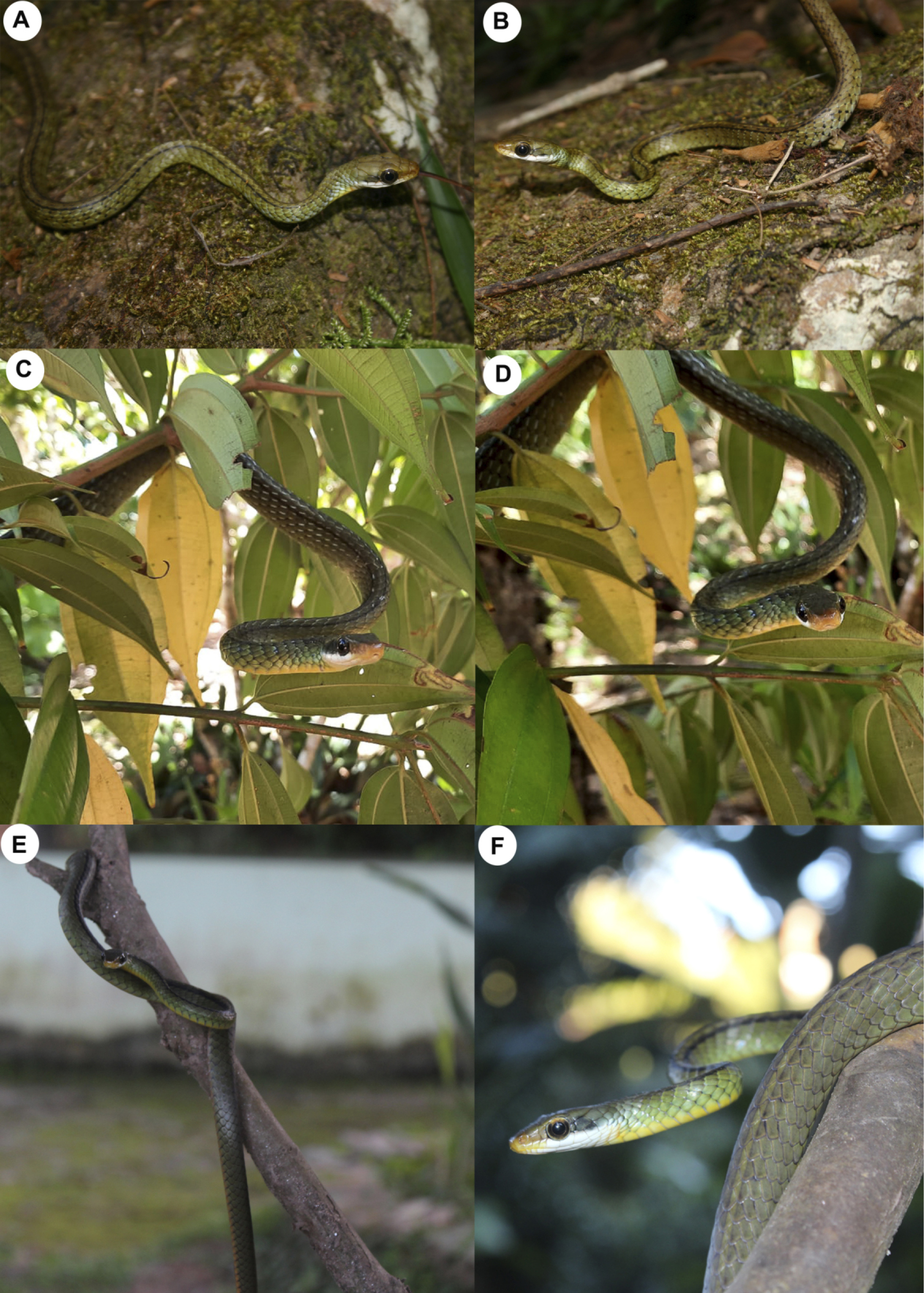
Sudré V, Andrade-Junior A, Folly M, Azevedo JAR, Ávila RW, Curcio FF, Nunes PMS, Passos P 2024. Revision of the Chironius bicarinatus complex (Serpentes: Colubridae): Redefined species boundaries and description of a new species. Vertebrate Zoology 74: 85-120.
A New Chironius from Trinidad
The island of Trinidad has several endemic reptile species that, in some cases are morphologically indistinguishable, or almost so, from their mainland counterparts. In particular, many snakes from the island have not been examined thoroughly with modern scientific methods and may be misidentified. At least two species of sipo snakes (Chironius carinatus, C. septentrionalis) are reported to inhabit Trinidad, both considered species already inhabiting the mainland, though their identities are based solely on morphology. Here, we evaluate the molecular distinctiveness of these Trinidadian snakes and assess their relationships to other members of the genus. We constructed a multi-locus data set (12S rRNA, 16S rRNA, cyt b, ND4, CMOS, NT3, Rag-1, Rag-2), including novel sequences and those available on GenBank to perform Bayesian and maximum likelihood phylogenetic analyses. Our phylogenetic reconstruction elucidates the identity of both Trinidad species, which have been misidentified since their discovery, and we provide a literature review of their taxonomic history. More specifically, our results suggest that the Trinidad population of Chironius carinatus is an undescribed species, described herein as Chironius nigelnoriegai sp. nov., and is the sister to C. flavopictus. Our results also demonstrate that the Trinidad population previously identified as C. septentrionalis is the mainland species C. cochranae, a member of a clade with C. foveatus, C. laurenti, and C. multiventris. Finally, we generated a time tree and inferred that our new species separated from C. flavopictus approximately 4 million years ago in the Pliocene, a time when the island of Trinidad detached from Northern Venezuela. This work contributes to a better understanding of species diversity of Trinidad and we hope that it assists in conservation efforts towards this important endemic region. These findings support the prospect of rapid speciation on Trinidad and imply that more extensive surveys of island squamates will reveal additional cryptic diversity.
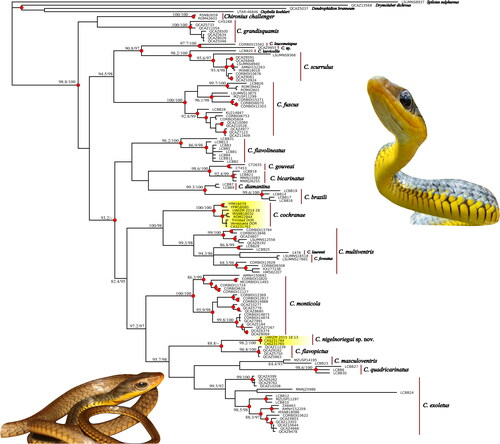
Jadin, R. C., Jowers, M. J., Blair, C., Ludwig, R. K., Salgado-Irazabal, X., & Murphy, J. C. 2024. Rectifying a century of misidentifications: a taxonomic re-evaluation of sipo snakes (Colubridae: Chironius) on Trinidad. Systematics and Biodiversity 22(1): 2338064.
Erythrolamprus darwinnunezi, A New Erythrolamprus from Andean Ecuador
Torres-Carvajal et al. (2024) describe a new species of Erythrolamprus from the eastern slopes of the Tropical Andes in Ecuador. The most similar species in morphology and color patterns are E. fraseri and E. lamonae. However, this new species differs in dorsal and ventral color patterning, as well as scale count and hemipenial morphology. Previous molecular phylogenies strongly support monophyly of the new species described herein and its sister taxon relationship with E. fraseri from the western slopes of the Andes of Ecuador and northern Peru. An identification key for species of Ecuadorian Erythrolamprus formerly assigned as subspecies of E. epinephelus is provided.
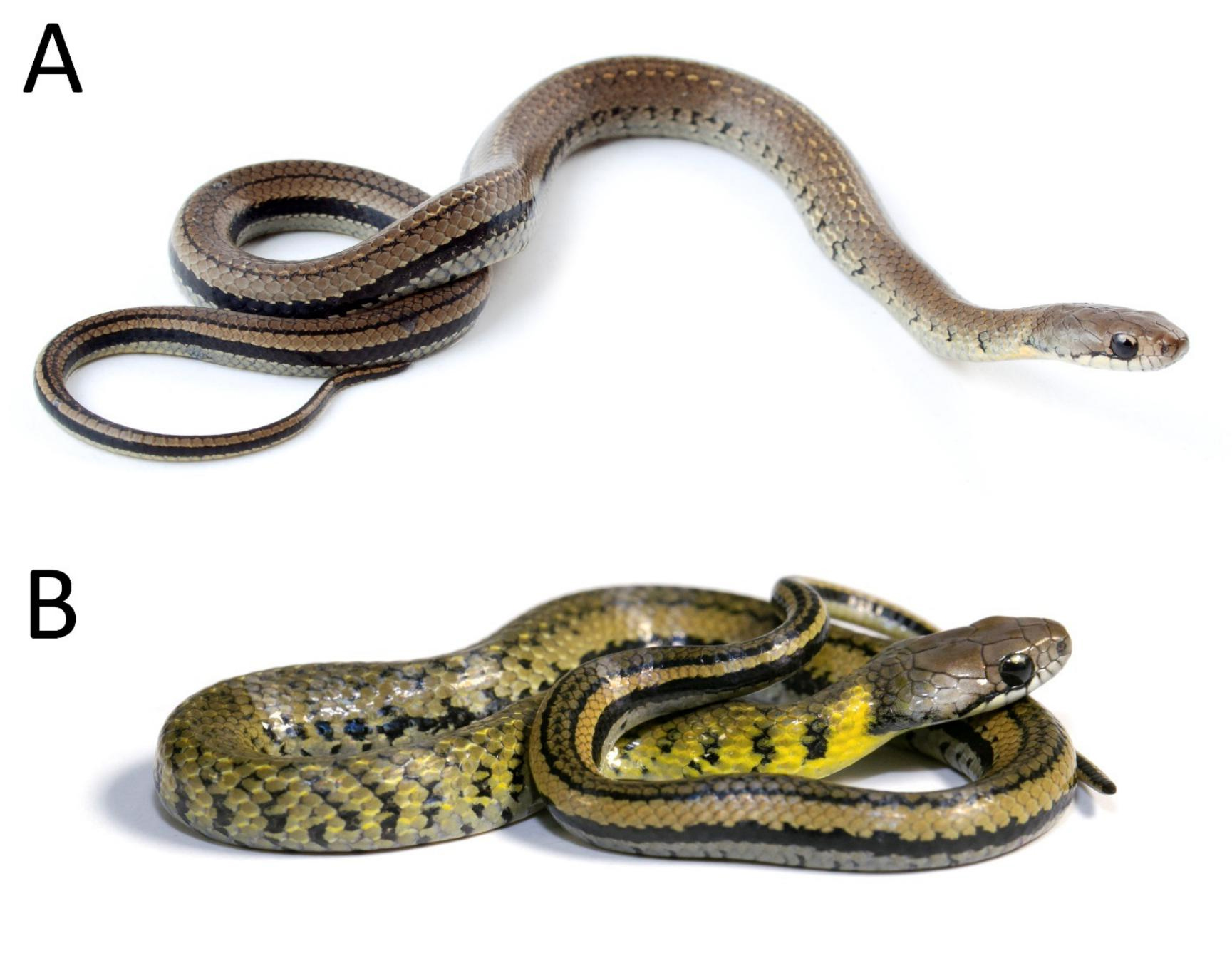
Torres-Carvajal, Omar, Hinojosa, Katherin C., and Paucar, Diego A. 2024. A New Species of Erythrolamprus (Serpentes:Dipsadidae) from the Andes of Ecuador. Herpetologica, 58(2) : 1-11.
Grayia obscura, A New African Watersnake, in the family Grayiidae (Grayiinae)
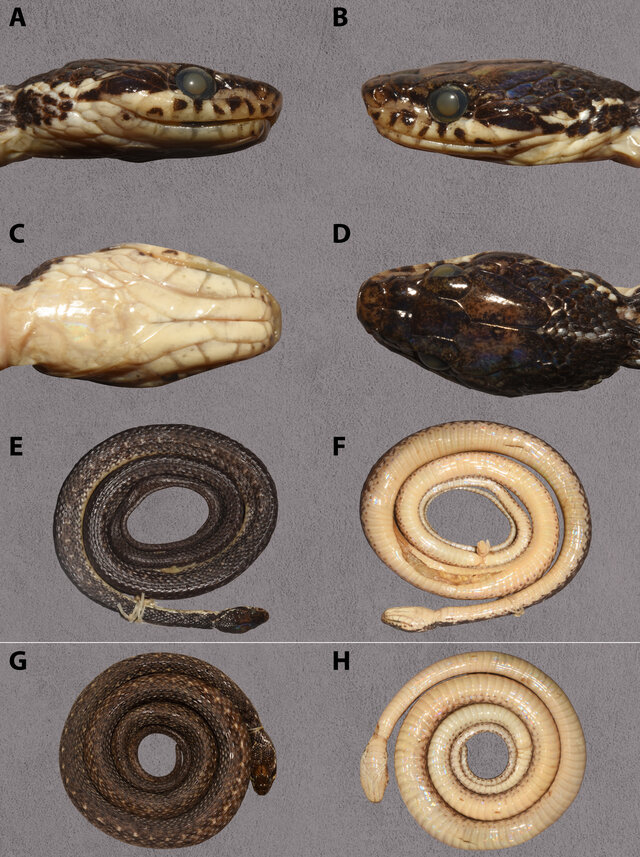
Grayia Günther 1858 is a genus of relatively large (1.2–2.5 m) aquatic Afrotropical snakes. Recent molecular phylogenies recovered Grayia in its own distinct subfamily (Grayiinae), which was supported as the sister group to Colubrinae. Tropical African snakes are generally understudied, so the relationships within Grayia are poorly known. High degrees of intra- and interspecies variation can make identification difficult, and previous studies involving Grayia included misidentified specimens in other genera. This study aims to create a phylogenetic tree that can be used to understand the relationships and taxonomy of Grayia via an integrative taxonomic approach that combines molecular data for 60 specimens and morphological data for 719 specimens. Two nuclear (BDNF, NT3) and four mitochondrial genes (COI, cyt b, 16S, and ND4) were used to construct phylogenetic trees with Maximum Likelihood and Bayesian Inference algorithms. The phylogenetic trees recovered two clades, Grayia caesar + G. tholloni and G. ornata + G. smythii, which the time-calibrated Bayesian Evolutionary Analysis Sampling Tree (BEAST) analysis estimated to have diverged from each other in the mid-Oligocene. This deep divergence, combined with distinct morphological differences, led us to resurrect the name Xenurophis Günther 1863 as a subgenus [G. (Xenurophis) caesar, G. (Xenurophis) tholloni]. Molecular and morphological evidence further supports a new cryptic species of Grayia from the Upper and Middle Congo River and its tributaries. This new species is estimated to have diverged from its nearest sister species, G. ornata, in the Late Miocene—which coincides with the divergence dates of sister taxa within other Central African snake genera. Grayia ornata sensu stricto was found to consist of several evolutionary lineages, which mirror the patterns recovered in other Central African vertebrates.
Chaney, Teslin; Olivier S. G. Pauwels, Zoltán T. Nagy, Václav Gvoždík, Chifundera Kusamba, Gabriel Badjedjea, Franck M. Masudi, Jeannot B. Akuboy, Raffael Ernst, Jean-François Trape, Laurent Chirio, Werner Conradie, Chad Keates, Van Wallach, Ange-Ghi 2024. Phylogenetics and Integrative Taxonomy of African Water Snakes (Squamata: Colubridae: Grayia). Herpetological Monographs, 38(1): 1-52.
Hebius citrinoventer, A New Watersnake from Yunnan Province, China
A new species of the genus Hebius Thompson, 1913 is described from Yingjiang County, Dehong Dai and Jingpo Autonomous Prefecture, Yunnan Province, China, based on molecular and morphological evidence. It can be distinguished from its congeners by the following set of characters: (1) dorsal scale rows 19–17–17, feebly keeled; (2) ventrals 146–151; (3) nasal complete, nostril in the middle of the nasal; (4) supralabials 9, the fourth to sixth in contact with the eye; (5) infralabials 10–11, the first 5 touching the first pair of chin shields; (6) preoculars 2; (7) postoculars 3; (8) temporals 3, arranged in two rows (1+2); (9) maxillary teeth 31, the last 4 slightly enlarged, without diastema; (10) tail comparatively long, TAL/TL ratio 0.334 in the male; (11) dorsolateral series of irregular orange or ochre yellow blotches, extending from the neck to the posterior part of the tail; and (12) venter pale orange, tips of ventrals with subrectangular black blotches. All Hebius specimens were strongly recovered as monophyletic, in which Hebius taronensis (Smith, 1940) and Hebius venningi (Wall, 1910) were monophyletic as sister to the Yingjiang County specimens. According to the p‐distance of cytochrome b, the new species differs from its congeners by 9.7–15.4%.
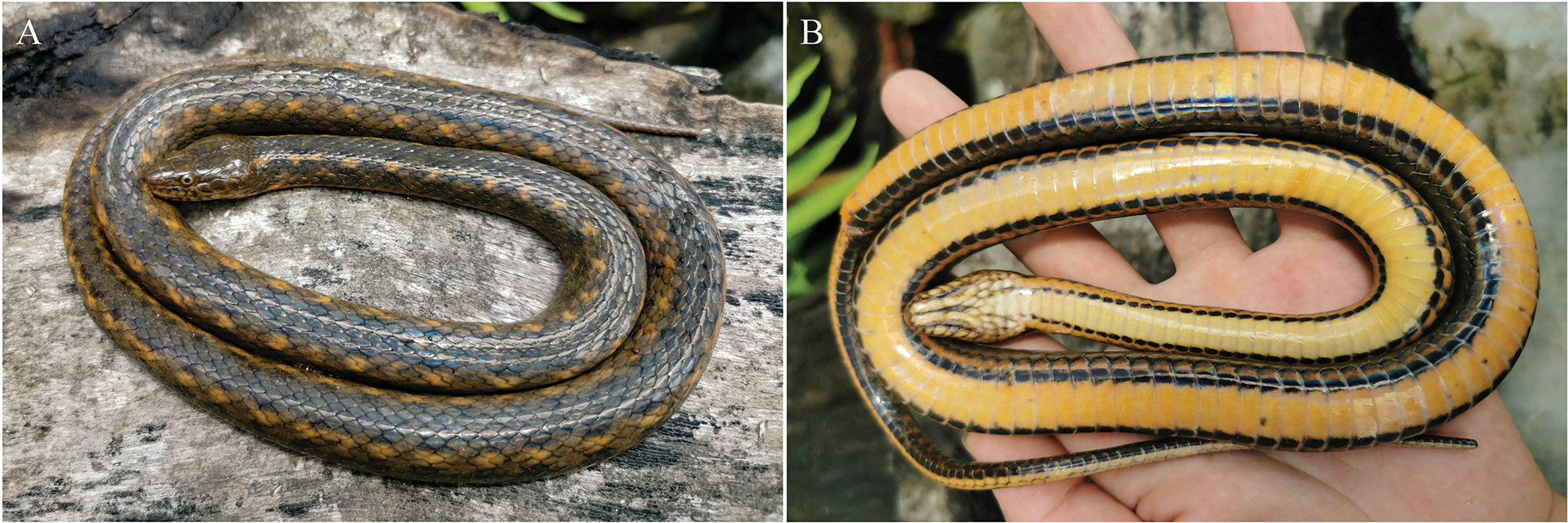
Xu Y-H, Yang D-C, Gong Y-A, Ouyang K-C, Weng S-Y, Deng J-D, Huang S, Peng L-F 2024. A new species of the genus Hebius (Squamata, Natricidae) from Yunnan, China. ZooKeys 1206: 255-274.
Herpetoreas davidi, A New Watersnake from Myanmar’s Rakhine Yoma Elephant Sanctuary
Based on molecular and morphological evidence, a new species of the genus Hebius Thompson, 1913 is described from Yingjiang County, Dehong Dai and Jingpo Autonomous Prefecture, Yunnan Province, China. It can be distinguished from its congeners by the following set of characters: (1) dorsal scale rows 19–17–17, feebly keeled; (2) ventrals 146–151; (3) nasal complete, nostril in the middle of the nasal; (4) supralabials 9, the fourth to sixth in contact with the eye; (5) infralabials 10–11, the first 5 touching the first pair of chin shields; (6) preoculars 2; (7) postoculars 3; (8) temporals 3, arranged in two rows (1+2); (9) maxillary teeth 31, the last 4 slightly enlarged, without diastema; (10) tail comparatively long, TAL/TL ratio 0.334 in the male; (11) dorsolateral series of irregular orange or ochre yellow blotches, extending from the neck to the posterior part of the tail; and (12) venter pale orange, tips of ventrals with subrectangular black blotches. All Hebius specimens were strongly recovered as monophyletic, in which Hebius taronensis (Smith, 1940) and Hebius venningi (Wall, 1910) were monophyletic as sister to the Yingjiang County specimens. According to the p‐distance of cytochrome b, the new species differs from its congeners by 9.7–15.4%.
Nguyen T.V., Lalremsanga H.T., Biakzuala L. & Vogel G. 2024. Taxonomic reassessment of the Herpetoreas xenura (Wall, 1907)(Squamata: Serpentes: Natricidae) from Myanmar with description of a new species. European Journal of Taxonomy, 932, 158-203.
A New Species of Gracile Blind Snake in the Genus Letheobia
The members of the typhlopid Letheobia pallida group are characterized by having a divided or split ocular scale. Letheobia wrayi sp. nov., differs from all other members of this group by having a low mid-dorsal scale count of 355 (other taxa 376–670). It also has a rostral which is rounded, not truncated posteriorly, and its nasal suture arises from the base of the first (not second) labial. In the new species the number of middorsal scales is similar to that of L. swahilica, but it is larger in total body length (245 mm compared to 190 mm). Letheobia wrayi sp. nov., differs from L. toritensis and L. pallida that have > 400 mid-dorsals. The new species can be distinguished from L. mbeerensis (mid-dorsals > 600, long tail 2.9% vs 1.2% short tail). It is known only from the holotype collected on the Sagalla Hill–Taita Hills at an elevation of about 1 100 m within a dry deciduous forest zone.
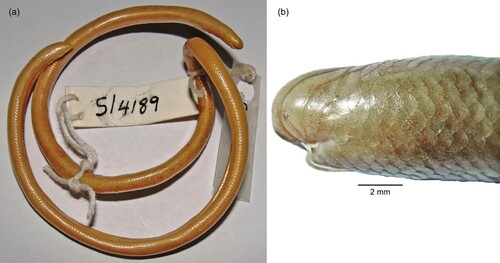
Malonza, P. K. 2024. A new species of gracile blind snake in the genus Letheobia (Squamata: Scolecophidia: Typhlopidae) from Sagalla Hill, south-eastern Kenya. African Journal of Herpetology, 1-8.
Three New Species of Coral Snakes Previously Confused with Micrurus ibiboboca
The elapid coral snake genus Micrurus is a group of Neotropical venomous snakes divided into two clades composed of species with monadal and triadal colour patterns. Historically, several studies have considered the triadal Micrurus ibiboboca a species complex. Here, we evaluate the cryptic diversity of the M. ibiboboca species complex based on a molecular phylogenetic analysis performed on a dataset that comprised 25 described species of Micrurus and five sequenced genes (one nuclear and four mitochondrial). Furthermore, we contrasted our molecular results with a comprehensive morphological study using external and hemipenial characters. The authors phylogenetic results recovered three well-supported clades for triadal colour patterns: (1) M. ortoni, M. surinamensis, M. potyguara, M. filiformis, M. lemniscatus, M. carvalhoi, M. diutius, and M. helleri; (2) M. dissoleucus and M. mipartitus; and (3) M. frontalis, M. brasiliensis, M. obscurus, M. altirostris, M. baliocoryphus, M. pyrrhocryptus, and the M. ibiboboca species complex. Based on our results, we redescribe M. ibiboboca and describe three new species of coral snake from Northeastern and Southeastern Brazil, previously confused with M. ibiboboca.
Nascimento, L. R., Graboski, R., Silva JR, N. J., & Prudente, A. L. 2024. Integrative taxonomy of Micrurus ibiboboca (Merrem, 1820)(Serpentes, Elapidae) reveals three new species of coral snake. Systematics and Biodiversity, 22(1): 2315958.
A New Genus and Species of Homalopsid from Vietnam
Homalopsid snakes of the genus Myrrophis include only two species distributed in southern China and northern Vietnam. Here, the authors describe a third species from southern Vietnam based on morphological data and nucleotide sequences from the mitochondrial gene cyt b. Myrrophis dakkrongensis sp. nov. is diagnosed by the following morphological characters: Medium-sized mud snake (largest total length 452 mm); internasal single and distinctly separated from loreals; dorsal scales smooth, in 23 rows at midbody, reduced to 19 or 20 rows before vent; ventrals 133–138; subcaudals 34–42, paired; cloacal plate divided; supralabials 8, fourth entering orbit; second pair of chin-shields small and oblique; maxillary teeth 17 or 18; gland-like tubercles present in the cloacal region; hemipenis short, forked and spinose, reaching 7th subcaudal; dorsum dark brown to black; and a white or yellow to orange lateroventral stripe present. The new species differs from its congeners by an uncorrected p distance in cyt b sequences of at least 10.5%.
Nguyen, S. N., Van Le, M., Lathrop, A., Murphy, R. W., & Che, J. 2024. A new species of mud snake (Squamata: Homalopsidae: Myrrophis) from southern Vietnam. Vertebrate Zoology 74, 221-233.
On Describing New Species