-
New genera of homalopsid snakes
posted on
Until recently these two snakes were both in the genus Enhydris. Both are adults, both have smooth scales and their internasals in contact. Yet they have different ancestors within the family homalopsidae as suggested by their dramatically different body shapes. JCM The colubroid snake family Homalopsidae also known as the Australasian rear-fanged water snakes contained…
-
A new high altitude pit viper from Sumatra
posted on
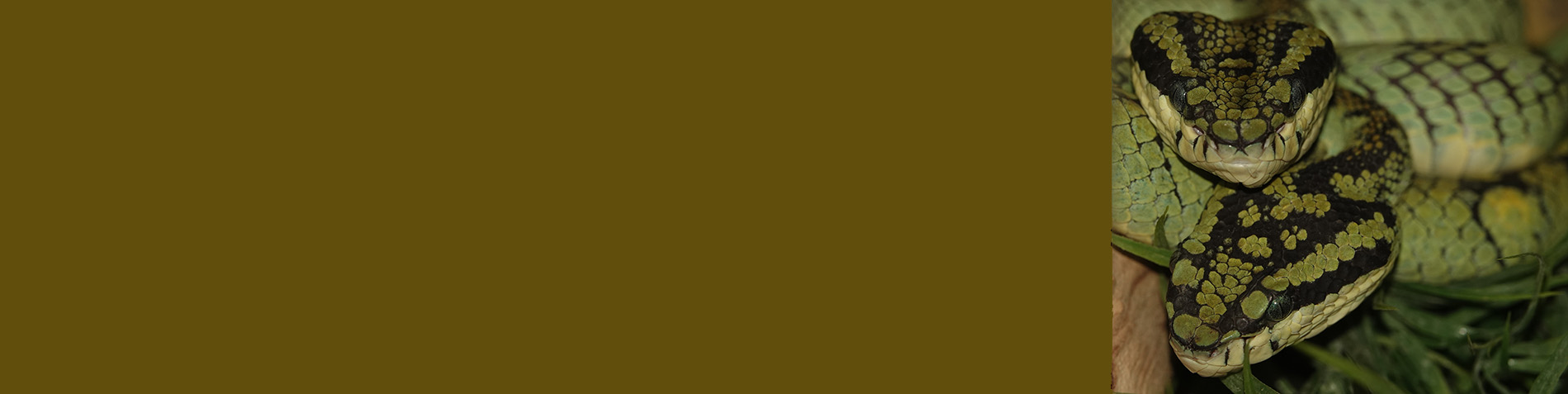
Top. Trimeresurus gunaleni. Below its habitat Vogel et al. (2014) investigated morphological variation in 126 specimens from at least 67 populations of Trimeresurus sumatranus. They found two distinct taxa: Trimeresurus sumatranus (Raffles) and Trimeresurus gunaleni sp. nov. They selected a neotype for Trimeresurus sumatranus and restricted its type locality to the vicinity of Bengkulu, Bengkulu Province,…
-
Gene duplication and the evolution of snake venom toxins
posted on
Gene duplication is a rare event in eukaryotic genomes and has been suggested as the major source of novel genetic material. Estimates of the rate of gene duplication in vertebrates vary from 1 gene per 100 to 1 gene per 1000 per million years and the most common fate for a duplicate gene is the…
-
Homalopsis hardwickii Gray, 1842
posted on
Homalopsis hardwickii Gray, 1842 Homalopsis buccata—Günther 1864:285; Boulenger 1890: 374; 1896: 14; Smith 1943: 390. Wall 1903: 94; Wall 1923: 38; Gyi 1970: 136; Murphy 2007: 193 Type locality. “India.” Holotype. BMNH 1946.1.7.26.” Distribution. Possibly restricted to northeast India, no known extant population. The holotype of Homalopsis hardwickii is reported to be from India, but…
-
Homalopsis buccata (Linnaeus, 1758)
posted on
Homalopsis buccata (Linnaeus, 1758) Coluber buccatus Linnaeus 1754; 1758: 217. Holotype: Lost, (Andersson 1899.). Type locality: “Indiis.” In accordance with Article 75.3 of the ICZN, FMNH 250114 is established as the neotype for Coluber buccatus Linnaeus, 1758. The selection is based upon the type locality “Indiis” which we interpret to mean the East Indies, now…
-
A new burrow-using, fanged frog from Sarawak
posted on
Limnonectes cintalubang, new species (KUHE 47859) Borneo is famous for its diverse endemic amphibians and the diversity can be expected to increase with the discovery of cryptic taxa. Frogs of the Limmnoectes kuhlii complex have enlarged head with fang-like processes on lower jaw in males, thus they are commonly called fanged frogs. Usually they have…
-
A phylogeny of snake combat and mating behaviors
posted on
A small study suggests snakes may have developed courtship and male-to-male combat behavior, such as moving undulations, neck biting, and spur-poking, over time, according to a study published September 24, 2014 in the open-access journal PLOS ONE by Phil Senter from Fayetteville State University and colleagues. Behaviors involved in courtship and male-to-male combat have been…
-
Cosumnes River Preserve restoration to protect Thamnophis gigas
posted on
The restored marsh and Thamnophis gigas. Photo credit CDFW The California Department of Fish and Wildlife (CDFW) has completed an emergency restoration project at the Cosumnes River Preserve to help save a state and federal threatened species, the giant garter snake (Thamnophis gigas). Snake Marsh at the Cosumnes River Preserve is home to a genetically…
-
Side-blotch lizard thermoregulation & climate change
posted on
Top: A side-blotch lizard. Photo Credit M. Goller. Below Thermograms of temperature microhabitats in the overall landscape (A–B) and analysis of lizard and environmental temperature (C–D). Measurement of lizard average temperature (line) and perch temperature (outline) is seen in (C). (D) Determination of maximum lizard temperature (box) and environmental maximum and minimum from the entire visible substrate available to the lizard. Only the rock surface (arrows indicate…
-
Varanus olivaceus picks fruit from trees
posted on
Varanus olivaceus feeding in a Microcos tree – Polillo, May 2005. From video by Simon Normanton/ Steel Spyda. Daniel Bennett (2014) used camera traps and direct observation to investigate the foraging behavior of the butaan, . This lizard is an obligatory frugivorous monitor lizard restricted to Luzon, Polillo and Catenduanes islands in the northern Philippines.…
-
Nidovirus in Ball Pythons
posted on
Researchers have identified a novel virus that could be the source of a severe, sometimes fatal respiratory disease that has been observed in captive ball pythons since the 1990s. The work is published this week in mBio®, the online open-access journal of the American Society for Microbiology. Investigators observed the virus, which they named ball…
-
Could ecdysis in wild reptiles be influenced by environmental conditions?
posted on
Anecdotal reports that ecdysis in the Southeast Asian tropical viper Calloselasma rhodostoma occurs when humidity is high. Humidity may be important during ecdysis to prevent dehydration, a risk of the increased activity required for shedding and potentially increased rates of cutaneous water loss. However, little is known about the role of humidity in ecdysis cycles…

SerpentResearch.Com
Amphibians, Reptiles, & Natural History





You must be logged in to post a comment.