-
Pacific Treefrogs, one, two, or three species?
posted on

Evolutionary divergence in sexual signals may lead to and maintain reproductive isolation between populations. Both selective forces—such as ecological and sexual selection—and random processes like genetic drift may influence the diversification of sexual signals. Understanding the patterns and sources of intraspecific variation in sexual signals among populations can inform the stages of differentiation and speciation.…
-
Burmese Python Nest in Great Cypress Swamp
posted on
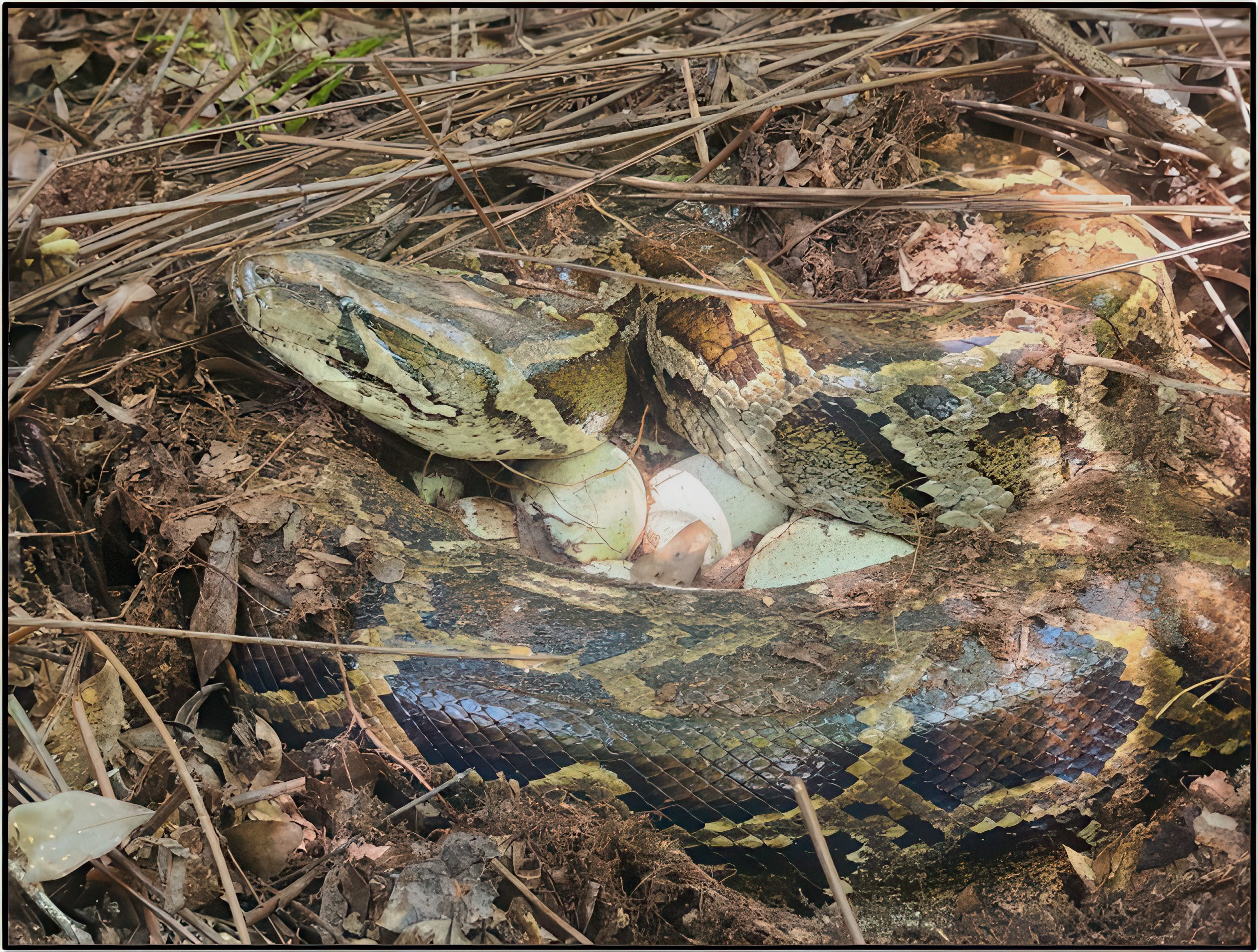
Lisa McBride, a U.S. Geological Survey (USGS) biologist, led a study to document a record-setting Burmese python nest found in Big Cypress National Preserve in 2022. McBride’s work details the python’s nesting behaviors and provides the first comprehensive photographic evidence of the brooding process in the wild. In 2022, a radio-tagged female python led researchers…
-
Hunting the HUNTERS
posted on

The following article appeared in the Florida Weekly Bonita Springs edition. Pythons are slithering into more areas of Florida, but scientists take innovative strides to stop them.By StaffDecember 14, 2023 BY ROGER WILLIAMSrwilliams@floridaweekly.com It’s breeding season again, not just eating season. Now entering his 11th year of a consuming battle against the most potent and…
-
Studying climate change’s impact on a dendrobatid frog
posted on
There’s a species of poison frog called the “strawberry frog” or the “blue jeans frog,” depending on who you ask. These frogs are smaller than a quarter, with bright red bodies and navy blue limbs, and they live in shady Costa Rican forests. Or, they did, until humans began cutting the forests to create farmland.…
-
SerpentResearch rated as one of the top ten herpetology blogs
posted on
SerpentResearch has been rated as one of the Top 10 Herpetology Blogs by Feedspot.com
-
New Caenophidian Snake Phylogeny
posted on
Elephant Trunk Snake, Acrochordus javanicus. JCM In a recent paper Zaher et al. (2019) examine Caenophidian snake phylogeny. Caenophidian snakes include the file snake genus Acrochordus and advanced colubroidean snakes that radiated mainly during the Neogene. Although caenophidian snakes are a well-supported clade, their inferred affinities, based either on molecular or morphological data, remain poorly…
-
Giant Gartersnake Research
posted on
Thamnophis gigas. By Photo: Dave Feliz, CC BY-SA 3.0, https://commons.wikimedia.org/w/index.php?curid=25541989 Protecting the Giant Garter SnakeRose et al. (2019) present work that highlights how the implications of uncertainties and unknowns can be explored by building and analyzing alternative models. We constructed Integral projection models (IPMs) for the threatened Giant Gartersnake (Thamnophis gigas) based on published studies…
-
Why did the Komodo Dragon survive the Pleistocene extinctions of the megafauna?
posted on
Sometimes exceeding 100 kg in weight, the Komodo dragon Varanus komodoensis is the largest species of lizard in the world (photo Ruchira Somaweera). (b) Large Komodo dragons in modern-day populations depend heavily upon introduced ungulates as prey. This Timor deer (Rusa timorensis) was actively hunted down by an adult Komodo dragon (photos W.K. Fletcher and Donna…
-
Komodo considers tourist ban to boost dragon numbers
posted on
The following is from the GuardianAuthorities are considering banning tourists from Komodo, the island home of the ancient Komodo dragon, to allow for conservation efforts amid concerns over animal-smuggling. The island, in Manggarai Barat, Indonesia, is a major tourist destination, with many making the trip to see the lizard which has a venomous bite, can…
-
Biologists observe a lizard lay eggs and give birth to live young
posted on
An adult Three-toed Skink. Photo Nadav Pezaro Biologists observe a lizard lay eggs and give birth to live young Scientists have never before witnessed the birth of live young and the laying of eggs from the same pregnancy. This world-first observation by Dr Camilla Whittington provides a fertile area for research into the evolution of…
-
Tiger Geckos in Viet Nam
posted on
Cat Ba Tiger Gecko (Goniurosaurus catbaensis) in its natural habitat. Photo Credit: Mona van Schingen. While proper information about the conservation status of tiger gecko species is largely missing, these Asian lizards are already particularly vulnerable to extinction, as most of them have extremely restricted distribution. Furthermore, they have been facing severe declines over the last…
-
Bd and Frog Biodiversity
posted on
An international study led by The Australian National University (ANU) has found a fungal disease has caused dramatic population declines in more than 500 amphibian species, including 90 extinctions, over the past 50 years. The disease, which eats away at the skin of amphibians, has completely wiped out some species, while causing more sporadic deaths…
-
A strong male-biased sex ratio in the Aesculapian Snake
posted on
Aesculapian snake, Zamenis longissimus. Photo credit: Felix Reimann. The adult sex ratio in all isolated populations of the Aesculapian Snake, Zamenis longissimus at the northern limit of its distribution was found to be male-biased; this did not apply to the Austrian population, in the center of its distribution range, where the ratio was almost 1:1. A recently…
-
Tiny, new Malagasy Frogs
posted on
An adult male Miniscule resting on a fingertip. Photo credit by Sam Hyde Roberts. Scientists at Ludwig-Maximilians-Universitaet (LMU) in Munich and the Bavarian State Collection of Zoology have named five new species of frogs found across the island of Madagascar. The largest could sit on your thumbnail, the smallest is hardly longer than a grain…
-
13-foot retic found in the British countryside
posted on

Google “python found” virtually any day and click on “news” and you will find stories about people finding pythons in unexpected places. Today I did this and found the story below. Most of the localities of most news stories are in the USA, but this was unusual because the snake was abandoned in the UK…
-
New species of lizards and some lizard stories from 2018
posted on
Lizards in the Gekkota clade made up a disproportionately large number of lizard species described in 2018. There were 55 species inthe family Gekkonidae, 4 species in the family Phyllodactylidae, and one Eublepharidae – for a total; of 60 geckos. Thus, 113 species of lizards described this past year, 53% were geckos. Skinks were next…
-
The Significance of the Green Rat Snake, Senticolis triaspis and the tribe Lampropeltini
posted on
The North American-Central America Green Rat Snake, Senticolis triaspis, represents an ancient lineage of Asian snakes that gave rise to the Western Hemisphere clade of snakes we now know as the Lampropeltini, the kingsnakes, gopher snakes and ratsnakes. An adult Green Rat Snake above, a juvenile Green Rat Snake below. North America rat snakes, kingsnakes, gopher…
-
Chironius phylogeny
posted on
Chironius carinatus. JCM The Neotropical snakes often referred to sipo snakes belong to the genus Chironius. These are large diurnal snakes with a long tail and big eyes that differ from other Neotropical snakes in having only 10 or 12 dorsal scale rows at midbody. Currently, 22 species range from Central America southward to Uruguay…
-
New snail-eating snakes from Ecuador
posted on
Photographs of some species of Dipsas in life: a D. andiana MZUTI 5413 from Bilsa, province of Esmeraldas, Ecuador b D. andiana from Mindo, province of Pichincha, Ecuador c D. bobridgelyi MZUTI 5414 from Buenaventura, Province of El Oro, Ecuador d D. catesbyi from Gareno, province of Napo, Ecuador e D. catesbyi from Gareno, province of Napo, Ecuador…
-
Reptile populations in decline
posted on
The Living Planet Index (LPI) is a measure of the state of the world’s biological diversity based on population trends of vertebrate species from terrestrial, freshwater and marine habitats. The LPI has been adopted by the Convention of Biological Diversity (CBD) as an indicator of progress towards its 2011-2020 target to ‘take effective and urgent…
-
Oldest known lizard
posted on
A team of international scientists, including paleontologists from Bristol University, Midwestern University (Arizona) and the University of Alberta, have described the world’s oldest known lizard fossil, permitting fresh insight into the evolution of extant snakes and lizards, the Squamata. Writing in the journal Nature, the researchers, including co-author Dr Massimo Bernardi from MUSE – Science…
-
Indian Egg-eating Snake – is not related to African Egg-Eating snakes
posted on
Two genera of colubroid snakes are known to swallow eggs whole, slit the shell, swallow the contents of the egg, and spit out the remains of the shell. In Africa, there are 13 species of egg-eating snakes of the Genus Dasypeltis. In India, there is one species in the genus Elachistodon, the Indian Egg-eater, Elachistodon…
-
China’s Giant Salamanders are gone from the wild
posted on
The Chinese Giant Salamander, Andrias davidianus (Blanchard, 1871), is the largest amphibians living today and may exceed more than one metre in length. It is widespread in central, south-western and southern China, although its range is now very fragmented. It occurs from 100–1,500 m ASL. Old records of the species in Taiwan may be the…
-
Boldness correlates with the mating success in varanid lizards
posted on
Yellow Spotted Monitor (Varanus panoptes) Photo by Greg Hume Boldness correlates with the mating success, but not body size or sex, of yellow-spotted monitor lizards roaming the remote Oombulgurri floodplains of tropical Western Australia, ecologists report in the Ecological Society of America’s open access journal Ecosphere. But boldness has a cost: bold individuals expose themselves to a much…
-
An extinct monitor lizard that had pineal and parapineal organs
posted on
This image depicts a reconstruction of what the extinct monitor lizard might have looked like. The parietal and pineal foramina are visible on the overlaid skull. Photo credit: Senckenberg Gesellschaft für Naturforschung / Andreas Lachmann / Digimorph.org Researchers reporting in Current Biology on April 2 have evidence that an extinct species of monitor lizard had four eyes,…
-
Rattlesnakes as seed dispersal agents
posted on
Despite the bad rap snakes often get, they are more central to ecology than most people realize. New research reveals that snakes might even play a key role in dispersing plant seeds. A Western Diamondback ingesting a kangaroo rat. JCM It’s long been known that some plants disperse their seeds by “hitchhiking” on animals, with…
-
An update on crustacean-eating snakes
posted on
Read the discussion of snakes’ handling prey and invariably the author will make a statement about snakes swallow their prey whole. Also, there is often a statement about that the size of the prey the snake can swallow is dependent upon the snake’s ability to gape its jaws. Thus, snakes are frequently referred to as…
-
THE KING COBRA ECOLOGY AND CONSERVATION PROJECT
posted on
The Agumbe Rainforest Research Station (ARRS) is currently recruiting volunteers for the radio telemetry part of the King Cobra Ecology and Conservation project (KCEC). This project consists of implanting king cobras with transmitters and tracking them, using receivers, through their natural habitat to learn about the habits, biology, and conservation of these remarkable creatures. The…
-
Recent advances in the knowledge of snake reproduction
posted on
The discovery that snakes have an XY chromosome system For over 50 years, biologists have accepted that all extant snakes share the same ZW sex chromosomes derived from a common ancestor, with different species exhibiting sex chromosomes at varying stages of differentiation. Accordingly, snakes have been a well-studied model for sex chromosome evolution in animals.…
-
Patterns of diversity in Neotropical Sankes
posted on
Neotropical region and ecoregion limits adopted here (sensu Olson et al., 2001), together with representative snakes species recorded for Central America Montane Forests: 1.1 Boa constrictor, 1.2 Oxybelis aeneus; Amazonia Most Forests: 1.3 Philodryas argentea, 1.4 Rhinobothryum lentiginosum, 1.5 Eunectes murinus, 1.6 Siphlophis compressus, 1.7 Amerotyphlops reticulatus, 1.8 Lachesis muta; Cerrado: 1.9 Imantodes cenchoa, 1.10…
-
An almost a complete list of new reptiles described in 2017 – 96 new species
posted on
Extant Turtles described in 2017 (n=1) FAMILY Trachemys medemi Vargas-Ramírez, Valle, Ceballos & Fritz 2017 Emydidae Extant Lizards described in 2017 (n=70) Gymnophthalmus marconaterai García-Pérez & Schargel 2017 Acanthodactylus margaritae Tamar, Geniez, Brito & Crochet 2017 Agamidae Ctenotus pallasotus Rabosky & Doughty 2017 Agamidae Ctenotus rhabdotus Rabosky & Doughty 2017 Agamidae Dendragama australis Harvey, Shaney, Sidik, Kurniawan & Smith 2017…
-
An almost complete list of the amphibians described in 2017 – 144 species
posted on
The following list is based upon data from AmphibiaWeb. This list was put together in mid-December 2017 so it probably does not represent all of the species that will be described in the calendar year. Species Family Country Distribution Reference Brachycephalus curupira Brachycephalidae Brazil Ribeiro LF, Blackburn DC, Stanley EL, Pie MR, Bornschein MR. (2017)…
-
A new species of blind snake lizard
posted on
Dibamus floweri. Photo Credit Evan Quah. The lizards of the genus Dibamus are a poorly known clade of 22 species found at scattered locations across Vietnam, Cambodia, Thailand, Peninsular Malaysia, Borneo, and Indonesia. The genus is also found in the Nicobar Islands of India, the Philippines, and New Guinea. Their worm-like appearance and burrowing lifestyle…
-
How do goannas find sea turtle nests?
posted on
Yellow-spotted goanna on Wreck Rock Beach, Queensland. Photo Credit: David Booth Goannas (AKA Monitor Lizards) have overtaken foxes as the number one predator of the endangered loggerhead turtle at its second largest Queensland nesting beach. A University of Queensland study has found that since feral red foxes were controlled in the 1980s, there has been an…
-
Twenty-six new species of Malagasy microhylid frogs – many are microendemics
posted on
Stumpffia davidattenboroughi. Photo credit G. M. Rosa The genus Stumpffia Boettger, 1881 was first described based on the species Stumpffia psologlossa a small frog from Nosy Be Island, Benavony, and Manongarivo on the adjacent mainland in north-western Madagascar. This appears to be a lowland species ranging as high as 700 m asl. It lives in the…
-
Viviparous sea snakes in the Indian Ocean
posted on
Hydrophis curtus The presence of the viviparous sea snakes in the Indian Ocean poses a unique question in this regard due to their evolutionary origins in Australasia (Australia and New Guinea). In a new paper Ukuwela et al. (2017) examine the origins and patterns of colonization of the Indian Ocean sea snake assemblage through time-calibrated…
-
The eye covering on snakes
posted on
The eye of all snakes is covered by a transparent spectacle that originates from the fusion of the eyelids during embryonic development. It is generally believed that the spectacle arose as an evolutionary adaptation to protect the eyes of early fossorial snakes. However, given that extant snakes occur in a variety of habitats with some species…
-
River valleys and snake genetics
posted on
Pituophis catenifer sayi The genetic population structure of snakes can vary markedly based on a number of intrinsic and extrinsic factors. Some snake species show only very modest levels of subdivision or none at all, while others show a high degree of differentiation over small spatial scales. The variation among species is likely due to…
-
The origin of Australian squamates
posted on
Eastern Tiger Snake, Notechis scutatus Deadly snakes are among Australia’s most iconic animals. Now a new study led by The Australian National University (ANU) has helped explain how they descended from creatures that have come from Asia over the past 30 million years. Lead researcher Dr Paul Oliver said about 85 percent of more than…
-
Marine Snake Diversity in the Straits of Malacca and the South China Sea
posted on
Bar graph showing the species composition and relative abundance for 852 marine snakes collected as by-catch from otter trawlers operating on the trawling grounds at Sungai Buloh. The snakes were collected in 1971 and 1974-75 and represented 10 species of true sea snake (Elapidae) and one species of file snake (Acrochordidae). The assemblage is strongly…
-
The Rediscover of Jackson’s Climbing Salamander (Bolitoglossa jacksoni)
posted on
The Search for Lost Species initiative is today celebrating the incredible and unexpected rediscovery of the first of its top 25 “most wanted” lost species, the Jackson’s Climbing Salamander (Bolitoglossa jacksoni), lost to science since its discovery in 1975. The rediscovery comes months before an organized expedition to Guatemala’s Cuchumatanes Mountain range to look for…
-
Western Rat Snakes and Resource Selection
posted on
Western Ratsnakes (Pantherophis obsoletus) Predicting the effects of global climate change on species interactions has remained difficult because regional climate models and the microclimates experienced by organisms are not always in sync. In a new paper George et al. (2017) evaluated resource selection in a predominant ectothermic predator using a modeling approach that permitted them to assess…
-
A new, hybrid, all female whiptail that is tetraploid
posted on
The Desert Grasslands Whiptail, Aspidoscelis inornatus. In a new paper, Cole et al. (2017) describe the second known tetraploid amniote that reproduces by parthenogenetic cloning. This all-female species of whiptail lizard originated in the laboratory from hybridization between the Little Striped Whiptail, Aspidoscelis uniparens (triploid parthenogen) and the Desert Grasslands Whiptail, Aspidoscelis inornatus (diploid bisexual species). Similar clonal lineages of…
-
The endangered Lanceheads of Martinique
posted on
Martinique Lancehead, Bothrops lanceolatus. Photo credit Nathalie Dewynter In a new paper, Gros-Désormeaux et al. discuss the impact of humans on the Martinique Lancehead, Bothrops lanceolatus. The lancehead is the only poisonous snake endemic to Martinique, Lesser Antilles arc. Today, this snake is on the verge of extinction. The recorded number of snakes killed yearly…
-
Fossil snakes from the Bahamas
posted on
Nerodia clarki The late Pleistocene snake fossils from Sawmill Sink (Abaco, The Bahamas) represent five taxa: a blindsnake or threadsnake (Scolecophidia); the Abaco boa (Boidae: Chilabothrus cf. exsul); a rat snake (Colubridae: Pantherophis sp.); a water snake (Natricidae: Nerodia sp.); and the Cuban racer (Dipsadidae: Cubophis cf. vudii). A scolecophidian, lChilabothrus exsul, and Cubophis vudii still…
-
A warming climate and viviparous lizards
posted on
Phrynocephalus sp. Climate change is and will continue to have a negatively impacting biodiversity. In a new paper Wang et al. (2017) note that lizards may experience population declines and extinctions on a similar scale to that experienced by amphibians. Within lizards, viviparous species are hypothesized to be more vulnerable to climate warming, because they…
-
Caribbean Ameivas moved to the genus Pholidoscelis
posted on
The family Teiidae is a New World clade of small to large-sized lizards that tend to be active foragers, diurnal, and omnivorous. Whiptails (genus Aspidocelis)in the USA, Racerunners (genus Cnemidophorus) in the Neotropics, the giant Tegus (Tupinmabis and Salvator) in the Neotropics are a few of the major clades. The Ameiva’s are primarily Neotropical but…
-
A frog that cannot hear its own call
posted on
Pumpkin toadlets, found in the leaf litter of Brazil’s Atlantic forest, are among the smallest frogs in the world. An international team from Brazil, Denmark, and the United Kingdom, has discovered that two species of these tiny orange frogs cannot hear the sound of their own calls. This is a unique case in the animal…
-
A new, morphologically cryptic, leaf-nesting frog of the genus Phyllomedusa
posted on
Male holotype of Phyllomedusa chaparroi sp. nov. (MUBI 13986) Casttoviejo-Fischer and colleagues describe and name the new leaf-nesting frog, Phyllomedusa chaparroi, a medium-sized species (67.9–77.5 mm) from the Amazonian rainforests of northern Peru. Morphologically the new species is most similar to P. boliviana and P. camba, it is indistinguishable from the latter in external qualitative and quantitative…
-
Brazilian microteiids – and the increase of Brazilian lizard species since 1995
posted on
Gymnophthalmus underwoodi, a widespread all-female species. In a new paper, Ribeiro-Junior and Amaral present distribution data of all Alopoglossidae and Gymnophthalmidae lizards known from the Brazilian Amazonia. The paper presents a total of 54 species-level taxa, belonging to 17 genera and two families. This represents 22 more species-level taxa than previously reported. The results were…

SerpentResearch.Com
Amphibians, Reptiles, & Natural History





You must be logged in to post a comment.