

by American Museum of Natural History edited by Sadie Harley, reviewed by Robert Egan
New research has uncovered a species of hook-toothed lizard that lived about 167 million years ago and has a confusing set of features seen in snakes and geckos—two very distant relatives. One of the oldest relatively complete fossil lizards yet discovered, the Jurassic specimen is described in a study, published in the journal Nature, from a multinational collaboration between the American Museum of Natural History and scientists in the United Kingdom, including University College London and the National Museums Scotland, France, and South Africa.
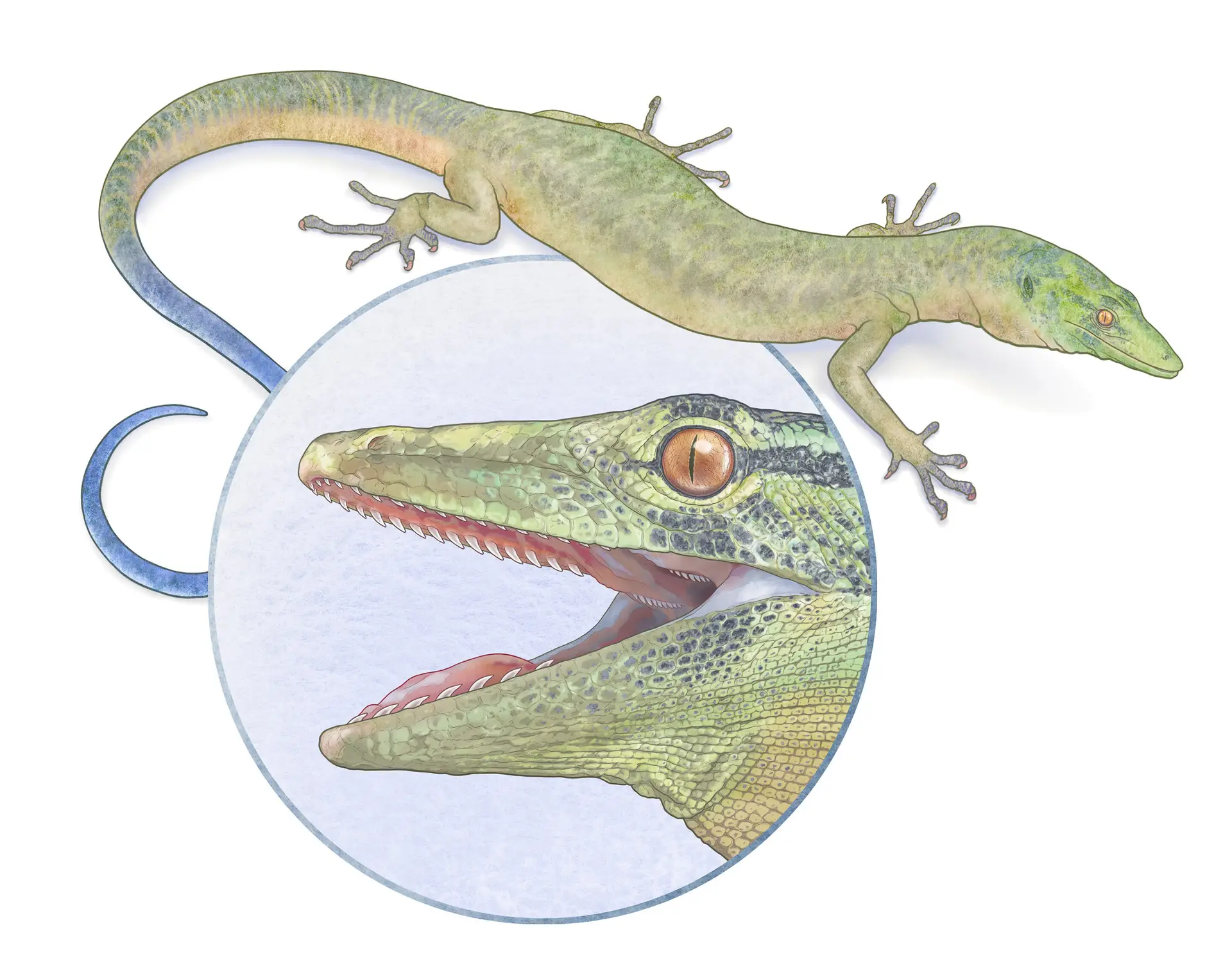
The species was given the Gaelic name Breugnathair elgolensis meaning “false snake of Elgol,” referencing the area in Scotland’s Isle of Skye where it was discovered. Breugnathair had snake-like jaws and hook-like, curved teeth similar to those of modern-day pythons, paired with the short body and fully-formed limbs of a lizard.
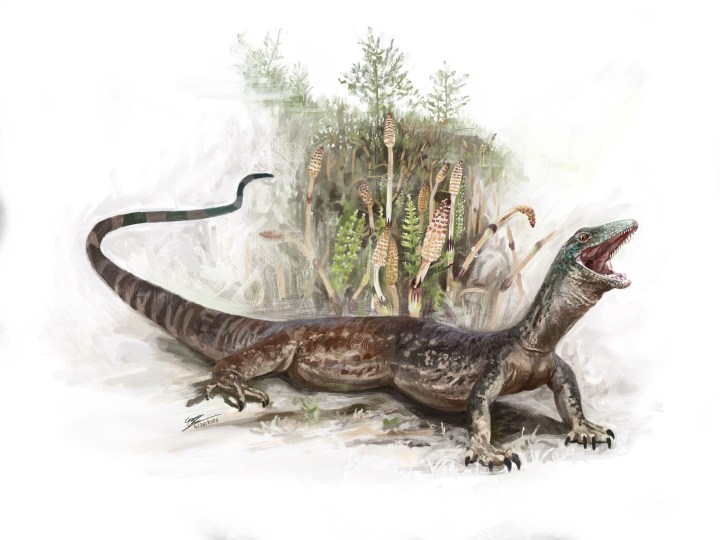
A reconstruction of Breugnathair elgolensis. Credit: National Museums Scotland Brennan Stokkermans.
“Snakes are remarkable animals that evolved long, limbless bodies from lizard-like ancestors,” said the study’s lead author Roger Benson, Macaulay Curator in the American Museum of Natural History’s Division of Paleontology.
“Breugnathair has snake-like features of the teeth and jaws, but in other ways, it is surprisingly primitive. This might be telling us that snake ancestors were very different to what we expected, or it could instead be evidence that snake-like predatory habits evolved separately in a primitive, extinct group.”
Lizards and snakes together form a group called squamates. Breugnathair has been placed in a new group of extinct, predatory squamates called Parviraptoridae, which was previously known only from more fragmentary fossils.
Earlier studies reported snake-like tooth-bearing bones that were found in close proximity with bones that had gecko-like features. But because these seemed so drastically different, some researchers believed they belonged to two different animals.
The new work on Breugnathair rejects those earlier findings, showing that both snake-like and gecko-like features exist together in a single animal.
References
Benson RB, Walsh SA, Griffiths EF, Kulik ZT, Botha J, Fernandez V, Head JJ, Evans SE. Mosaic anatomy in an early fossil squamate. Nature. 2025 Oct 1:1-7.
Hussam Zaher, Mix-and-match fossils tell the tale of snake and lizard evolution, Nature (2025). DOI: 10.1038/d41586-025-02972-2 , doi.org/10.1038/d41586-025-02972-2

