-
Suizo Report — Late October and November 2012
posted on
Howdy Herpers, 11/28/12 The last Suizo rattlesnake roundup to occur in 2011 was a dandy. The effort, which happened in September, brought three very cool snakes into the fold. The first was male Crotalus tigris #11, (CT11) “Steven.” The second was female Crotalus molossus #10, (CM10) “Susan,” and male CM11 “Gus.” (Although at that point…
-
The Boa Constrictor in Puerto Rico
posted on
MAYAGÜEZ, Puerto Rico— Non-native boa constrictors, which can exceed 10 feet and 75 pounds, have established a breeding population in Puerto Rico, one that appears to be spreading, according to research published in the journal Biological Invasions. While boa constrictors and two species of pythons have established invasive populations in Florida, this research is the…
-
Tropical Lizard Adapts to Florida Winter
posted on
The Puerto Rican lizard Anolis cristatellus pictured above has adapted to the cooler winters of Miami. Credit: Manuel Leal, Duke. DURHAM, NC – One tropical lizard’s tolerance to cold is stiffer than scientists had suspected. A new study shows that the Puerto Rican lizard Anolis cristatellus has adapted to the cooler winters of Miami. The…
-
European Fashion & the Python Trade
posted on
Nearly a half million python skins are exported each year – almost exclusively for use in European fashion – in a massive market with a legal value of more than $1.0 billion, according to the study Trade in South-East Asian Python Skins. Many of the skins end up as designer handbags, belts, wallets and other…
-
Legislation to Regulate Importation of Constrictors
posted on
The following story is being carried by The Chattanoogan.com. One of the country’s leading conservation groups wants Congress to ban imports of reticulated pythons, green anacondas, boa constrictors, and two other constrictor snakes that pose a major threat to native wildlife. In a letter sent the U.S. House Resource Committee, American Bird Conservancy says these…
-
Orsini Viper’s Reproductive Strategy
posted on
A female Orsini’s viper observed at the end of August 2011. This snake is gestating and will give birth to two offspring a fortnight later. Credit: Thomas Tully. This image is available from the CNRS phototheque, phototheque@cnrs-bellevue.fr Orsini’s viper is a small insectivorous snake that is rare and extremely threatened in France. Since the early 1980s,…
-
Migration Behavior in Giant Tortoises
posted on
While Galapagos giant tortoises move very slowly and at a leisurely pace, they can nevertheless cover great distances. © MPI f. Ornithology The Galapagos giant tortoise, one of the most fascinating species of the Galapagos archipelago, treks slowly and untiringly across the volcanic slopes. Scientists of the Max Planck Institute for Ornithology in Radolfzell, together…
-
A New Blunt-headed Treesnake from Ecuador
posted on
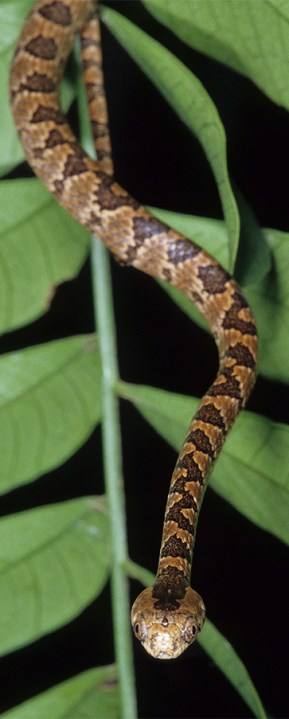
Imantodes chocoensis Blunt-headed tree snakes range from Mexico and Argentina, and are distinct from all other New World snakes because they have an exceptionally thin body, slender neck, big eyes, and a blunt head. The arboreal snakes hunt frogs and lizards at night and their extremely gracile bodies allow them to bridge gaps between branches…
-
Hybrid Salamander Larvae Survive Pesticides
posted on
Three types of salamander larvae: native California tiger salamanders (Ambystoma californiense), barred tiger salamanders (Ambystoma tigrinum mavortium), and the hybrid offspring born when the two species mated. Photo Credit: Bruce Delgado, U.S. Bureau of Land Management. Hybridization among ambystomid salamander species is common. Ambystoma tigrinum mavortum, the barred tiger salamander may have been introduced into California…
-
Squamate Body Elongation & Climate
posted on
Gymnopthalmus underwoodi, a species not included in this study. The evolution of elongated body shapes in squamate vertebrates has intrigued biologists for decades. Grizante et al. (2012) suggest several factors may explain how the environment influences the evolution of body elongation, and note climate needs to be incorporated in this scenario to evaluate how it…
-
New Report of a Rare Bothrops
posted on
Murici Lancehead, Photo Frank Stemitz Bothrops muriciensis was described more than a decade ago by Ferrarezi & Freire (2001) from Brazil’s Atlantic Forest on the basis of three specimens. Freitas et al.(2012) report on six more specimens collected in the Murici region of Alagoas, Brazil. They increase the number of localities the snake has been…
-
Herps of the Tucker Valley Bioblitz
posted on
The first BioBlitz in Trinidad and Tobago was held in Tucker Valley in Chaguaramas on November 17 & 18. The idea behind a BioBlitz is to identify as many species as possible in a chosen area within 24 hours, provided science with some information and raise awareness of biodiversity within the general public. Tucker Valley includes a…
-
Steroids & Temperature Influence Sex Determination in Gekko japonicus
posted on
Sex determination is a developmental process altering undifferentiated gonads into testes or ovaries. Vertebrates have two types of sex determination: genotypic sex determination (GSD), in which offspring sex is determined at the time of fertilization by genetic factors and environmental sex determination (ESD), where environmental factors act after fertilization at a critical time in embryonic…
-
Sensitive Crocodilians
posted on
Scanning electron microscope image of the jaws of a crocodile clearly show the sensory spots dotting its skin. (Courtesy of the Catania Lab) Crocodiles and alligators are notorious for their thick skin and well-armored bodies. So it comes as something of a surprise to learn that their sense of touch is one of the most acute in…
-
London’s Exotic Herpetofauna
posted on
Zamenis longissimus. Photo credit: Felix Reimann The following article is from the Independent by Michael McCarthy. A large rat-eating snake from Europe is breeding in central London – just one of more than 50 foreign reptiles and amphibians seen living wild in the capital area in recent years. At up to 6 ft 6 ins…
-
A new sphenodontid beakhead from the late Jurassic
posted on
The extant tuatara, Sphenodon punctatus Rhynchocephalians (beakheads) form the sister group to the squamates (lizards and snakes) and are represented by the extant single genus Sphenodon (the tuataras) today. Beakheads are often considered to represent a very conservative lineage. However, rhynchocephalians were common from the late Triassic to late Jurassic, but the clade went into…
-
Suzio Report- Recent Additions to the Kilometer Club
posted on
Happy Halloween Herpers, 10/31/12 We’ll let the images do the talking: Image 1: CM12, Site 25: This is our world traveling, big, bad male molossus. Between August 8 and August 24–he bombed westward, and then back eastward. Total distance moved: 1,968 meters. He was only 33 meters off traveling in straight west-east trajectory! I couldn’t follow a compass and…

SerpentResearch.Com
Amphibians, Reptiles, & Natural History





You must be logged in to post a comment.