-
Suizo Report — Some Summer and Fall Highlights
posted on
Happy New Year Herpers, I’m going to take a minute to try to persuade some of you to step up for the Tucson Herpetological Society. If any of you have a herp-related presentation of any sort that you would like to give us, please let me know. Currently, we have openings from March 2013 through…
-
The White-flanked Malagasy Tree Frog, A New Frog from southern Madagascar
posted on
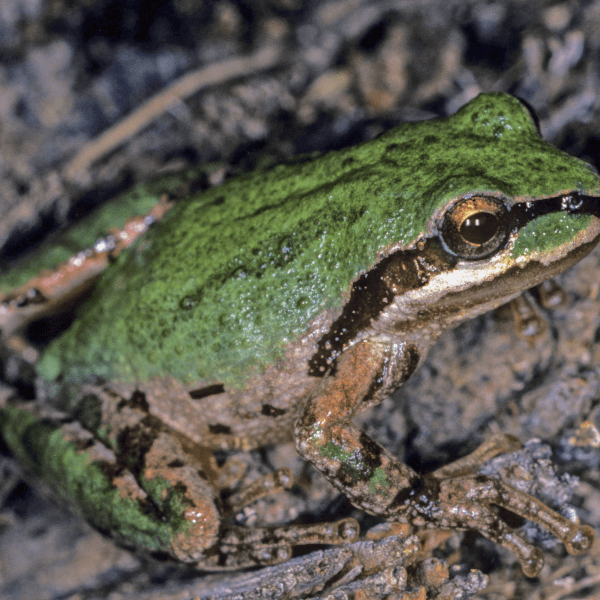
Guibemantis tasifotsy Mantellid frogs comprises the largest radiation of frogs in Madagascar with 200 know species in 12 genera. Within the family, at least three clades have independently adapted to phytotelmic breeding: Blommersia angolafa, Mantella laevigata, and the subgenus Pandanusicola in the genus Guibemantis. Pandanusicola are small frogs with snout–vent lengths between 20–38 mm that…
-
Squamates & the Cretaceous Extinction
posted on
The carnivorous lizard Palaeosaniwa stalks a pair of hatchling Edmontosaurus as the snake Cerberophis and the lizard Obamadon look on. Obamadon gracilis is a small polyglyphanodontian named after President Obama. These squamates disappeared with the dinosaurs at the Cretaceous extinction. More than 9,000 living species of snakes and lizards exploit an extraordinary range of ecological…
-
The First Known Freshwater Mosasauroid
posted on
An artist’s drawing of the Pannoniasaurus inexpectatus that lived 84 million years ago in freshwater floodplains. (Image: Tibor Pecsics) Until now, mosasauroids have been considered exclusively marine. However, László Makádi from the Hungarian Natural History Museum, and colleagues from the University of Alberta, Canada and MTA-ELTE Lendület Dinosaur Research Group, in Hungary report the discovery…
-
Length–mass allometry in snakes
posted on
Arboreal, burrowing, and aquatic boids. Clue’s to an animals life style (aquatic or terrestrial, burrowing or arboreal) are related to its body size and mass. Body size and body shape are closely correlated to an animal’s physiology, ecology and life history, and, therefore, play a major role in understanding ecological and evolutionary phenomena. Since many…
-
No evidence for erycine boas in North America before the Miocene
posted on
Extant erycine boas: An African Exyx colubrinus, and the North American Lichanura, and Charina The central Rocky Mountain Interior has long been a focus of study for late Eocene early Oligocene fossils in North America. The Medicine Pole Hills of North Dakota has preserved abundant late Eocene fossils which provide a glimpse of the central…
-
Capuchin monkeys learn to respond or not respond to snakes
posted on
Photo credit: Steven G. Johnson Primates have evolved antipredator behaviors for many potential predators including snakes, crocodiles, caimans, felids, canids, raptors, and other primates. Antipredator behavior includes avoidance, mobbing, alarm calls, vigilance, evasive maneuver/fleeing/seeking refuge, and aggressive behavior based on level of risk. Young animals are smaller and less experienced than adults and thus may be susceptible…
-
Origins of the North American Desert Fauna
posted on
The Rosy Boa, Lichanura trivirgata. Phylogeographic studies of the southwestern deserts of North America have suggested diverse historical processes, with two hypotheses posed as most important for shaping genetic structure: climate fluctuations in the Pleistocene and pre-Pleistocene vicariance. Support for the climate fluctuation hypotheses emerged from a historical understanding of Pleistocene vegetation patterns within North…
-
The Beaked Sea Snake, Two Cryptic Species
posted on
The deadliest sea snakes in the world can be found from the Arabian Peninsula to Australia. They like to live in estuaries and lagoons near the shore and have been known to get tangled in fishermen’s nets and inflict fatal bites. Their venom is extremely toxic, more potent than that of a cobra. But the…
-
Suizo Report — 1,834
posted on
I find myself in the midst of my own man-made purgatory. We speak of going through my notes and assembling data. Since the year 2000, I find that I have logged over 20,000 lizards. That number seems unbelievable. But I did something today that makes this number seem trivial by comparison. I decided to count…

SerpentResearch.Com
Amphibians, Reptiles, & Natural History





You must be logged in to post a comment.