-
Why did the Komodo Dragon survive the Pleistocene extinctions of the megafauna?
posted on
Sometimes exceeding 100 kg in weight, the Komodo dragon Varanus komodoensis is the largest species of lizard in the world (photo Ruchira Somaweera). (b) Large Komodo dragons in modern-day populations depend heavily upon introduced ungulates as prey. This Timor deer (Rusa timorensis) was actively hunted down by an adult Komodo dragon (photos W.K. Fletcher and Donna…
-
Large Burmese Python from Big Cypress National Preserve
posted on
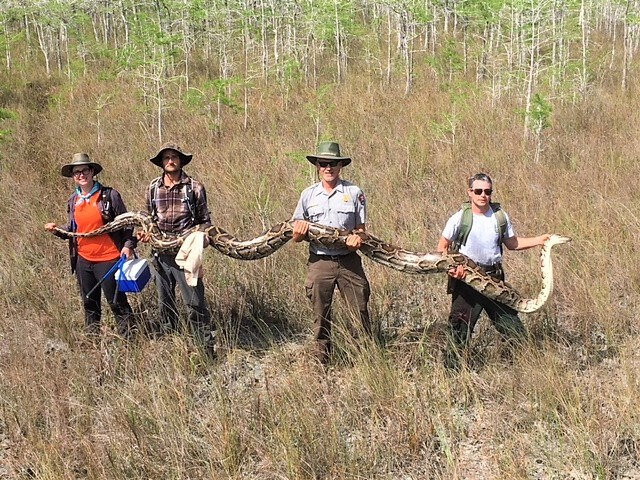
Researchers last week captured and killed the largest Burmese python to be removed from Big Cypress National Preserve in the Florida Everglades, according to wildlife officials.The 17-foot, 140-pound female snake — an invasive species devastating to native wildlife — was discovered using a new tracking approach that leans on technology and the laws of attraction.Burmese…
-
Komodo considers tourist ban to boost dragon numbers
posted on
The following is from the GuardianAuthorities are considering banning tourists from Komodo, the island home of the ancient Komodo dragon, to allow for conservation efforts amid concerns over animal-smuggling. The island, in Manggarai Barat, Indonesia, is a major tourist destination, with many making the trip to see the lizard which has a venomous bite, can…
-
Biologists observe a lizard lay eggs and give birth to live young
posted on
An adult Three-toed Skink. Photo Nadav Pezaro Biologists observe a lizard lay eggs and give birth to live young Scientists have never before witnessed the birth of live young and the laying of eggs from the same pregnancy. This world-first observation by Dr Camilla Whittington provides a fertile area for research into the evolution of…
-
Burmese pythons in the Loxahatchee National Wildlife Refuge
posted on

In a new paper, Hunter et al. (2019) used environmental DNA (eDNA) to detect the presence of the invasive Burmese Python. Environmental DNA is shed into the environment through skin cells and bodily fluids and can be detected in water samples collected from lakes, rivers, and swamps. In south Florida, invasive Burmese pythons (Python bivittatus)…
-
Tiger Geckos in Viet Nam
posted on
Cat Ba Tiger Gecko (Goniurosaurus catbaensis) in its natural habitat. Photo Credit: Mona van Schingen. While proper information about the conservation status of tiger gecko species is largely missing, these Asian lizards are already particularly vulnerable to extinction, as most of them have extremely restricted distribution. Furthermore, they have been facing severe declines over the last…
-
Bd and Frog Biodiversity
posted on
An international study led by The Australian National University (ANU) has found a fungal disease has caused dramatic population declines in more than 500 amphibian species, including 90 extinctions, over the past 50 years. The disease, which eats away at the skin of amphibians, has completely wiped out some species, while causing more sporadic deaths…

SerpentResearch.Com
Amphibians, Reptiles, & Natural History





You must be logged in to post a comment.