-
Tracking Python bivittatus in Everglades National Park
posted on
The largest and longest Burmese Python tracking study of its kind — here or in its native range — is providing researchers and resource managers new information that may help target control efforts of this invasive snake, according to a new study led by the U.S. Geological Survey. Among the findings, scientists have identified the…
-
The endemic freshwater snake Parahelicops boonsongi moved to a new genus
posted on
Isanophis boonsongi new comb., preserved holotype (FMNH 135328). From top to bottom: Dorsal view – Ventral view – Lateral view of the head and neck, left side. Photographs by Patrick David. There is little doubt that Southeast Asia harbors the most diverse assemblage of living snake species. And, a number of species from the Indochinese region,…
-
Hydrops caesurus Scrocchi, Ferreira, Giraudo, Avila and Motte 2005
posted on
Hydrops caesurus Scrocchi, Ferreira, Giraudo, Avila and Motte 2005. Type locality: Departamento Itapúa, Isla Paloma, Canal de los Jesuitas, Paraguay. Hydrops triangularis bolivianus— Williams and Couturier 1984Hydrops triangularis — Álvarez and Aguirre 1995 Distribution. Northeast Argentina and Paraguay. The distribution is disjunct from other members of the genus. It inhabits temperate and subtropical latitudes. Type locality:…
-
Hydrops triangularis (Wagler, 1824)
posted on

Elaps triangularis Wagler 1824: 5. Type locality: Ega (= Tefé) Lago Tefé, at confluence with Rio Amazon, Brazil. Hydrops triangularis – Wagler 1830: 170 Hydrops triangularis bassleri Roze 1957:83 Hydrops triangularis bolivianus Roze 1957:86 Hydrops triangularis fasciatus Roze 1957:76Hydrops triangularis neglectus Roze 1957:81 Hydrops triangularis venezuelensis Roze 1957:78 Distribution. Amazonas, Orinoco and Guyana drainages includes Bolivia,…
-
Helicops angulatus (Linnaeus, 1758)
posted on
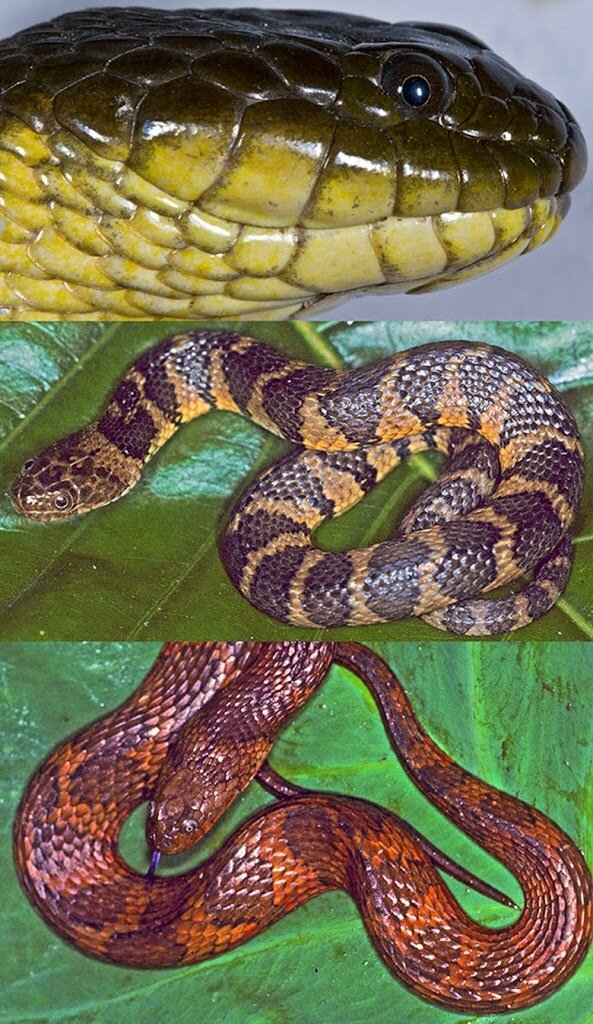
Coluber angulatus Linnaeus 1758: 217. Type locality: “Asia” (in error).Coluber alidras Linnaeus 1758:Coluber Surinamensis Shaw 1802: 460Natrix aspera Wagler 1824: 37Helicops angulatus — Wagler 1830: 171Helicops fumigatus Cope 1868: 308Helicops cyclops Cope 1868: 309Uranops angulatus — Sclater 1891: 45Helicops angulata — Beebe 1946: 28 Distribution, Venezuela (Amazonas, Apure, Bolivar, Monagas, Delta Amacuro, Sucre, Portuguesa, Anzoátegui, Guárico,…
-
Hydrops martii (Wagler, 1824)
posted on
Elaps Martii Wagler 1824. Type locality: Provincia Maranhao, Rio Itapicuru, Brazil Hydrops Martii — Wagler 1830: 170Homalopsis Martii — Schlegel 1837: 356Hydrops callostictus Günther 1868: 421Calopisma martii — Jan and Sordelli 1868Hydrops triangularis martii — Amaral 1930Hydrops martii — Dowling 2002 Distribution: Distribution: Amazon basin from Colombia and eastern Peru to Maranhao, Brazil. Known from tributaries of…
-
Helicops apiaka Kawashita-Ribeiro, Ávila & Morrais, 2013
posted on
Holotype: UFMT-R 8512, adult male, collected on 27 October 2009 by Carolina L. Cavlac. Diagnosis. Helicops apiaka sp. nov. is distinguished from all congeners by the following combination of characters: (1) dorsal scales in 21/21/19 rows in males and 23/21/19 rows in females; (2) subcaudals 79–103 (n = 14; 95.1 +/- 5.8) in males and…
-
Helicops carinicaudus (Wied-Neuwied 1825)
posted on
Coluber carinicaudus Wied-Neuwied 1825: 300. Holotype: AMNH 3365, a 909 mm specimenHomalopsis carinicaudus — Schlegel 1837: 350Helicops carinicaudus — Wagler 1830: 170. Distribution. Brazil (Espirito Santo, Rio Grande do Sul), Colombia.
-
Helicops hagmanni Roux 1910
posted on
Helicops hagmanni Roux 1910:439. Holotype: NMBA 6281, a 630 mm male (G. Hagmann). Type locality: Santarem, Brazil. Distribution: N Brazil (Pará etc.), Colombia ?, Venezuela (TF Amazonas), Peru. Original description. Roux, J. 1910. Eine neue Helicops-Art aus Brasilien. Zool. Anz. 36: 439-440
-
Helicops gomesi Amaral 1921
posted on
Helicops Gomesi Amaral 1921: 7 Holotype: Institute Butantan 1,843. Type locality: Costa Pinto Station, Railway Sorocaba, São Paulo, Brazil. Distribution: Brazil (Sao Paulo). Original description. Amaral, A. 1921. Contribution to the knowledge of the Brazil snakes. Part I Four nine species of snakes brasileires. Anex. Mem. Inst. Butantan 1 (1): 1-37,
-
Helicops infrataeniatus Jan 1865
posted on
Helicops infrataeniatus Jan 1865: 253. Lectotype: ZMH – R04331 (formerly no. B88 da) The other syntype from Brazil is deposited in Essex Inst. Salem according to Jan (1865). Types: ZMH R04340-4 (5 specimens) type locality “Mexico” in error. The type specimens of Calopisma septemvittata are a species inquirenda (Smith & Taylor , 1945), and cannot…
-
Helicops danieli Amaral 1938: 232
posted on
Helicops danieli Amaral 1938: 232 Holotype: Instituto Butantan 9872, juvenile female. Type locality: Colombia, Santander, Carare. Original description. Amaral, A. D. 1938. Estudo sobre ophidios neotropicos 34. Novas notas sobre a fauna da Colombia e descripcao de uma especie nova de Colubrideo aglypho. Mem. Inst. Butantan 11 [1937]: 232-240
-
Helicops modestus Günther 1861
posted on
Helicops modestus Günther 1861: 425. Holotype BMNH 1946.1.14.42. Type locality. Tropical America?Tachyplotus hedemanni Reinhardt 1866Helicops assimilis Reinhardt 1866: 156. Type locality. Minas Gerais, Brazil. Distribution. Brazil: Minas Gerais, Distrito Federal, Goias, Bahia. Original description. Günther, A. 1861. On the ophidian genus Helicops. Ann. Mag. Nat. Hist. (3) 7: 425-428.
-
Helicops leopardina Schlegel 1837
posted on
Homalopsis leopardina Schlegel 1837: 358. Holotype. ? Type locality: unknownHelicops leprieurii Dumeril Bibron & Duméril 1854 750Helicops leprieurii – Günther 1861: 427Helicops leopardinus – January 1865 Distribution. Guiana, Suriname, French Guiana, Brazil, Bolivia, Paraguay, northern Argentina,? Colombia? Ecuador, Peru. Original descriptionSchlegel, H. 1837. Essay on the faces of serpents. General section: xxviii + 251 S.…
-
Helicops pastazae Shreve 1934
posted on
Helicops pastazae Shreve 1934: 129. Holotype ?MCZ. Type locality: Río Pastaza, between Canelos and the Marañon River, Ecuador. Distribution. Ecuador, Colombia, Venezuela (Zulia), Peru. Original description. Shreve, B. 1934. Notes on Ecuadorian snakes. Occ. Pap. Boston Soc. Nat. Hist. 8: 125- 131.
-
The sea snake assemblage in the Muar estuary
posted on
Enhydrina schistosa. Photo credit: Aaron Lobo The first major survey of marine snakes were published by Malcolm Smith and covered the coastal areas of the Gulf of Thailand and the Malay Peninsula between 1915 and 1918 and yielded a collection of 548 sea snakes representing 17 species. These snakes were obtained as by-catch from local…
-
Dehydration and drinking in sea snakes
posted on
A new article (Lillywhite et al. 2015) in the Journal of Zoologyreports on the drinking behavior a sea snakes. It had been assumed sea snakes had a salt gland located under their tongue and that it was involved in the regulation of sodium ions,allowing the snakes to drink sea water. However, experimental work suggested that…
-
Coyote refuses to eat a dead kingsnake
posted on
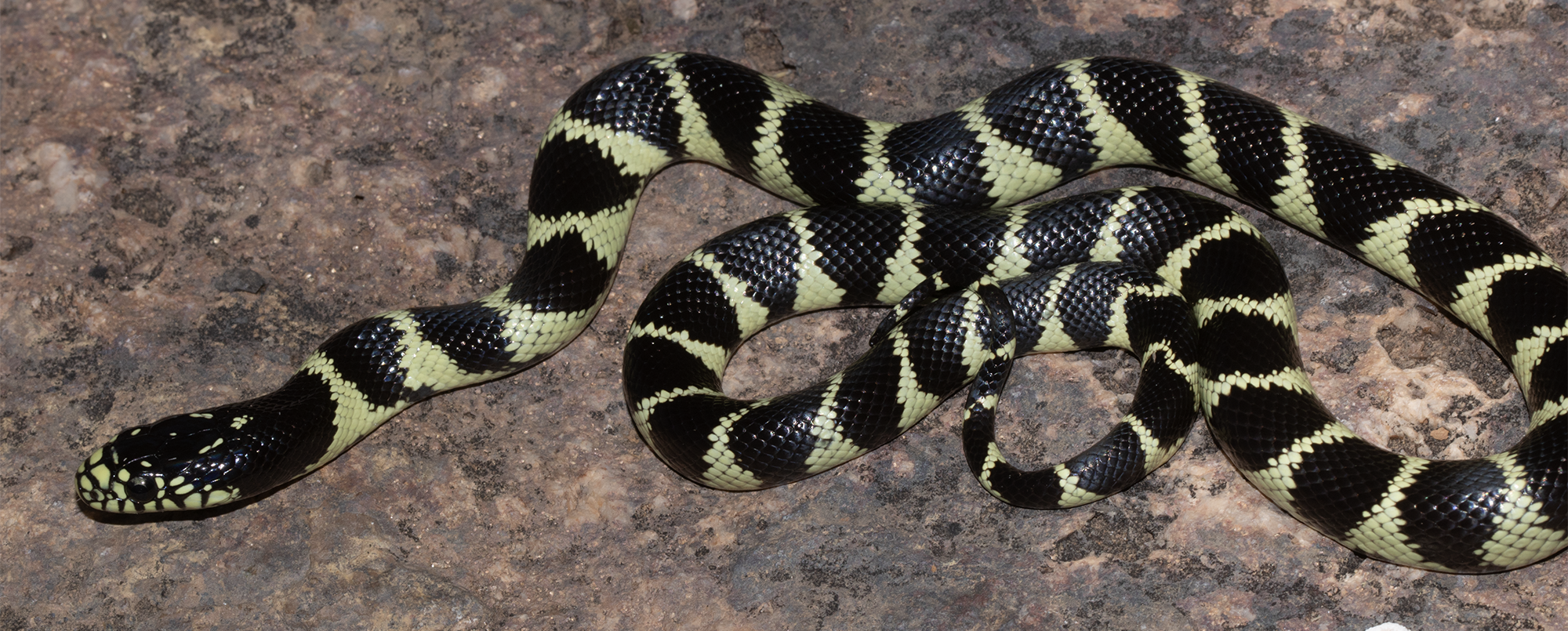
The very short video below shows a coyote attempting to scavenge a dead California Kingsnake (Lampropeltis californiae) in southeastern Arizona. The canid picked it up with its mouth and then dropped it – apparently because it tasted bad. The snake was one of two killed by a human and left to rot. The kingsnake is…
-
Chinese Mud Snake, Myrrophis chinensis (Gray, 1842)
posted on
Hypsirhina chinensis Gray, 1842 Zoological Miscellany, p. 66. Type locality: “China” holotype: BMNH 1946.1.2.42. Collector: J. R. Reeves. Hypsirhina sinensis – Stanley, 1914 Journal of the North-China Branch Royal Asiatic Society, Shanghai, ns, 45:30 (in error for chinensis). Chang (1935, Peking Nat. Hist. Bull. 9:143) placed this name in the synonymy of chinensis. Enhydris chinensis…
-
Bennett’s Mud Snake, Myrrophis bennettii (Gray, 1842)
posted on
Hypsirhina bennettii Gray, 1842 Zoological Miscellany, p. 67. Type locality: “China.” Holotype: BMNH 1946.1.2.49 [This specimen is probably a male, it has a damaged tail.] Collector: unknown. Hypsirhina maculata Duméril, Bibron and Duméril, 1854Érpétologie générale…Reptiles, Paris 7(2):950 type locality: “China.” Holotype: MNHN c3453(2). Collector: unknown. Hypsirhina enhydris var. maculata 1868 Jan and Sordelli, Iconographie Generale…
-
Selangor Mud Snake, Raclitia indica Gray 1842
posted on
Raclitia indica Gray 1842 Zoological Miscellany, p. 67. Type locality: Malay Peninsula. Syntypes: BMNH 1946.1.2.36, 1946.1.2.46. Hypsirhina indica – Boulenger, 1896 Catalogue of Snakes in the British Museum.3:4. Enhydris indica – Tweedie, 1957 Snakes of Malaya, p. 89. Diagnosis: A snake with seven upper labials, one postocular, and 19 scale rows on the neck and…
-
Bocourt’s Mud Snake, Subsessor bocourti (Jan, 1865)
posted on

Hypsirhina bocourti Jan, 1865 Archiv per la Zoologia, l’Anatomia e la Fisiologia. 3:258. Type locality: Bangkok, Thailand. Holotype: is at the MNMH according to Gyi. Collector: unknown. Ferania sieboldi (non Schlegel) Günther, 1866 Annals and Magazine of Natural History, ser. 3, 18:28. Hypsirhina gigantea Werner, 1923a Annalen des Naturhistorischen Museum in Wein, 36:163. Type locality:…
-
Broome Mangrove Snake, Myron resetari Murphy, 2011
posted on
Myron richardsonii: Gyi, 1970: 172–174, fig. 28. Myron resetari Murphy, 2011: 232 .Holotype: QM J52861. Type Locality: Broome, Western Australia. Distribution: Known only from type locality (Murphy, 2011) and coastal Western Australia. Diagnosis: Nineteen scale rows on the neck and at mid-body; one preocular; large, plate-like occipital scale that is posterior and lateral to parietals.…
-
Aru Mangrove Snake, Myron karnsi Murphy 2011
posted on
Myron richardsonii – Rooij, 1917, 2: 192. Myron karnsi Murphy, 2011:231. Holotype: SMF 19569.Type Locality: Indonesia Aru, Kobroor, Selrutti. Distribution: Known only from type locality (Murphy, 2011). Diagnosis: Melanistic, 21 scale rows at mid-body; seven upper labials; single preocular, semi-divided nasal and a black dorsum with narrow yellow cross bands separate this species from other…
-
Richardson’s mangrove snake, Myron richardsonii Gray, 1849
posted on
Myron richardsoniiGray, 1849 Catalog of specimens of snakes in the collection of the British Museum, p. 70. Type locality: North West Australia. Holotype: BMNH 1946.1.2.43. Collector: Sir J. Richardson. [type specimen is a female and has had the skull removed.] Neospades kentiide Vis, 1889 Proceedings of the Royal Society of Queensland, 4:238, pl. 14. Type…
-
Reuss’ Mud Snake, Miralia alternans (Reuss, 1833)
posted on
Brachyorrhos alternans Reuss, 1833 Museum Senckenbergianum, 1:155, pl. 9, Figure 3. Type locality: “Java”, Dr. Peitsch collector. Holotype: SMF 19465. Homalopsis decussataSchlegel, 1837 Essai sur la physionomie des serpentes, 2:344, pl. 13, Figures 14-16. Type locality: “Java”, Collector: Reinwardt. Holotype RMHL – 1157. Miralia alternans– Gray, 1842 Zoological Miscellany, p. 68. Eurostus alternans– Duméril, Bibron,…
-
Macleay’s Mud Snake, Pseudoferania polylepis (Fischer, 1886)
posted on

Hypsirhina polylepisFischer, 1886 Abhandlungen und Gebiet der Naturwissenschaften in Hamburg, 9:14. Type locality: Fly River, Papua New Guinea. Collector: Unknown. Holotype: Dresden Museum MTKD D437 (probably destroyed in WWII, fide Obst, 1977). Pseudoferania macleayiOgilby, 1891 Proceedings of the Linnaean Society of New South Wales, ser. 2, 5:51. Type locality: Herbert River, Queensland, Australia. Holotype: Australian…
-
Siebold’s Mud Snake, Ferania sieboldii (Schlegel, 1837)
posted on
Homalopsis sieboldii Schegel, 1837 Essai sur la physionomie des serpents, 2:349, pl. 13, Figures 4-5. Type locality: Bengal. Holotype: RNHL 1168. Collector: unknown. Ferania sieboldii – Gray, 1842 Zoological Miscellany, p. 67. Trigonurus sieboldii – Duméril, Bibron and Duméril, 1854 Érpétologie générale…reptiles, 7:960. Hypsirhina sieboldi – Jan, 1863 Elenco systematico degli ofidi, p. 78. Feraniodes…
-
Blackwater Mud Snake, Phytolophis punctata Gray, 1849
posted on
Phytolophis punctataGray,1849 Catalogue of the Specimens of Snakes in the Collection of the British Museum, p. 68. Type locality “India” (in error). Holotype: BMNH 1946.1.2.37. Eurostus heteraspisBleeker, 1859 Natuurkundig Tijdshrift voor Nederlandsch Indië, 14:440. Type locality: Sinkawang, Borneo. Collector: Dr. Bleeker. Holotype: BMNH 1946.1.2.39. Tachyplotus hedemanniReinhardt, 1866 Videnskabelige Meddelelser fra Dansk Naturhistorisk Forening i Kjobenhaun,…
-
Sumatran Mud Snake, Sumatranus albomaculatus (Duméril, Bibron, and Duméril 1854)
posted on
Homalopsis albomaculatusDuméril, Bibron, and Duméril, 1854 Érpétologie générale…reptiles. Paris 7(2):974. Type locality: Padang, Sumatra. Holotype: MNHN c3452. Hypsirhina albomaculata – Jan, 1863, Elanco systematico degli ofidi, p. 77. Enhydris albomaculata – Haas, 1950 Treubia, 20(3):575. Sumatranus albomaculatusMurphy and Voris, 2014:37. Etymology. The name albomaculatapresumably refers to the white spots on the head and dorsum, and is…
-
Sind River Mud Snake, Mintonophis pakistanicus (Mertens, 1959)
posted on
Enhydris pakistanica Mertens, 1959: 117. Holotype: SMF 56340. Type locality: Jati, Sind, West Pakistan. Mintonophis pakistanicus – Murphy and Voris, 2014:27. Diagnosis: Dorsal scales smooth, in 29 rows at mid-body; 153–162 ventrals exceptionally narrow on anterior body, widening posteriorly; 8–9 upper labials, 4 or 4–5 in orbit; internasal divided contact loreal; loreal contacts upper labials…
-
Pahang Mud Snake, Kualatahan pahangensis (Tweedie, 1946)
posted on
Enhydris pahangensis Tweedie, 1946: 142. Holotype: BMNH 1947.1.1.70. Type locality: Kuala Tahan, River Tembeling, Pahang, between 500 and 1,000 feet altitude (152–308 m). Diagnosis: Twenty-five scale rows at mid-body, eight upper labials, upper labials 2–3 contact loreal, dorsal scales lanceolate; two pairs of chin shields, five lower labials contacting first pair. Dark lateral stripe on…
-
Boie’s Mud Snake, Hypsiscopus plumbea (Boie, 1827)
posted on
Homalopsis plumbea Boie, 1827 Isis von Oken, column 560. Type locality: Java. Holotype: RNHL 1163. Collector: Unknown. Hypsirhina hardwickii Gray, 1835 2:187, Fig. 1 Illustrations of Indian Zoology. Holotype: BMNH 1946.1.2.44, presented by Gen, Hardwicke. Type Locality: Penang. Collector: Unknown. [The holotype has 19 – 19 – 18 dorsal scale rows, 125 ventral scales and…
-
Matana Mud Snake, Hypsiscopus matannensis (Boulenger, 1897)
posted on
Hypsirhina matannensisBoulenger, 1897: 225. Holotype: NMB 1735. Type locality: Lake Matana, Celebes (Sulawesi, Indonesia). Enhydris matannensis: Haas, 1950: 576. Hypsicopus matannensis Murphy and Voris 2014:26. Diagnosis: This snake has 21 scale rows at mid-body, a single postocular scale, and a divided internasal that does not contact the loreal scale. Enhydris enhydris may be sympatric with…
-
Martaban Water Snake, Homalopsis semizonata Blyth 1855
posted on
Homalopsis semizonataBlyth, 1855: 187. Holotype; ZSI 8137. Type locality: Martaban (= Mattama, southern Myanmar). Homalopsis buccata: Günther, 1864: 285. Distribution. Homalopsis semizonata is known from Kawkareik, Twante near Rangoon, and Mottama, Myanmar. This species may be more widespread than known specimens suggest. Its known distribution is centered on the Gulf of Martaban, but it may…
-
Jack’s Water Snake, Homalopsis mereljcoxi Murphy, Voris, Murthy, Traub and Cumberbatch 2012
posted on
Homalopsis buccata: Morice, 1875b: 58 [in part]. Homalopsis mereljcoxiMurphy, Voris, Murthy, Traub and Cumberbatch, 2012c: 13. Holotype: FMNH 263756. Type locality: Thailand, Ban Badan (14°31’04”N, 101°58’25” E). Distribution: Homalopsis mereljcoxi is known from lowland localities in Thailand, Cambodia, and Vietnam. On the western edge of its known range it is found as far north as…
-
Kapuas Mud Snake, Homalophis gyii Murphy, Voris, Auliya 2005
posted on
Enhydis doriae – Brown, 1902:180 Proceedings of the National Academy of Science Philadelphia. Enhydris gyii Murphy, Voris, and Auliya 2005, Raffles Bulletin of Zoology, 53:116 Holotype. – A female, ZFMK 65824 from Indonesia, Kalbar, Sungei Kapuas, near Putussibau (0º49’60”N, 112º55’60”E). Collector: Mark Auliya, November 11, 1996. Paratypes (2). – ZFMK 65825, a female from Indonesia,…
-
Sarawak Mud Snake, Homalophis doriae Peters, 1871
posted on
Homalophis doriae Peters, 1871: 577. Syntypes, MSNG CE 30665 and ZMB 7120. Type Locality: Sarawak, Borneo. Hypsirhina doriae: Boulenger, 1893, 3: 13. Enhydris doriae: Haas, 1950: 576. Diagnosis. Dorsal scales in 29–33 rows at mid-body; suboculars present; 11–16 upper labials with last 5–9 horizontally divided. It may be most easily confused with H. gyii, which…
-
Ancient over-water dispersal of amphisbaenia
posted on
Tiny, burrowing reptiles known as worm lizards or amphisbaenians became widespread long after the breakup of the continents, leading scientists to conclude that they must have dispersed by rafting across oceans soon after the extinction of the dinosaurs, rather than by continental drift as previously thought. Scientists at the Universities of Bath, Bristol, Yale University…

SerpentResearch.Com
Amphibians, Reptiles, & Natural History





You must be logged in to post a comment.