

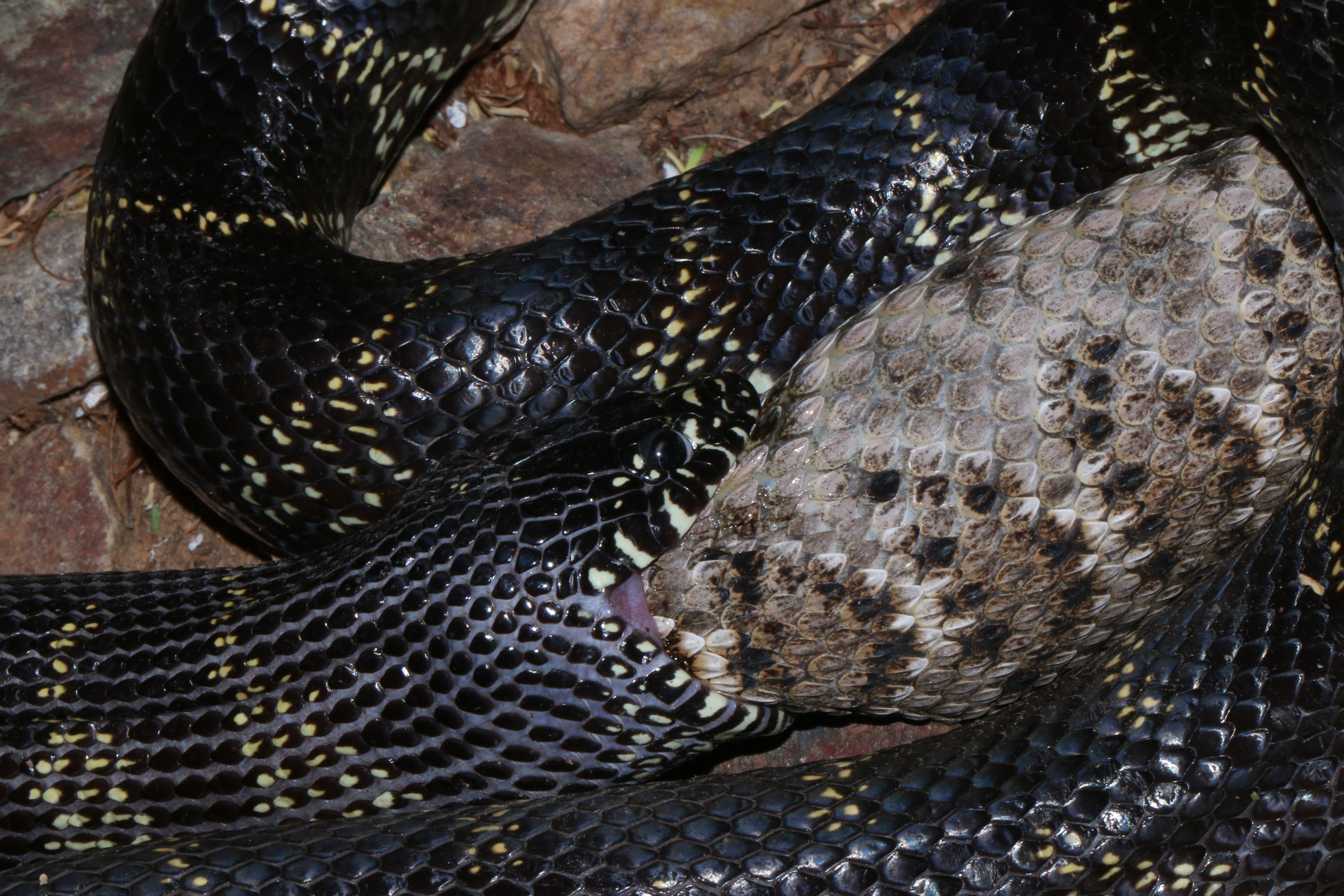

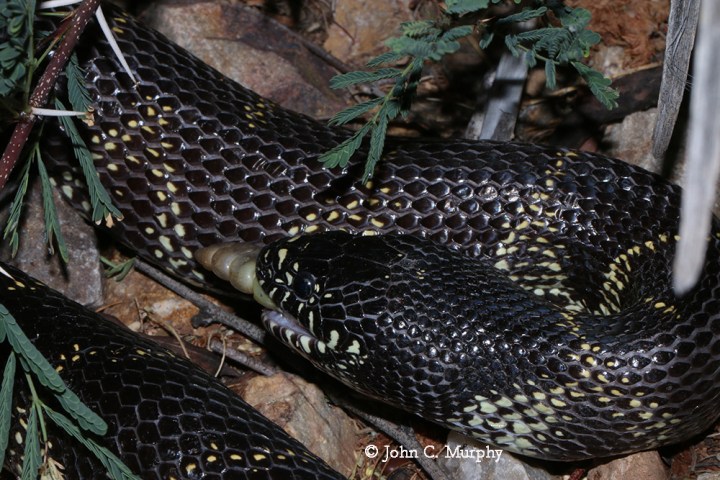
The feeding behavior of kingsnakes preying on rattlesnakes is a well-known example of a predator-prey relationship among snakes. Recently, my neighbor drew my attention to what he believed to be a snake coiled up near a sidewalk. Upon closer examination, I discovered that there were two snakes present. One was a typically patterned Green Valley California Kingsnake (Lampropeltis californiae), while the other was a Western Diamondback Rattlesnake (Crotalus atrox). It was late afternoon on a Sunday, and I spent approximately an hour observing the intense struggle between these two snakes. Finally, after constricting the rattlesnake for about 20 minutes, the kingsnake relaxed and began swallowing the rattlesnake head first until the rattle completely disappeared into its own body. The rattlesnake measured around 25 inches long, while the kingsnake was approximately 32 inches long.


In a study conducted by Wiseman et al. in 2019, the feeding habits of California Kingsnakes (Lampropeltis californiae) were investigated using stomach contents from 2,662 museum specimens, 90 published records, and 92 unpublished observations. These snakes are typically active during the day and display a broad foraging behavior, consuming prey head-first. The analysis of 447 diet items revealed that 29% consisted of mammals, 29% were snakes, 25% were lizards, 11% were birds, 4% were squamate eggs, 1% were unidentified squamates, and 1% were amphibians. No differences in diet were observed based on kingsnake sex or color pattern, indicating the absence of individual specialization. Larger individuals consumed rodents, lizards, and birds more frequently, while predation on mammals, birds, and lizards (but not snakes) showed seasonal restrictions. Kingsnakes from arid regions consumed fewer rodents and lizards but more snakes than those from non-arid regions.
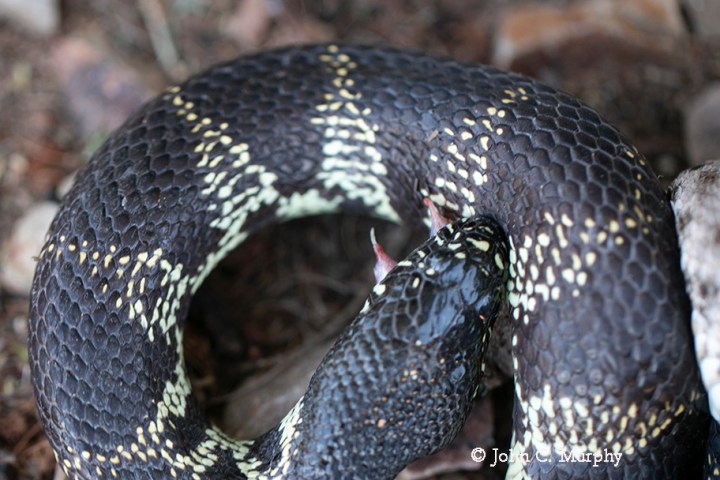
Interestingly, despite rodents and snakes being consumed at similar frequencies, snakes accounted for a substantial portion of the kingsnake’s prey biomass, comprising 45% of the total. Among snakes, rattlesnakes constituted 24% by frequency and 37% by biomass and energy. On average, the mass ratio between predator and prey was 0.24 ± 0.19. Although a positive relationship was observed between prey mass and snake mass, larger snakes also consumed smaller prey items. Despite making up only 7% of the overall diet and 16% of the total biomass and energy value, rattlesnakes were available throughout the active season. They provided a higher payoff per item compared to other prey types. These findings by Wiseman et al. shed light on the paradox of kingsnakes being generalist predators while showing specialization, such as possessing immunity to rattlesnake venom, for rare prey types like rattlesnakes.
Citation
Wiseman KD, Greene HW, Koo MS, Long DJ. 2019. Feeding ecology of a generalist predator, the California kingsnake (Lampropeltis californiae): why rare prey matter. Herpetological Conservation and Biology. 2019 Apr 1;14(1):1-30.