
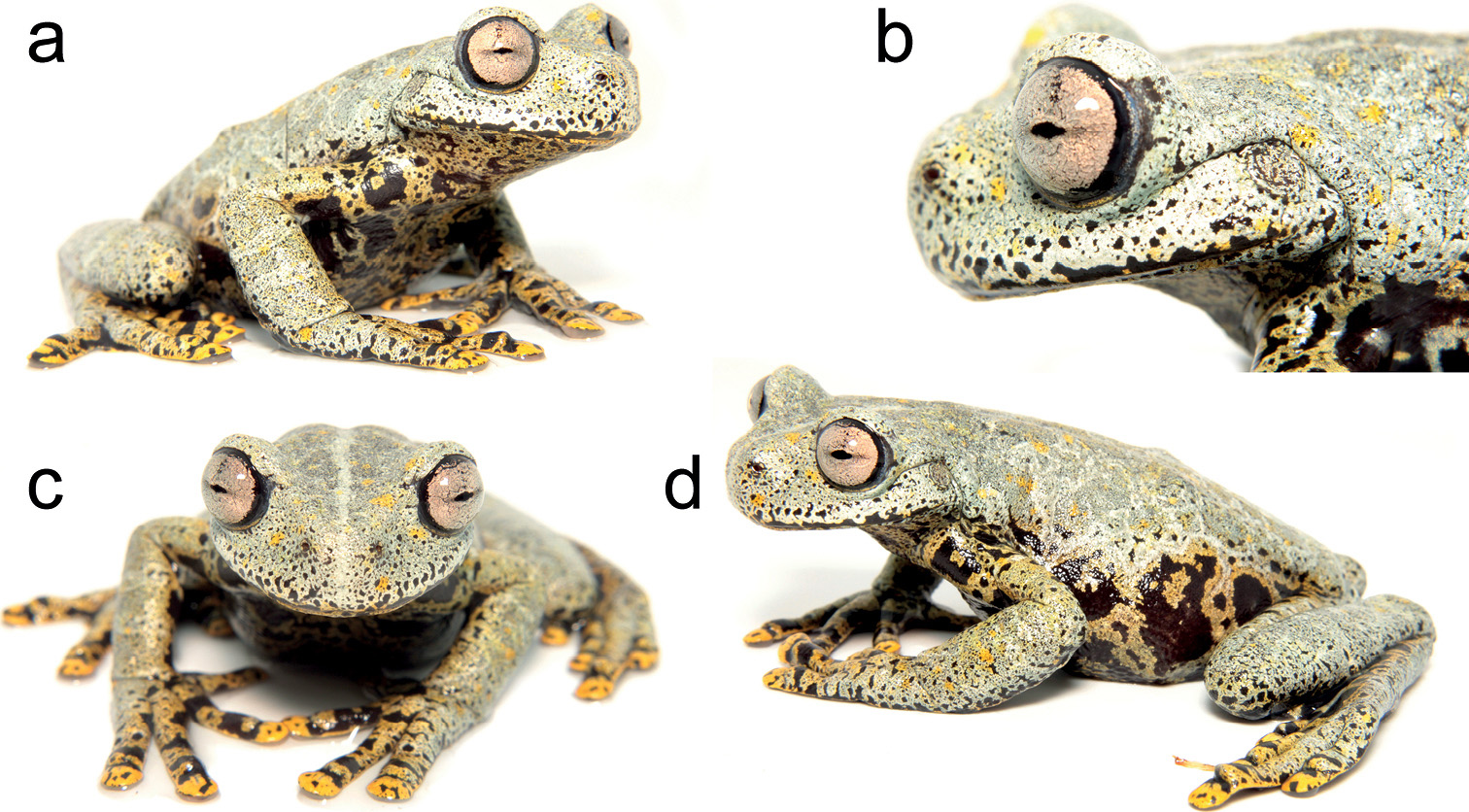

In a paper by Sánchez-Nivicela et al. (2023) they described a spectacular new stream-dwelling hylid from Río Negro-Sopladora National Park. The new species of Hyloscirtus tolkieni is is easily diagnosed from all other congeners by its large body size (64.9 mm SVL in adult female); broad dermal fringes in fingers and toes; prepollex not projected into a prepollical spine and hidden under thenar tubercle. The dorsum is greyish-green, with paler-hued reticulum, yellow spots and black speckles; throat, venter, flanks and hidden surfaces of limbs golden-yellow with large black blotches and spots; fingers, toes and webbing yellow with black bars and spots; iris pale pink with black periphery. It is currently known only from its type locality, in the high montane forest on the southern slopes of the Cordillera Oriental of the Andes, southeastern Ecuador. The new species might be related to the H. larinopygion species group based on its morphology.
The specific epithet tolkieni is in honour of the writer, poet, philologist, and academic John Ronald Reuel Tolkien (J.R.R. Tolkien, 1892–1973), creator of Middle-earth and author of fantasy works like “The Hobbit” and “The Lord of the Rings”. The fantastic colors of the new species evoke the magnificent creatures that seem to only exist in fantasy worlds.
Hyloscirtus tolkieni is only known from its type locality on the southeastern slopes of the Cordillera Oriental of the Andes of Ecuador, at 3190 m elevation, in the Río Negro-Sopladora National Park, province of Morona Santiago. The ecosystem in the area is the High Montane Forest of the Eastern Cordillera of the Southern Andes of Ecuador (MAE et al. 2013). The holotype was active at night at 20:30 amidst tree branches, c. 5 m above ground and 8 m from the nearest stream. It was found in sympatry with an undescribed species of Pristimantis.
And, speaking of Pristimantis. Another paper Ortega et al. (2022) describes six new species of rainfrogs of the genus Pristimantis (Strabomantidae) from Amazonian cloud forests in Ecuador. We also present a phylogeny showing the relationships of the new species. The phylogeny is based on mitochondrial genes 16S rRNA (16S), 12 rRNA (12S), NADH-ubiquinone oxidoreductase chain 1 (ND1) and the nuclear gene recombination-activating 1 (RAG1). We also describe the osteology of two new species using high-resolution x-ray computed tomography. The new species belong to two clades. The first clade is sister to the subgenus Huicundomantis and includes P. tamia sp. nov., P. miktos, and P. mallii. Pristimantis tamia sp. nov. is morphologically similar to P. miktos, P. mallii, P. martiae, and P. incomptus, but differs from them by lacking vocal slits and tympanic membrane and by having light greenish blue iris. Based in the results the authors expand the subgenus Huicundomantis to include the P. miktos species group. The second clade is remarkable by being highly divergent and consisting exclusively of new species: P. anaiae sp. nov., P. glendae sp. nov., P. kunam sp. nov., P. resistencia sp. nov., and P. venegasi sp. nov. The new species resemble P. roni, P. yanezi, P. llanganati, P. katoptroides, P. verecundus, and P. mutabilis . Still, they can be distinguished from them by lacking vocal slits and tympanic membrane and by having large dark round areas with thin clear borders in the sacral region. All six new species occur in the eastern slopes of the Ecuadorian Andes and are known from a single locality in Llanganates or Sangay National Park. Therefore, we recommend assigning all of them to the Data Deficient (DD) Red List category. Based on the high-resolution x-ray tomographies, the authors report structures that appear to be intercalary elements. This would be the first report of such structures in Terrarana.
Citations
Ortega JA, Brito J, Ron SR. 2022. Six new species of Pristimantis (Anura: Strabomantidae) from Llanganates National Park and Sangay National Park in Amazonian cloud forests of Ecuador. PeerJ 10:e13761
Sánchez-Nivicela JC, Falcón-Reibán JM, Cisneros-Heredia DF (2023) A new stream treefrog of the genus Hyloscirtus (Amphibia, Hylidae) from the Río Negro-Sopladora National Park, Ecuador. ZooKeys 1141: 75-92.