

The Union Island Gecko (Gonatodes daudini) is small, beautiful, and in demand in the pet trade
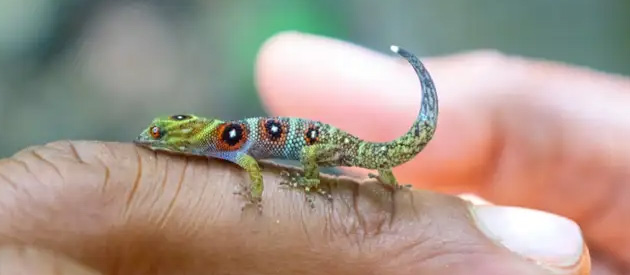
The Union Island gecko (Gonatodes daudini) is found in the Chatham Bay forest on Union Island of the same name in Saint Vincent and the Grenadines. It was described in 2005 by Powell and Henderson and quickly became highly attractive for the illegal international pet trade thanks to its jewel-like markings. It is only three centimeters long, but poaching and trafficking resulted in the decline of the wild population.
The natural gecko population lives in a 50-hectare patch of ancient forest, making them especially vulnerable to human activity. So in 2016, the Saint Vincent and the Grenadines Forest Department and conservation organizations worked with local residents to devise a species recovery plan.
These conservation efforts ranged from the expansion and increased management of protected areas to anti-poaching patrols and round-the-clock camera surveillance by community wardens in the forest. The result, Union Island Gecko numbers have increased from 10,000 in 2018 to 18,000 today.
“As a Unionite and a community leader, I am extremely proud to be a part of this success story,” said Roseman Adams, co-founder of the local Union Island Environmental Alliance, in a statement.
“Saving the Union Island gecko in the wild has been a collaborative effort,” says Jenny Daltry of Fauna and Flora International and Re:wild, two international conservation charities that were part of the work. “The people of Union Island are amazing to work with, and rightly very proud of their unique gecko and their ancient forest.”
The success in protecting the gecko has led the conservation groups to develop a wider initiative that aims to protect other wildlife in Chatham Bay forest, providing sustainable employment and development opportunities for the local community in the process. “Though small, it is chock-full with endangered and endemic animals and plants, and new species are still being uncovered,” says Daltry.
Union Island has a surface of 8.1 km² and has the highest elevation of the Grenadines with 305 m asl and an average annual precipitation of 1.025 mm (Daudin 2003). Howard (1954) describes the habitat where Gonatodes daudini had been found as flat and relatively dry, with secondary vegetation. Forests are open, with low vegetation of 4.5 to 10 meters high. Fiard (2003) describes the species’ habitat in the Water Rock Forest Reserve as “surprisingly lush for a dry island” with tree heights of 15–18 m and Bursera simaruba, Pisonia fragrans, Lonchocarpus violaceus, Albizia caribaea, and Spondias mombin as dominant species.
The small-scale distribution range seems to be limited to the remnants of the original dry highland forest. Powell & Henderson (2005) found the geckos under rotting tree trunks with litter and rocks interspersed on the ground.
References
Daudin, J. (ed.). 2003. A Natural History Monograph of Union Island. Martinique, French West Indies: Désormeaux.
Daudin, J. 2003. The physical environment. In A Natural History Monograph of Union Island, ed. J. Daudin, 37-41. Martinique, French West Indies: Désormeaux.
Fiard, J.-P. 2003. The phytosociologic and dynamic outline of the main forestry groups of Union Island. In A Natural History Monograph of Union Island, ed. J. Daudin, 47-53. Martinique, French West Indies: Désormeaux.
Howard, R. A. 1952. The vegetation of The Grenadines, Windward Islands, British West Indies. Contribution from the Gray Herbarium of Harvard University (174):1-129.
Langner C, Pfau B, Bernardes M, Gerlach U, Hulbert F, van Schingen-Khan M, Schepp U, Arranz C, Riedling M, Kwet A. 2022. Evaluation of the Captive Breeding Potential of Selected Amphibian and Reptile Taxa Included in Appendices I and II at CITES CoP18.
Powell, R. and Henderson, R.W. (2005) Conservation Status of Lesser Antillean reptiles. Iguana, 12, 62-77.
Powell, Robert, and Robert W. Henderson 2005. A new species of Gonatodes (Squamata: Gekkonidae) from the West Indies. Caribbean Journal of Science 41 (4): 709-715.