
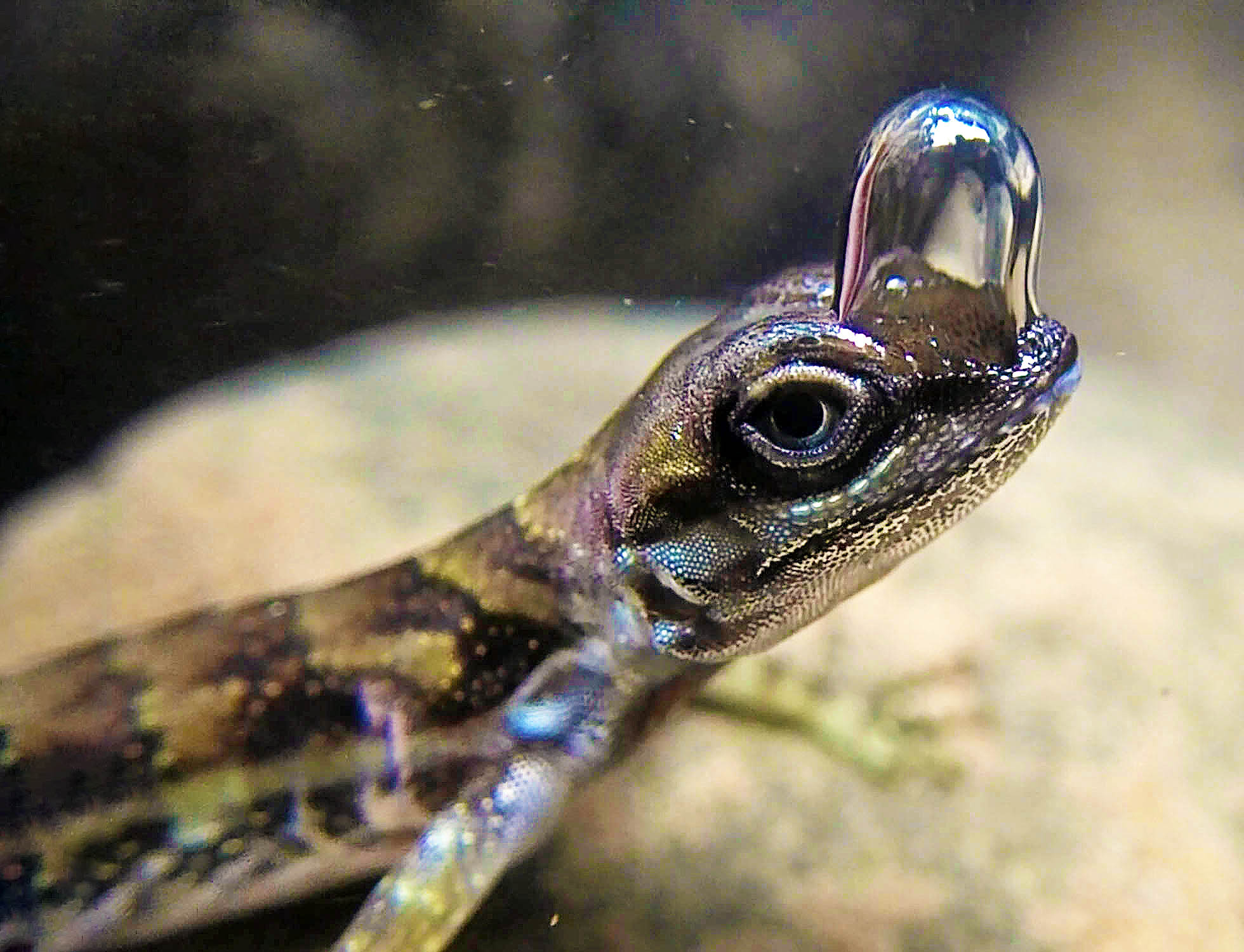

Many small invertebrates utilize bubbles to facilitate underwater respiration, but until recently, there was no evidence that vertebrate animals do the same. Only one group of vertebrates, semi-aquatic Anolis lizards, has evolved the ability to use air trapped in bubbles. These lizards dive underwater when threatened, and while underwater, they rebreathe a bubble of air over their nostrils. Although it seems that rebreathing should be adaptive, possibly functioning to extend the time that lizards remain in underwater refugia, this hypothesis has not been empirically tested.
A 2021 paper (Boccia et al.) found that four species of Anolis use bubbles when underwater. Non-aquatic anoles occasionally rebreathe when submerged but exhibit more rudimentary rebreathing behaviors. Anoles’ rugose skin supports a thin air layer that enables rebreathing upon submergence. The authors propose that the water-repellent skin observed in all the anoles we studied may have enabled these species to develop specialized rebreathing abilities for diving. Phylogenetic analyses strongly suggest that specialized rebreathing is adaptive for semi-aquatic habitat specialists.
In a 2024 paper, Lindsey Swierk, of Binghamton University, State University of New York, demonstrates that rebreathing extends dive time in a semi-aquatic anole, Anolis aquaticus. She prevented the formation of normal rebreathing bubbles by applying a commercial emollient on the skin surface where bubbles form to assess the impact of bubbles on rebreathing cycles, gular pumps, and dive times. Lizards that were allowed to rebreathe typically remained underwater an average of 32% longer than those with impaired rebreathing, suggesting a functional role of rebreathing in underwater respiration. Unlike rebreathing, gular pumping was unaffected by treatment and may warrant further research regarding its role in supplementing underwater respiration. This study provides evidence that vertebrates can use bubbles to respire underwater, raising questions about adaptive mechanisms and potential bio-inspired applications.
“Lizard skin is hydrophobic. Typically, that allows air to stick very tightly to the skin and permits this bubble to form. But when you cover the skin with an emollient, air no longer sticks to the skin surface, so the bubbles can’t form,” said Swierk.
Citations
Boccia CK, Swierk L, Ayala-Varela FP, Boccia J, Borges IL, Estupiñán CA, Martin AM, Martínez-Grimaldo RE, Ovalle S, Senthivasan S, Toyama KS. 2021. Repeated evolution of underwater rebreathing in diving Anolis lizards. Current Biology 12;31(13):2947-54.
Swierk L. Novel rebreathing adaptation extends dive time in a semi-aquatic lizard. Biology Letters. 2024 Sep 18;20(9):20240371.