
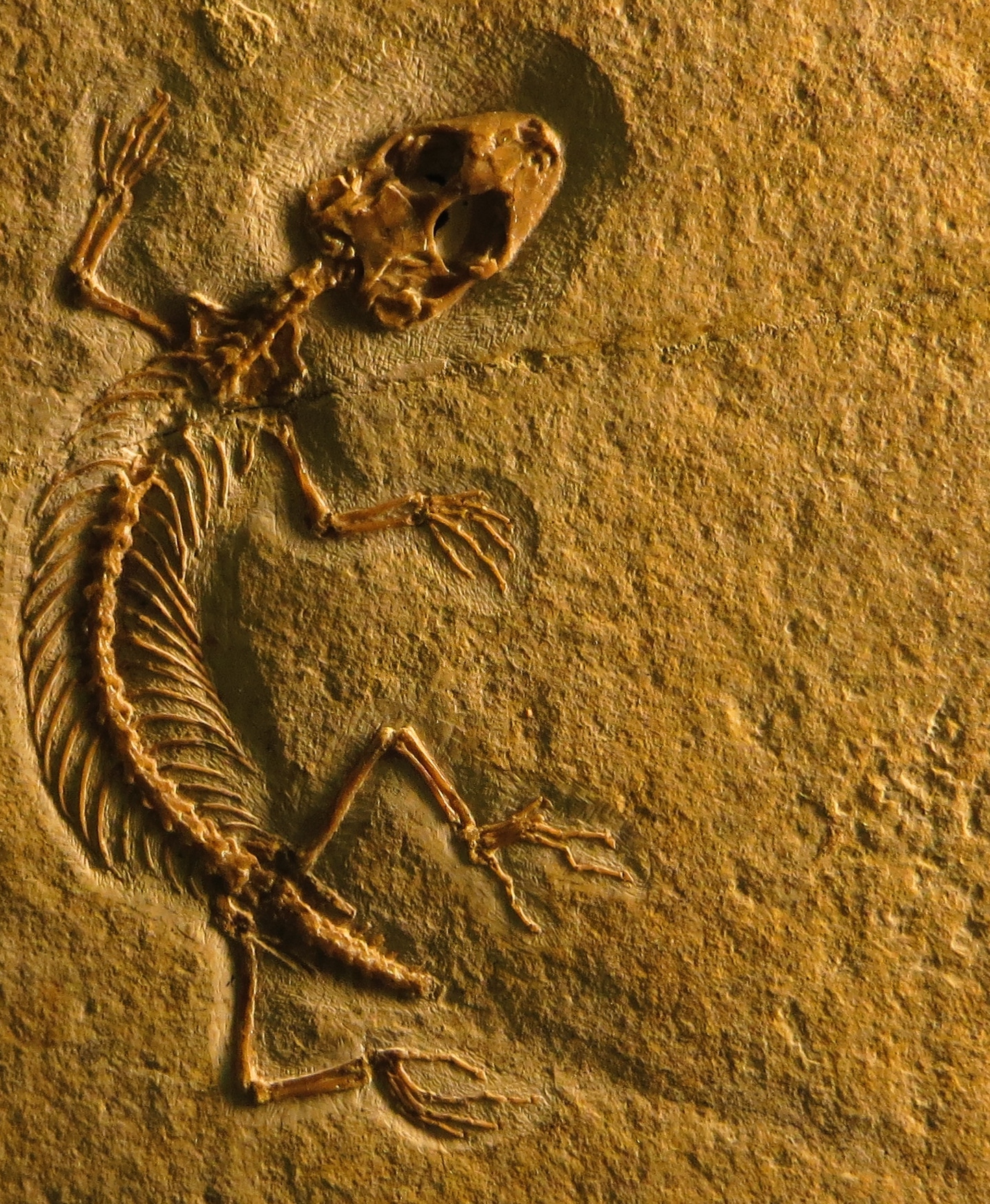

Above. The type specimen of Eichstaettisaurus schroederi. A Jurassic lizard that showed many oof the traits seen in geckos. Photography By Ghedoghedo – Own work, CC BY-SA 4.0, https://commons.wikimedia.org/w/index.php?curid=119376518
New research published in eLife (Bolet et al. 2022) by researchers from the Institut Catala de Paleontologia Miquel Crusafont (ICP) and the University of Bristol (UB) moves back the date of the radiation of squamates, a group of reptiles which includes lizards and snakes to the Jurassic, a long time before current estimates.
The Squamata are key parts of modern terrestrial faunas, especially in warmer climates, with a diversity of more than 10,000 species. However, understanding the evolutionary paths that made them successful are poorly understood.
There is a consensus that all the main squamate groups had arisen prior to the event that wiped out dinosaurs and other groups of reptiles at the end of the Mesozoic era. Before that global catastrophic event, through the Cretaceous, many terrestrial tetrapod groups like mammals, lizards and birds, apparently underwent a great diversification during the Cretaceous Terrestrial Revolution, that was triggered by the rise of flowering plants.
Fossil remains of squamates are rare through the Jurassic suggesting that the main burst of squamate evolution happened in the Cretaceous (between 145 and 66 MYA.), when their fossil record dramatically improves.
Bolet et al. (2022) challenges this view by suggesting a much earlier radiation of squamates. Their research concludes that this group of reptiles probably achieved a diverse array of adaptations in the Jurassic (between 201 -145 MYA.), long before previously thought.
Michael Benton, co-author, said of the research, “Even though Jurassic squamates are rare, reconstructed evolutionary trees show that all the main specializations of squamates evolved then, and it’s possible to distinguish adaptations of geckoes, iguanas, skinks, worm lizards, and snakes some 50 million years earlier than had been thought,”.
But how could the scarce Jurassic fossils suggest an early burst in evolution? The key is in their anatomy. The few Jurassic squamates do not show primitive morphologies as would be expected, but they relate directly to the diverse modern groups. “Instead of finding a suite of generalized lizards on the stem of the squamate tree, what we found in the Jurassic were the first representatives of many modern groups, showing advanced morphological features,” said Arnau Bolet, lead author of the article.
The observed times of divergence, morphospace plots and evolutionary rates, all suggest that the Jurassic was a time of innovation in squamate evolution, during which the bases of the success of the group were established. According to these results, the apparent sudden increase in diversity observed in the Cretaceous could be related to an improved fossil record, capable of recording a larger number of species, or to a burst of origins of new species related to the new kinds of forests and insects.
Establishing the timing and mode of radiation of squamates is key for not only understanding the dynamics of terrestrial ecosystems in the Mesozoic, but also for deciphering how the group achieved an astonishing diversity of more than 10,000 species, only rivalled by birds among tetrapods. (ANI)
Citation
Bolet A, Stubbs TL, Herrera-Flores JA, Benton MJ. The Jurassic rise of squamates as supported by lepidosaur disparity and evolutionary rates. Elife. 2022;11.