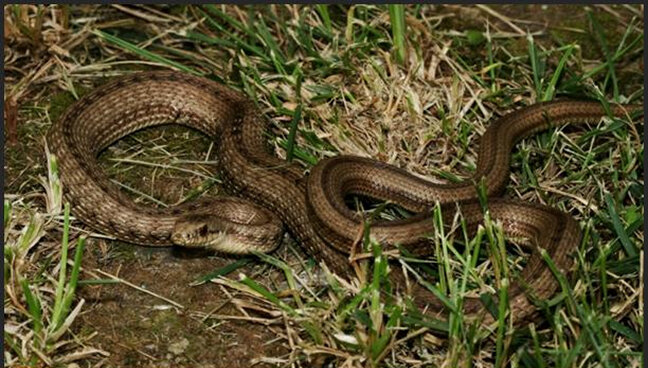
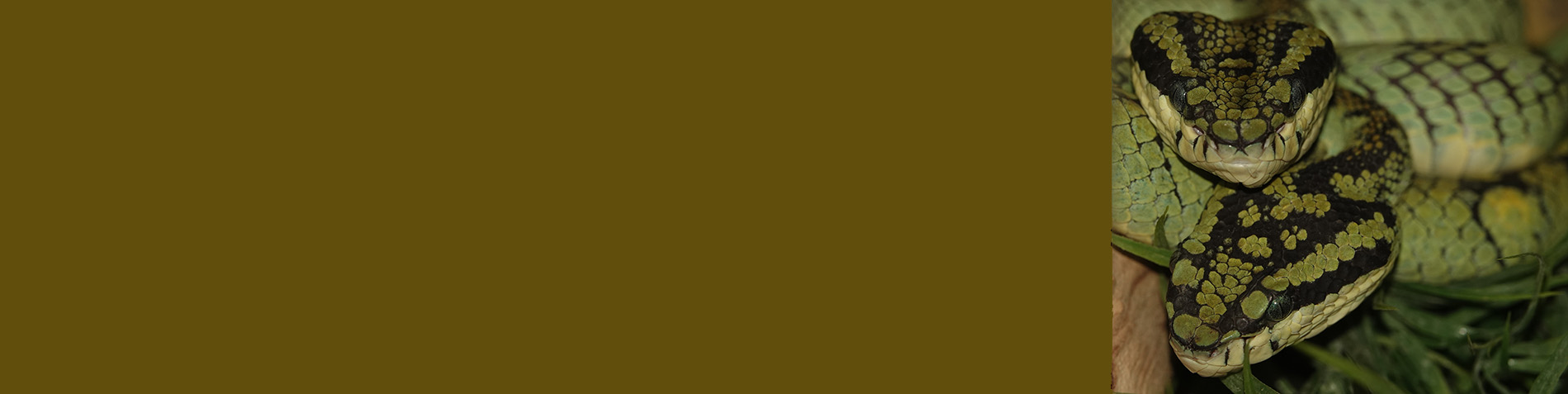
Top. A Thermophis. Below. Map of the currently known distribution of Thermophis baileyi, T. zhaoermii, and T. shangrila. Records are according to and based on survey data. Locations where we did not find Thermophis are included in the map (absence). Hot-spring sites are drawn according to the “Atlas of Tibet.”. Type localities of the three species are imprecise in the original descriptions and cannot be mapped exactly–T. baileyi: “Thibet”; T. shangrila: “Shangri-La, Northern Yunnan, China” but coordinates match Yulong, Lijiang, Yunnan Province, China; T. zaoermii: Litang County, Sichuan, China (probably locality no. 12 according to. The extension of the Hengduan Mountains region (HMR) is roughly reflected by its typical temperate coniferous forests ecoregion .”>
Hot-spring snakes of the genus Thermophis are unique – they are one of the few eastern hemisphere members of the family Dipsasidae – all of the others reside in the western hemisphere, and they are the only snakes that live at elevations up to 4900 m ASL. Living in such extreme habitats requires physical and behavioral adaptations to cope with the high, cold, and arid environments.
In a recent paper, Hoffman et al. (2021) examine the distribution of the three species of Thermophis and find that they are restricted to geothermal sites on the Tibetan Plateau (T. baileyi) and in the Hengduan Mountains (T. zhaoermii, T. shangrila). Although the suture zones of these regions are widely covered with hot springs, Thermophis populations are restricted to only a few of these habitats. Hoffman et al. use bioclimatic, topographic, and land cover data to model the potential distribution of the genus. Moreover, using logistic regression on field survey data for T. zhaoermii, they test whether hot-spring water parameters and landscape features correlate with the species’ presence or absence. Hot springs with temperatures between 45 and 100 ◦C and winter precipitation showed the most predictive power.
The estimated divergence time (MRCA for Thermophis and xenodontine snakes (Dipsadidae) was ~10–28 MYA); thus, this genus’ ancestral lineages may have been present in the area of Paleo-Tibet long before the final uplift of the Plateau. With the continuously rising Himalaya-Tibet orogen and the associated cooling of the environment, these ancestors were probably forced to retreat into geothermal active areas or, otherwise, would have gone extinct. At least some of the hot-spring sites have served as refuges for the snakes during the Pleistocene.
The rare hot-spring snakes Thermophis zhaoermii, and T. shangrila, are geographically separated from their sister species, the Tibetan hot-spring snake T. baileyi. However, all species share a strong association with geothermal sites in high elevation areas and, thus, also a severe threat from habitat destruction due to the construction of geothermal power stations or other commercial establishments at the hot springs.
Compared with the Tibetan Plateau where hot springs are more sparsely distributed, the Hengduan Mountains are densely covered with hot springs. Surprisingly, the distribution of T. zhaoermii and T. shangrila is virtually unknown for the Hengduan Mountains and adjacent mountain ranges, despite multiple herpetological field surveys that have been carried out in these regions.
Today, Thermophis cover the southern central region of the Tibetan Plateau along the Yarlung suture zone and the central range of the Hengduan Mountains (Chola Shan, Shaluli Shan). The fact that only these relatively narrow areas are predicted to be suitable, and host recorded presence localities suggest that the potential distribution of the species might not be much more comprehensive than our current records indicate. The distribution map for the genus provides details on hot-spring localities with a high probability of the species’ presence, which could guide future surveys and conservation activities. It also indicates that the current distribution of these snakes depends on the amount of winter precipitation and springs with water above 45 degrees C.
According to the IUCN Red List, T. baileyi is considered as “near threatened”, while T. zhaoermii as “endangered”; T. shangrila is not even registered in the IUCN red list. Both T. baileyi and T. zhaoermii are flagged with a decreasing population trend, and their presence in any protected areas is unknown. Given the geographic distribution maps in the most recent status assessment for the IUCN Red List, our predicted potential distribution of Thermophis differs substantially from these data. However, despite their exceptional value for biodiversity, no specific conservation action plans exist for the hot-spring snakes.
Citation
Hofmann S, Fritzsche P, Dorge T, Miehe G, Nothnagel M. 2021. What Makes a Hot-Spring Habitat “Hot” for the Hot-Spring Snake: Distributional Data and Niche Modelling for the Genus Thermophis (Serpentes, Colubridae), Diversity 13(7):325.