
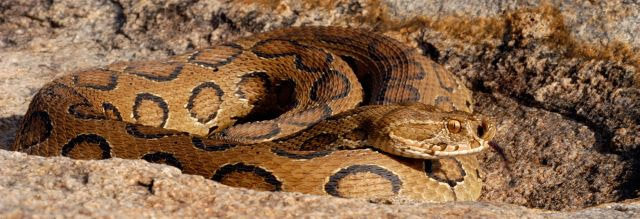

Russell’s Viper was first described in The Naturalist’s Miscellany: Or, Coloured Figures Of Natural Objects; Drawn and Described Immediately From Nature by English naturalist George Shaw and illustrator Frederick P. Nodder described the species in 1797 as Coluber russelii, from a specimen presented to the British Museum by Scottish herpetologist Patrick Russell. Russell had written of this species in 1796 in his An account of Indian serpents, collected on the coast of Coromandel, confirming its highly venomous nature by experimenting on chickens and dogs.
Glaudas (2021) has published the results of a study that radio tracked this snake in the tropical rural villages of Rathnapuri and Chowdikatte, in the Mysore District in the state of Karnataka. Russell’s vipers (Daboia russelii), are one of the most medically important snakes in the world, and Glaudas quantified the proximity between the snake and people and estimate human susceptibility to snakebite envenoming in India. He observed people ≤50 m of a radio-equipped viper in ~17% of 2,066 snake relocations. People were more frequently observed in proximity to Russell’s vipers in January and July compared to March, but all other contrasts were statistically similar. This pattern suggests that snakebite incidence, which peaks in summer in the study area, is not particularly linked to the encounter frequency between people and vipers. However, consistent with epidemiological data plantation workers were the most at-risk part of the population. By integrating information about the locations of humans and snakes in space and time, this pioneering research highlights the need to include snake ecology into the study of the human–venomous-snake conflict and provides a model approach to help mitigate the burden caused by venomous snakes in the rural Tropics.
Citation