
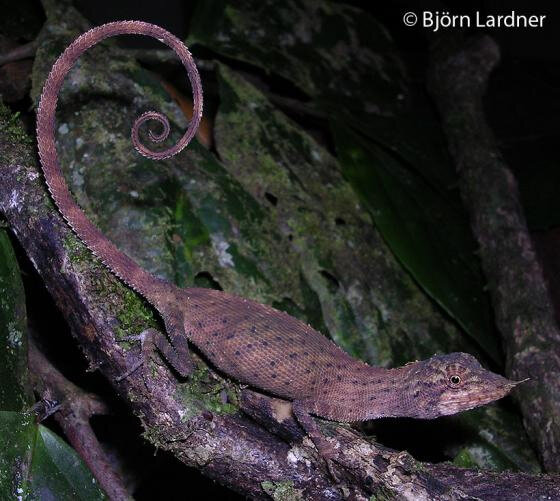

Since Robert Mertens described Harpesaurus borneensis in 1924, it has been not easy to find. The type locality is in central Borneo (Kalimantan), and the species is known from four localities, Sarawak and Kalimantan. In a new paper, Kurita et al. (2020) provide insights into this unusual agamid lizard. The arboreal species moves slowly and deliberately, making it cryptic to predators and its viviparous. An ancestral state reconstruction suggests that a shift to an arboreal lifestyle preceded the evolution of viviparity. Harpesaurus is a member of the agamid subfamily Draconinae, and their phylogenetic analyses, support the monophyly of Southeast-Asian draconine genera, Aphaniotis, Coryphophylax, Bronchocele, Gonocephalus, and Harpesaurus, was supported (95/1.00). Harpesaurus borneensis was recovered as the sister to all the other Southeast-Asian genera (kept at 78/1.00). These five genera, the Sundaland group, formed a monophyletic group with the Sri Lankan endemic genera, Ceratophora, Cophotis, and Lyriocephalus .
Citation
Kurita T, Kojima Y, Hossman MY, Nishikawa K. Phylogenetic position of a bizarre lizard Harpesaurus implies the co-evolution between arboreality, locomotion, and reproductive mode in Draconinae (Squamata: Agamidae). Systematics and Biodiversity. 2020 Aug 8;18(7):675-87.