

Niche partitioning is a concept at the heart of understanding biodiversity. The concept refers to the process by which natural selection drives competing species into different patterns of resource use in various niches. Two recent papers by Westeen et al. (2023a, b) look at several species of spiny lizards (genus Sceloporus) in the Chiricahua sky islands of southern Arizona.
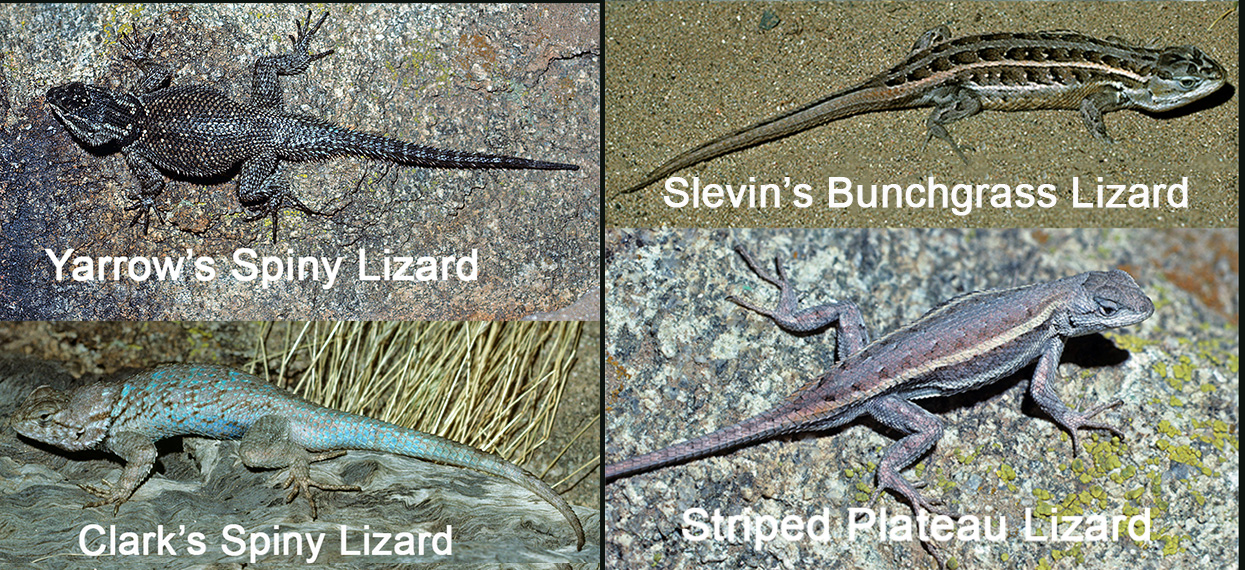
Westeen et al. (2023b) used DNA metabarcoding to investigate the dietary preferences of three closely related lizard species inhabiting the Madrean Sky Islands region in southeastern Arizona. These species include the Striped Plateau Lizard (Sceloporus virgatus), a small-to-medium-sized lizard that occupies a variety of perches, such as small rocks, logs, and even ground habitats. Slevin’s Bunchgrass Lizard (Sceloporus slevini) is also small-bodied, with a more elongated body shape and reduced limbs than the Striped Plateau Lizard. It primarily dwells within bunchgrass habitats. While these two species occupy distinct niches, they share some spatial and ecomorphological overlap in this ecosystem.
Yarrow’s Spiny Lizard (Sceloporus. jarrovii) is a medium-to-large lizard that predominantly inhabits rocky areas and occasionally ventures into trees. It coexists with the two smaller species but maintains a unique microhabitat and temporal niche compared to the Bunchgrass Lizard. It does share some spatial and temporal overlap with the Striped Plateau Lizard. The Striped Plateau Lizard and Yarrow’s Spiny Lizard are both sit-and-wait predators. At the same time, the foraging behavior of the Bunchgrass Lizard, which prefers bunchgrass clusters, is presumed to follow a similar sit-and-wait predation strategy, given their shyness and habitat specificity.
Given the differences in how these species use their habitat in terms of space and time and their sedentary predation habits, the authors anticipated observing interspecific dietary niche partitioning. More specifically, they expect the Slevin’s Bunchgrass Lizard to exhibit a narrower dietary niche due to its high specialization for a specific habitat. It is likely to share a more significant dietary overlap with Striped Plateau Lizard, another small-bodied ground-dweller, than with S. jarrovii. To explore these predictions, we collected fecal samples from 228 lizards across the Chiricahua Mountains and Appleton-Whittell Research Ranch in Arizona, USA. The authors aim to understand how diet composition varies among these three species and within populations of each species. Through this analysis, we aim to quantify both intraspecific and interspecific dietary niche breadth and identify the degree of dietary overlap, shedding light on how these lizards utilize this crucial resource axis and how dietary niche partitioning may influence species interactions in their coexistence.
Many aspects of a lizard’s ecology—including habitat preferences, foraging modes, predation risks, interspecific competition, and thermal constraints—interact to shape diets, and dietary niche partitioning simultaneously contributes to community co-occurrence. Westeen et al.(2023b) used DNA metabarcoding of fecal samples to identify prey items in the diets of three sympatric Sceloporus lizards – Clark’s Spiny Lizard, Sceloporus clarkii; Yarrow’s Spiny Lizard, the Slevin’s Bunchgrass Lizard; and the Plateau Lizard. The authors found evidence for dietary niche partitioning between interacting species concomitant with their respective ecologies. The authors also compared diet composition between populations to understand how conserved or plastic species’ diets are between different environments. Our findings suggest that habitat generalists are also diet generalists in this system, while the same may be true for specialists. Identifying prey items to much lower taxonomic levels than previously documented further reveals hidden diversity in the diets of these species. It underscores the utility of metabarcoding for understanding the full complexity of lizard diets.
The Sceloporus lizards in the Chiricahua Mountains have survived historical climate warming that drove lowland populations between the Madrean Sky Islands and their core range in the Sierra Madre Occidental to extinction. The Chiricahua Mountains are, thus, at or near the northern extent of the ranges of Clark’s Spiny Lizard, Yarrow’s Spiny Lizard, the Slevin’s Bunchgrass Lizard, and there is evidence that the Chiricahua populations of these three species are genetically distinct from other populations. Given the isolated nature of the Sceloporus species in the Chiricahua Mountains relative to other parts of their ranges, the authors expect community dynamics in this system to play out much as they would on an oceanic island. They conducted a field study over three consecutive seasons to determine if and how the sympatric Sceloporus lizards partition niche space along key resource axes in this system.
Closely related species should be more similar and, therefore, more likely to compete for resources. Yet, many examples of species-rich congeneric communities are present in nature. To avoid competition, many species possess suites of traits associated with differential resource use – or ecomorphologies – that promote niche differentiation with co-occurring species. Yet, most systems are still poorly understood the axes through which niche partitioning evolves and the traits involved in island systems, in which species interactions can form strong forces of selection due to limited resources, provide valuable insights into how ecomorphological diversity contributes to coexistence. Westeen et al. (2023a) examined axes of resource use and morphological traits that facilitate niche partitioning in a community of spiny lizards (genus Sceloporus) in a sky island system, the Chiricahua Mountains of southeastern Arizona. By quantifying structural, temporal and thermal niche use for over 300 co-occurring lizards from the four species over three field seasons, they show that sympatric species diverge primarily in perch height and type, but also in thermal and temporal resource use.
Westeen et al. obtained compelling evidence of perch height partitioning among species across all sites. In the Madrean oak woodland, there were significant differences in perch height among species. Clark’s Spiny Lizard and Yarrow’s Spiny Lizard perch higher off the ground than the Striped Plateau Lizard. Interestingly, the two larger species, Yarrow’s Spiny Lizard and Clark’s Spiny Lizard, showed no evidence of perch height partitioning based on sex, within or between species.
Additionally, the authors uncovered evidence of thermal niche partitioning. In the montane conifer forest, the Striped Plateau Lizard used significantly cooler perches than Yarrow’s Spiny Lizard. However, the authors did not identify significant differences in thermal sensitivity at other study sites.
On a temporal axis, Clark’s Spiny Lizard exhibited earlier activity than Yarrow’s Spiny Lizard and the Striped Plateau Lizard in the Madrean oak woodland. In the montane conifer forest, the Bunchgrass Lizard was active later in the day than Yarrow’s Spiny Lizard. Conversely, the authors did not detect a significant difference in activity time between Yarrow’s Spiny Lizard and the Slevin’s Striped Plateau Lizard in the Madrean pine-oak habitat.
Furthermore, Westeen et al. identified several statistically significant relationships between species and their chosen substrate types, particularly for Yarrow’s Spiny Lizard and the Slevin’s Bunchgrass Lizard. In the Madrean oak woodland, Yarrow’s Spiny Lizard exhibited a significantly higher likelihood of perching on rocks than other substrates. In the Madrean pine-oak habitat, Yarrow’s Spiny Lizard tended to use rocks more frequently than any other substrate; however, since rocks were also the most widely available substrate, this difference was not statistically significant. In the montane conifer forest, where logs were more abundant, and rocks were scarce (please note that talus slopes were not surveyed), Yarrow’s Spiny Lizard strongly preferred using logs for perching than on the ground. On the other hand, the Plateau Lizard exhibited no preference in the Madrean oak woodland but, in the Madrean pine-oak habitat, showed a preference for perching on small rocks compared to the ground, logs, or trees. Although Clark’s Spiny Lizard was most frequently observed in trees, there was no significant difference between perch types. The Slevin’s Bunchgrass Lizard strongly preferred bunchgrass over other substrates, including the ground (non-bunchgrass), logs, and rocks.
Across sites, Yarrow’s Spiny Lizard, which was present at all three sites, maintained consistent perch height and thermal sensitivity. The only difference observed for this species between sites was in activity time, with lizards in the pine-oak habitat being active later in the day compared to the oak woodland or montane conifer forest. The Striped Plateau Lizard exhibited consistent thermal sensitivity between the two sites where it was found, but it perched higher, and its activity was earlier in the day in the oak woodland compared to the pine-oak forest.
Citations
Westeen EP, Martínez-Fonseca JG, Chen H, Wang IJ. 2023a. Phenotypic diversity facilitates niche partitioning in a sky Island assemblage of spiny lizards. Biological Journal of the Linnean Society. 2023 Aug 9:blad077.
Westeen EP, Martínez‐Fonseca JG, d’Orgeix CA, Walker FM, Sanchez DE, Wang IJ. 2023b. Dietary niche partitioning of three Sky Island Sceloporus lizards as revealed through DNA metabarcoding. Ecology and Evolution. 2023 Sep;13(9):e10461.