
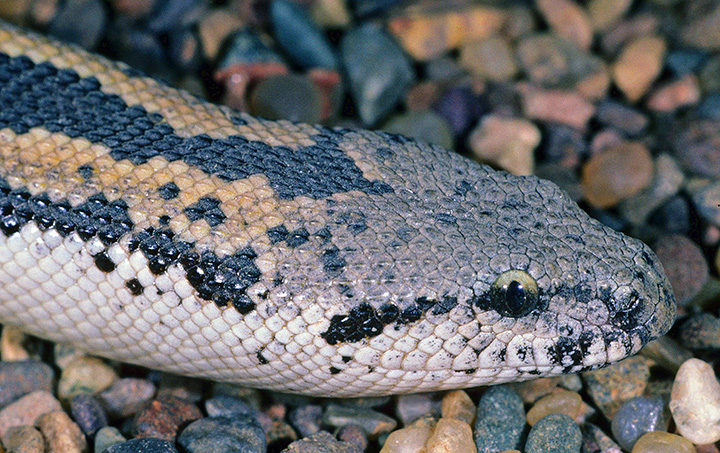

Sand boas of the Eryx (family Erycidae) are a group of stout terrestrial snakes with rather short, stubby tails and specialized shovel-shaped snouts suited to their burrowing lifestyle. Recent molecular phylogenetic studies, found the family Erycidae contains only one monotypic genus, Eryx. Members of this clade inhabit desert and steppe habitats where they feed on small vertebrates, such as rodents, lizards, and birds.
Extant species of Eryx are widely distributed across the Old World, mainly in central and western Asia (e.g., E. elegans, E. jayakari, E. johnii, E. miliaris, and E. conicus) and Africa (e.g., E. mulleri and E. colubrinus). Eryx jaculus occupies the widest known geographic range, including Asia, Europe, and Africa .
In recent decades, only one species, E. miliaris has been recorded in northwestern China, in the area north of the Yellow River, provinces of Inner Mongolia, Ningxia, Gansu, and Xinjiang.
Published studies on the phylogenetic relationships of erycines have been mainly based on morphological or molecular data and they revised the taxonomic relationships within the family Erycidae. Some of those changes include recognizing E. tataricus as a junior synonym of E. miliaris and describing a new species, E. sistanensis. As Reynolds et al. (2014) discussed, the Eryx sand boas display interesting biogeographic patterns, and previous molecular phylogenetic studies hypothesized at least two dispersal events between Africa and Asia. However, the divergence dates within this clade have not yet been estimated because of some phylogenetic uncertainty, poor knowledge of their temporal distribution, and the near absence of total-evidence phylogenetic studies, including fossil data. The fossil records of extinct erycines (Eryx sensu lato) are quite rich throughout the Cenozoic Old World, including Falseryx and Paleryx from the Late Eocene of Egypt and England, Bransateryx from the Middle/Late Pliocene (MN 15/16) of Spain and Oligocene of Germany (Szyndlar, 1994), Albaneryx from the Middle Miocene of France, unidentified erycine from Late Miocene Athens, Greece (Georgalis, 2019), and Cadurceryx from the Eocene of France and England. Note that recent studies suggested excluding Flaseryx and Paleryx from “erycine” snakes.
The earliest fossil record of Eryx sensu stricto is based on the well-preserved trunk and caudal vertebra from the Ayakoz locality in Kazakhstan with their age correlated as Neogene Mammal Zone MN 4 to MN 5 (late Early Miocene, Malakhov, 2005). Recently, that correlation was shifted to the earliest Miocene (Aquitanian; MN 1–2, Vasilyan et al., 2017).
In a new Paper Shi et al. (2023) describe the partial skeleton of a fossil snake from the Upper Miocene “Liushu” Formation of the Linxia Basin, Gansu Province, in the northeastern Tibetan Plateau of China. The fossil comprises the rarely preserved palatomaxillary arch, and a series of vertebrae. The fossil represents a new species of erycine sand boa, Eryx linxiaensis; and is the first record of the superfamily Booidea in China. A phylogenetic analysis of osteological, ecological, and molecular data places this new species within the crown clade Eryx; and it is the sister species to the African E. colubrinus. An average divergence time is estimated at ~8.1 Ma. for the new species. The fossil species differs from the congeneric species by the combination of a series of morphological characters Vertebral measurements against the body size of extant specimens, using an allometric model, provide an estimated minimum snout-vent length of about 571 mm and a total body length of about 694 mm. Estimated species divergence times across the phylogenetic tree support intercontinental dispersal and overall radiation of the clade through the Miocene. There evolution is likely tied to increased aridification during parts of the Miocene. The analysis also suggests that the Eryx crown clade evolved in Africa with at least three intercontinental dispersal events between African and Eurasian continents during the Miocene and with rapid species diversification during the Middle and Late Miocene.
Citation
Shi J, Li Q, Stidham TA, Zhang C, Jiangzuo Q, Chen M, Ni X. Evolutionary and biogeographic implications of an Erycine snake (Serpentes, Erycidae, Eryx) from the Upper Miocene Linxia Basin, Gansu Province, China. Palaeogeography, Palaeoclimatology, Palaeoecology. 2023 Mar 10:111491.