
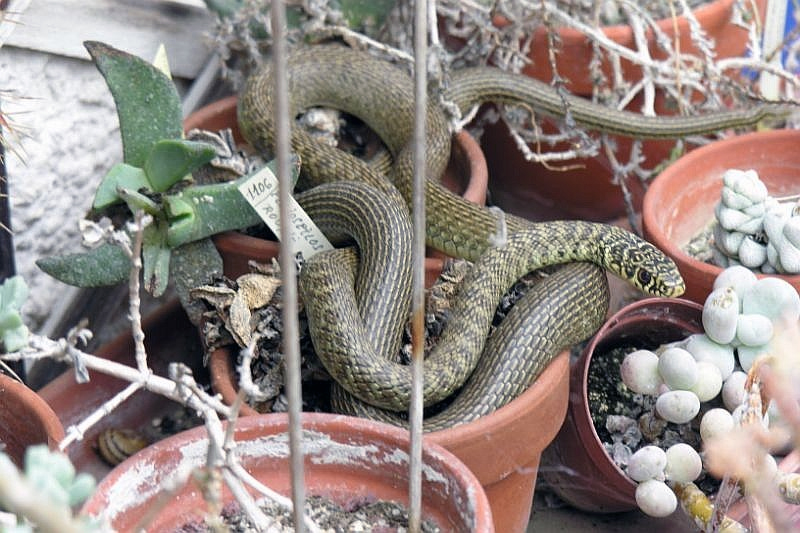

The photo above is a Green whipsnake, Hierophis viridiflavus, in Gradignan Gironde, France. Gradignan Gironde, France. Photography by Jean-Jacques Milan.
As if we needed confirmation, that snakes can do significant damage to ecosystems when they are transplanted to new environments, environments in which they did not evolve. Mondino et al. (2022) examined the diet of the Green Whip Snake in its non-native habitat, in Canton of Vaud (Switzerland). Using next-generation sequencing of DNA from the gut of 94 specimens found as much as 20% the Green Whipsnake diet was composed of threatened taxa and included the Asp Viper (Viper aspis), the Aesculapian Snake (Zamensis longissimus), and the Western Green Lizard, Lacerta bilineata. An extermination program was implemented in 2016 to reduce the whip snake’s expansion. However, it may have been too late. The whipsnake has expanded into the range of the Aesculapian Snake, and appears to have reduced their numbers.
Citation
Mondino A, Crovadore J, Lefort F, Ursenbacher S. 2022. Impact of invading species on biodiversity. Global Ecology and Conservation 38 (2022) e02239