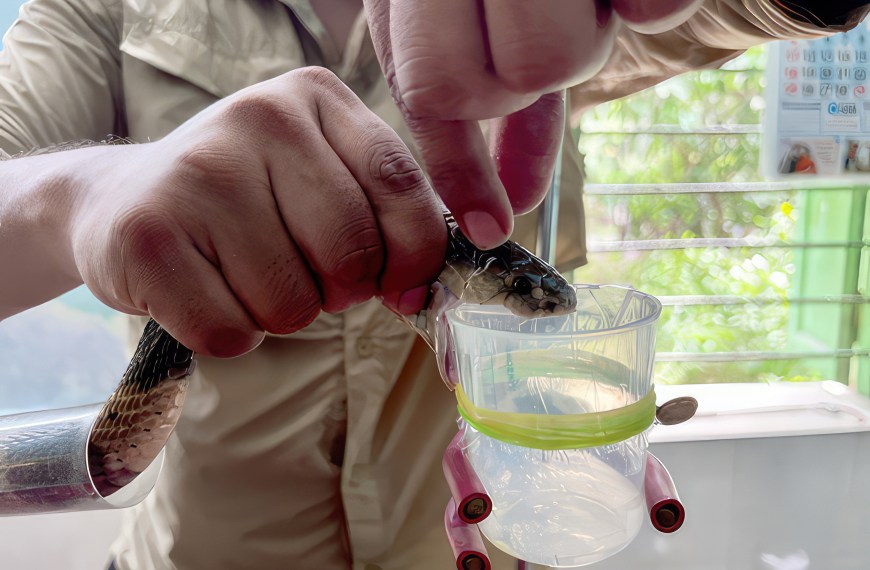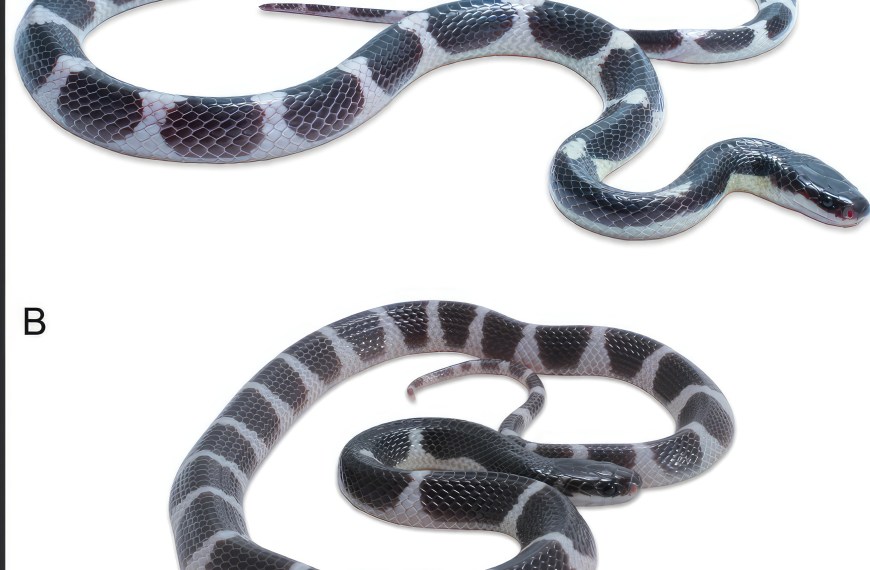

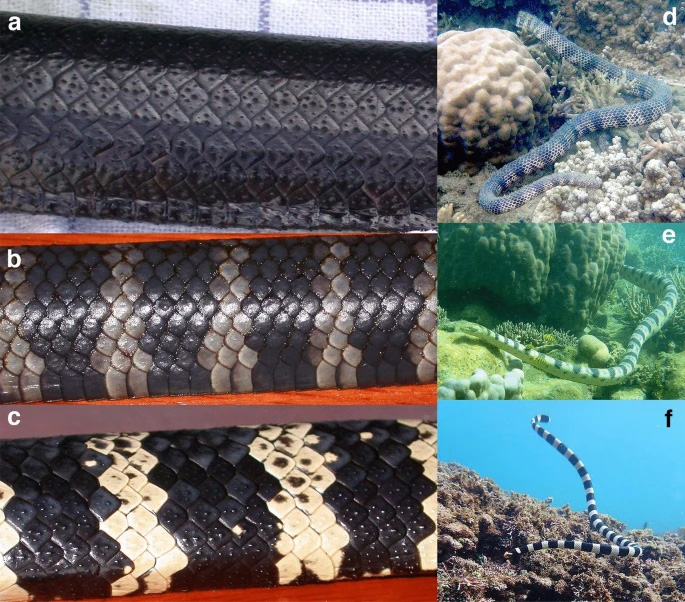

Image above. Photographs of colour morphs in turtle-headed sea snakes, Emydocephalus annulatus, and putative models that may be mimicked by the banded morphs. Left-hand panels show (a) melanic, (b) intermediate, and (c) black-and-white banded specimens of E. annulatus. Right-hand panels show the putative models for banded morphs (d) Aipysurus duboisii, (e) Hydrophis major, and (f) Laticauda saintgironsi. Photographs by R. Shine except for H. major and L. saintgironsi (C. Goiran).
Turtle-headed Sea Snakes (Emydocephalus annulatus) are medium-sized marine snakes that attain 800 mm snout-vent length that are entirely aquatic. Adult females produce a litter of about two large offspring (300 mm SVL) on an approximately biennial cycle, usually in May–June. Courtship and mating occur in the cooler months (June–August), with ovulation in spring (September–October) followed by a long gestation. Both sexes mature at about 500 mm SVL, and at two to three years of age. The diet of this species are the eggs of demersal-spawning fishes and has dramatically changed the feeding apparatus. Fang size is greatly reduced as are the venom glands, venom toxicity, and the ability to widely gape the mouth. Thus, unlike almost all other sea snakes, this species is essentially non-venomous.
Evolutionary theory suggests that polymorphic traits can be maintained within a single population only under specific conditions, such as negative frequency-dependent selection or heterozygote advantage. The non-venomous turtle-headed sea snakes (Emydocephalus annulatus) living in shallow bays near Noumea, New Caledonia exhibit three color morphs: black, black-and-white banded, and an intermediate (grey-banded) morph that darkens with age. The authors recorded morph frequencies during 18 consecutive years of surveys, and found that the numbers of recruits (neonates plus immigrants) belonging to each morph increased in years when that morph was unusually rare in the population, and decreased when that morph was unusually common. Thus, the morph frequencies are maintained by negative frequency-dependent selection. They interpret the situation as the result of Batesian mimicry of highly venomous sea snakes (Aipysurus, Hydrophis, Laticauda) that occur in the same bays, and range in color from black-and-white banded to grey-banded. Consistent with the idea that mimicry may protect snakes from attack by large fish and sea eagles, behavioral studies have shown that smaller fish species in these bays flee from banded snakes but attack black individuals. As predicted by theory, mimetic (banded) morphs are less common than the cryptically-colored melanic morph.
Citation
Shine R, Brown GP, Goiran C. 2022. Frequency-dependent Batesian mimicry maintains colour polymorphism in a sea snake population. Scientific Reports 18;12(1):1-9.