

The Press Story from the BBC says,
This is the largest marine turtle ever found in Europe!
It’s called Leviathanochelys aenigmatica, and researchers say it could grow to be as big as a small car (up to 4m).
You won’t be coming across it any time soon if you have a dip in the sea though – this creature lived on earth around 83 million years ago, around the same time as the velociraptor.
It’s the second largest turtle fossil ever found on Earth.
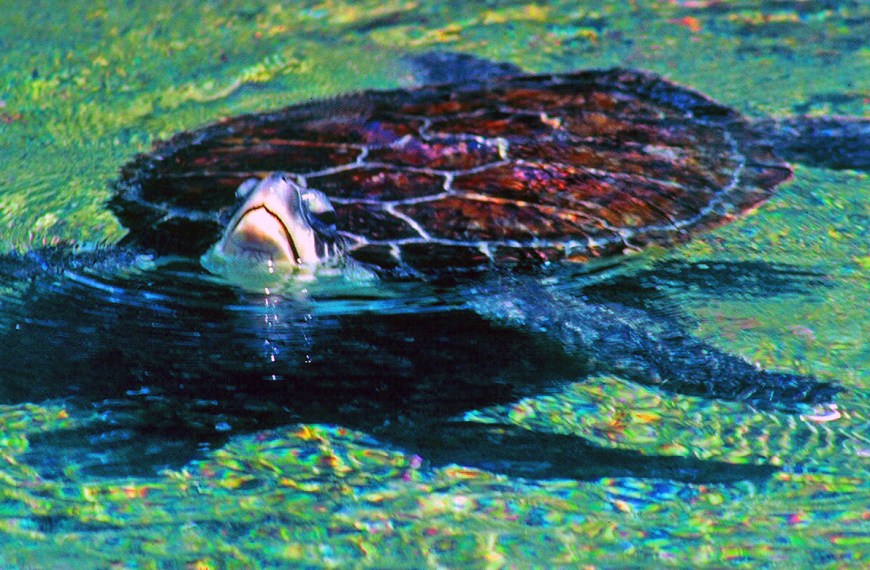
The largest turtle that exists now is the Leatherback, which can reach up to 2 meters in length.
But in the Cretaceous Period, turtles as big as Leviathanochelys aenigmatica roamed the seas.
Scientists say these prehistoric turtles were so big because their predators were even bigger!
Their biggest threat came from mosasaurs which were huge marine reptiles with a big powerful jaw and other animals like sharks.
While previous fossils of ancient turtle species can be linked to species we still have around today, researchers think Leviathanochelys aenigmatica is a new lineage.
That’s because the shape of its pelvis is something scientists haven’t seen in the turtle family.
Researchers think it was likely to allow them to spend lots of time in the depths of the water.
It’s not the biggest turtle fossil ever found though – the largest turtle on record is the Archelon which would fetch up to 4.6m in length.
The Abstract from the paper in Science Reports, says…
Abstract. Marine turtles were common in the subtropical Upper Cretaceous epi-continental seas that once washed the coasts of the ancient European archipelago. But unlike its contemporaneous faunas from North America, in Europe no taxon surpassed the 1.5 m shell-length. Here, the remains of a new large marine turtle, Leviathanochelys aenigmatica gen. et sp. nov., from the Middle Campanian of the Southern Pyrenees are described. Anatomical and histological evidence concur in identifying the specimen as a basal chelonioid. The new taxon autapomorphically differs from other marine turtles by possessing an additional process on the anteromedial side of the pelvis, and an acetabulum directed strongly ventrally. Based on the pelvis size, it is likely that Leviathanochelys was as large as Archelon, thus becoming one of the largest marine turtles found to ever exist. The large body size of the new taxon could have evolved as a response to the unique habitat conditions of the European Cretaceous archipelago seas. The presence of the accessory pubic process further suggests the occurrence of an additional insertion point of the Musculus rectus abdominis, which together with the paleohistologic evidences support the hypothesis that the new taxon had an open marine pelagic lifestyle.
Citation: Castillo-Visa O, Luján ÀH, Galobart À, Sellés A. 2022. A gigantic bizarre marine turtle (Testudines: Chelonioidea) from the Middle Campanian (Late Cretaceous) of South-western Europe. Scientific Reports 12(1):1-0.