
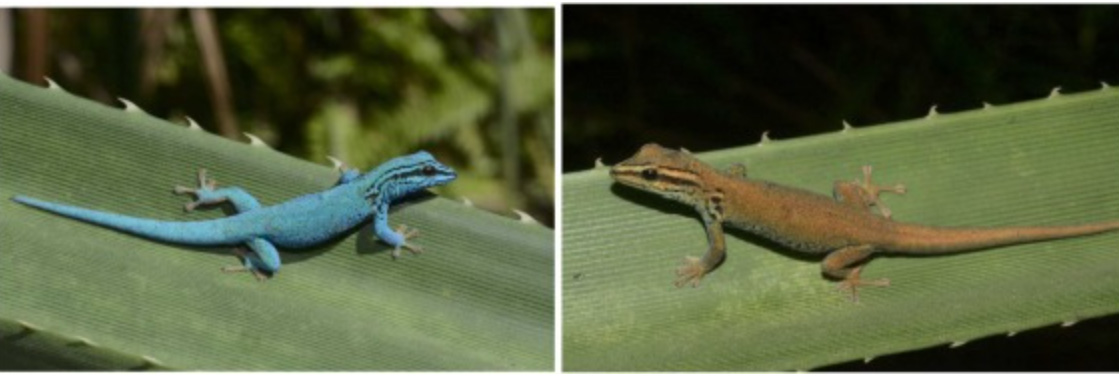

In the photo above…an adult male (left) and female (right) of Lygodactylus williamsi on a leaf of Pandanus rabaiensis in Kimboza Forest Reserve. Photos by John Lyakurwa.
The Electric Blue Gecko, Lygodactylus williamsi, is a small, diurnal, gekkonid. Dominant males are a bright and vibrant turquoise-blue body, and retain this color throughout the year, while females are green-bronze. The gecko is territorial and dwells exclusively on the leaves of Pandanus rabaiensis in Kimboza Forest Reserve, Tanzania. The gecko was reported as abundant and widespread in the Kimboza forest in the 1990s. However, the illegal pet trade and habitat loss led to a severe decline in the population prompting it to be declared Critically Endangered by the IUCN Red List in 2012. In that year the wild population was estimated to be 148,684 mature individuals.
The illegal trade in the species has now stopped thanks to a ban on wild-caught L. williamsi trade by the European Union and enforcement of local laws on trade involving live animals. The population size of the gecko may now likely returned to pre-harvesting years.
However, Cedrela odorata is a tree native to the neotropics ranging from Mexico through Central America to Argentina including the Caribbean. The tree has been introduced to various African countries including Tanzania, Uganda, Madagascar, South Africa, and several Southeast Asian and Pacific countries, where it is established in a monoculture plantation for timber. And it has invaded the range of the Electric Blue Gecko.
In a recently published paper, Charles Joseph Kilawe Hadija, Ahmad Mchelu and Cosmas John Emily (2022) report finding an inverse relationship between the abundance of Cedrela odorata trees (diameter at breast height (DBH)> 10 cm) and the abundance of P. rabaiensis. Spatially, the two trees dominated different parts of the forest. In contrast, the abundance of L. williamsi was not significantly affected by the presence of C. odorata. However, change in the canopy cover of the trees growing above the P. rabaiensis significantly affected the abundance of L. williamsi. The abundance of the gecko in a 0–30% cover was significantly higher than 30–50% and > 50% canopy covers. The findings of this study suggest that if left unmanaged, C. odorata could continue to take up the space occupied by P. rabaiensis and other native plants, and thus limit the population size of the Electric Blue Gecko.
Citation. Kilawe CJ, Mchelu HA, Emily CJ. 2022. The impact of the invasive tree Cedrela odorota on the Electric Blue Gecko (Lygodactylus williamsi) and its habitat (Pandanus rabaiensis) in Kimboza Forest Reserve, Tanzania. Global Ecology and Conservation. 2022 Jul 11:e02225.