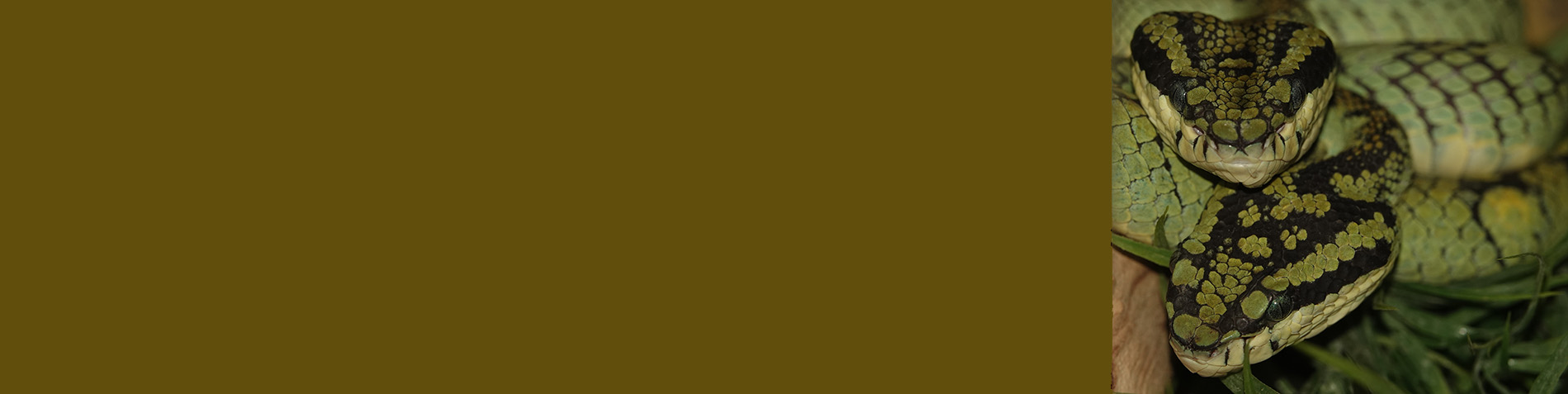


Above, predator and prey: (a) Greater sea snake or Olive-headed Sea Snake, Hydrophis major; (b) swarm of striped eel catfish, Plotosus lineatus. Photographs by (a) Claire Goiran, and (b) Aline Guémas.
Udyawer et al. (2020) combined behavioral-ecology experiments on captive sea snakes and their prey (catfish) with acoustic tracking of free-ranging sea snakes, to explore the use of waterborne chemical cues in this predator-prey interaction. In the coral-reef ecosystems of New Caledonia, the greater sea snake (Hydrophis major) feeds only upon the Striped Eel Catfish (Plotosus lineatus). Captive snakes became more active after exposure to waterborne chemical cues from catfish, whereas catfish did not avoid chemical cues from snakes. Movement patterns of tracked snakes showed that individuals were most active on a rapidly falling tide, which is the time when chemical cues from hidden catfish are likely to be most readily available to a foraging predator. By synchronizing foraging effort with the tidal cycle, greater sea snakes may be able to exploit the availability of chemical cues during a rapidly falling tide to maximize efficiency in locating and capturing prey.
A resurgence of research on sea snakes is providing a far richer understanding of their biology and confirming that sea snakes possess a wide range of morphological and physiological adaptations to oceanic habitats. Increasingly, the behavioral adaptations of these animals to marine life are being also being revealed.
Citation
Udyawer V, Goiran C, Chateau O, Shine R (2020) Swim with the tide: Tactics to maximize prey detection by a specialist predator, the greater sea snake (Hydrophis major). PLoS ONE 15(10): e0239920. https://doi.org/10.1371/journal.pone.0239920
