


Read any herpetology book on snake feeding behavior and they report snakes swallow their prey in one
piece. There are some, but very few, exceptions. Snail-eating snakes occur in the families Dipsadidae and Pareidae and extract the live animal from its shell; and a few natrids of the genus Storiera reportedly do the same. But, nonetheless the snakes are still consuming the entire live animal. The coastal homalopsids of the genera Fordonia and Gerarda are known as crab-rippers and tear apart and consume crabs and other crustacens. At least three species of blind snakes (Typhlopoidea) including the genus Indotyphlops eat only part of their prey. A few of the threadsnakes (Leptotyphlopidae) of the genera Epictia and Rena also eat only parts of their termite or ant prey, some sucking abdominal contents out of termites or biting off the heads and discarding them. Colubrid snakes known to feed on frog eggs, may also consume only part of the egg mass.
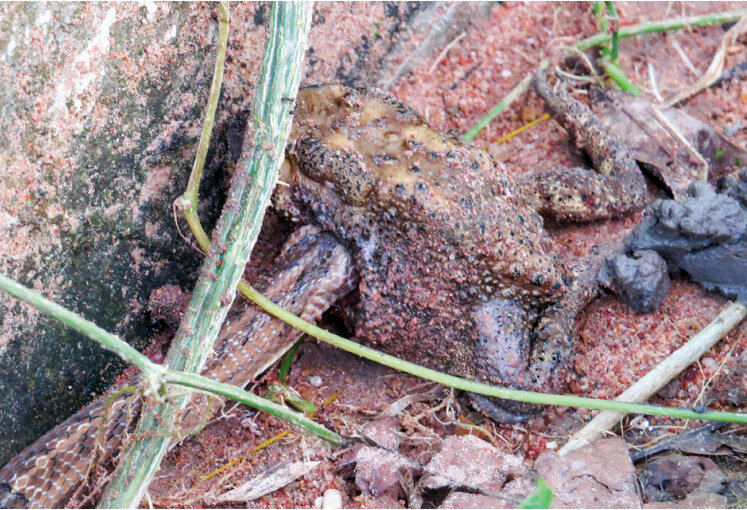
In a recent paper, Bringsøe et al. (2020) describe an new, previously unsubscribed behavior of the Small-banded Kukri Snake, Ologodon fasciolatus, using its knife-like rear fangs to slit open the highly poisonous toad, Duttaphrynus melanostictus and eat its organs. The snakes and toads were adults in three cases documented with photographs.
The observations were made at one locality near Loei, in northeast Thailand, in August 2016, April 2020 and June 2020. in Na Muang village 15 km north of Loei, Sri Songrak subdistrict, Muang district, Loei province. The habitat consisted of cultivated land near human habitation on the estate belonging to two of the authors who made the observations and took photos in all three cases. Additionally, one observation of O. fasciolatus swallowing an entire large juvenile D. melanostictus was made at a locality in Phitsanulok, Central Thailand, in June 2020.
Citation
