
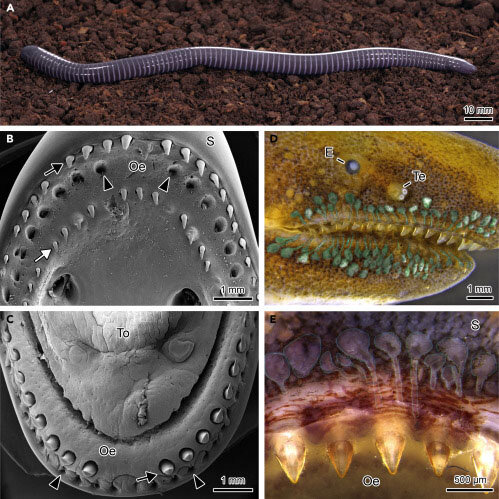

Caecilians, which are often mistaken for snakes due to their long, legless bodies, are amphibians like salamanders and frogs. Recent studies suggest that, like snakes, caecilians possess glands near their teeth that secrete toxins, raising the possibility that they may be the first venomous amphibians.
Evolutionary biologist Pedro Mailho-Fontana, along with fellow biologists Marta Antoniazzi and Carlos Jared of the Butantan Institute, discovered large glands in the upper and lower jaws of caecilians that had ducts going to the teeth. The team characterized these unexpected oral glands in several caecilian species using standard and electron microscopes and found that the glands arise from dental tissue, which is similar to venom glands of snakes but is a first for amphibians.
Biochemical tests revealed that the fluid in the newfound glands contains phospholipase A2 enzymes, a large group of fat-chopping proteins that are frequent components in animal venoms. However, it is not yet conclusive that the animals are venomous.
Unlike some amphibians that use bony protrusions to create wounds in their attackers and deliver skin-derived toxins, the caecilian oral glands do not appear to help inject secretions. Instead, they work more like the venom systems of venomous lizards. The glands simply ooze secretions onto the teeth, which then enter the victim as those teeth tear into flesh.
According to Antoniazzi, the fact that caecilians and snakes have similar bodies is likely not a coincidence, as both animals benefit from having oral chemical weapons since they do not have limbs to subdue prey.
While the caecilians’ teeth and associated glands are fascinating, it is still unclear whether the gland secretions are indeed toxic and play a functional role in feeding or defense. The team hopes to provide additional evidence for these amphibians being venomous soon, including a more detailed work-up of the oral gland components. This would shed new light on these enigmatic and poorly studied animals, which are perhaps the most unknown vertebrate.
Citation
Mailho-Fontana P.,et al. 2020. Morphological evidence for an oral venom system in caecilian amphibians. iScience. doi:10.1016/j.isci.2020.101234.