
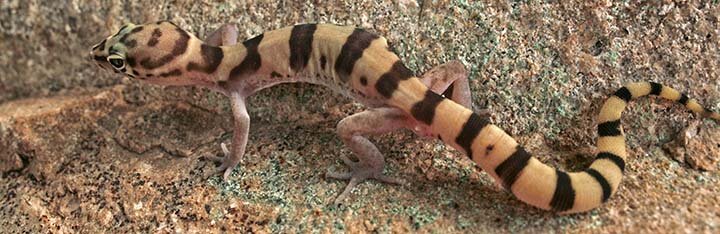


Laurence Klauber writing about banded geckos in 1945 notes that Coleonyx is found only in North America and that they occur from the arid areas of the southwestern United States southward to the jungles of Panama. He also noted that while they have sometimes been placed in the Eublepharidae, erected by Boulenger in 1883 to comprise three genera characterized by the possession of single parietal bones, more recently they have been reincluded in the far more generalized and widespread family Gekkonidae, partly as a result of the work of Noble, who determined that the genera assigned to the family Eublepharidae were probably of polyphyletic origin. Of course, we know today that the banded geckos do in fact belong to the family Eublepharidae and that they had an Asian origin.
Today eight species are recognized in the genus, two of them are polyphyletic, Coleonyx elegans witrh two subspecies and C. variegatus with four subspecies. Leavitt et al (2020) recently took a look at the phylogeography of Coleonyx variegatus using multilocus sequence data to address deep phylogeographic structure within C. variegatus. Their analyses of mtDNA data recover six divergent clades throughout the range of C. variegatus. Topology of the mtDNA gene tree suggests separate origins of peninsular populations with an older lineage in the south and a younger one in the north. In contrast, analyses of multilocus nuclear data provide support for four lineages, corresponding to the subspecies C. v. abbotti, C. v. peninsularis, C. v. sonoriensis and C. v. variegatus. Phylogenetic analyses of the nuclear data recover C. v. abbotti and C. v. peninsularis as a clade, indicating a single origin of the peninsular populations. Discordance between the nuclear and mtDNA data is largely the result of repeated episodes of mtDNA introgression that have obscured both lineage boundaries and biogeographic history. Dating analyses of the combined nuclear and mtDNA data suggest that the peninsular clade diverged from the continental group in the Late Miocene. The geomorphological formation of the Baja California peninsula and the Gulf of California is a principal driver of diversification for the reptiles of North America’s warm deserts.
The western banded gecko, Coleonyx variegatus, is distributed throughout the Mojave, Sonoran, and Peninsular deserts. In ta recent study Leavitt et al. (2020) use multilocus sequence data to address deep phylogeographic structure within C. variegatus. Analyses of mtDNA data recover six divergent clades throughout the range of C. variegatus. The topology of the mtDNA gene tree suggests separate origins of peninsular populations with an older lineage in the south and a younger one in the north. In contrast, analyses of multilocus nuclear data provide support for four lineages, corresponding to the subspecies C. v. abbotti, C. v. peninsularis, C. v. sonoriensis and C. v. variegatus. Phylogenetic analyses of the nuclear data recover C. v. abbotti and C. v. peninsularis as a clade, indicating a single origin of the peninsular populations. Discordance between the nuclear and mtDNA data is largely the result of repeated episodes of mtDNA introgression that have obscured both lineage boundaries and biogeographic history. Dating analyses of the combined nuclear and mtDNA data suggest that the peninsular clade diverged from the continental group in the Late Miocene.
Literature
Klauber, L.M. 1945. The geckos of the genus Coleonyx with descriptions of new subspecies. Transactions of the San Diego Society of Natural History 10:133-216.
Leavitt DH, Hollingsworth BD, Fisher RN, Reeder TW. 2020. Introgression obscures lineage boundaries and phylogeographic history in the western banded gecko, Coleonyx variegatus (Squamata: Eublepharidae). Zoological Journal of the Linnean Society. 2020:1-46.
