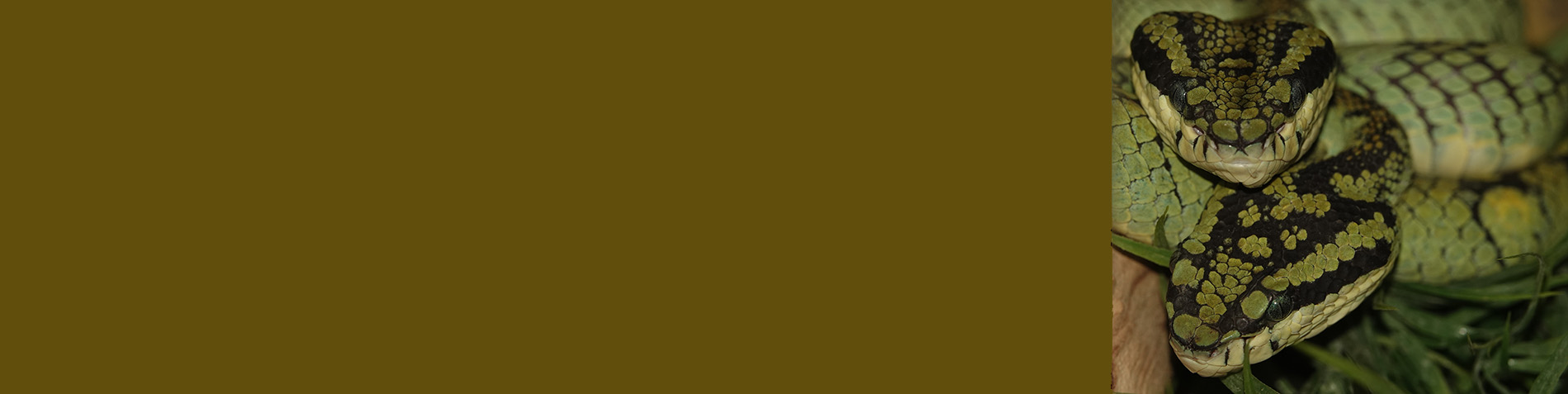


In the early 1980’s, while working on the Trinidad and Tobago fauna I was in the field four or five times but by the late 1980’s I was focused on working on museum specimens from the island. Most of that work was done at the Field Museum in Chicago (FMNH). When I was free of my teaching duties, I was at the museum counting scales and checking literature at the FMNH. Harold Voris (HKV) was curator and Bob Inger (RFI) was curator emeritus. Sometime in 1988 HKV asked me (JCM) if I would be willing to go to Borneo for a couple of months to work on a community ecology study site in Sabah (previously known as British North Borneo). RFI’s first trip to Borneo was in 1950 and he made collecting regular trips to the island during the next sixty years. In 1987 RFI was working in Sabah and collected a small snake, 337 mm in total length. He was focused on frogs. He recognized the snake as being distinctly different. (Bob is recently deceased, and you can see an online interview with him where he discusses this snake.)
After I returned from Borneo and was working at the museum one day when Alan Resetar, the collection manager handed me a snake one morning with the question what family do you think this belongs to? It was the specimen RFI had collected in 1987. After a careful look and running it though keys that took most of the day, I realized I had no idea what family of snakes it belonged to. A second specimen was collected in 1988 by Christian Schafer from Berlin, but this specimen was from Peninsular Malaysia about 20 km north of Kuala Lumpur.
This genus is taxonomically and phylogenetically challenging because the snakes possess several morphological traits that distinguish them from all other snake species; head scales with numerous sensory papillae, large prefrontal scales, and an upper jaw which has a spiny palatine process. They also lack any pelvic girdle vestiges, a left lung, or a coronoid bone.
Rainer Günther and Ulrich Manthey at the Museum fur Naturkundse der Humboldt-University had been working on the Schafer specimen and added the Inger specimen to their study, in 1995 they described the new genus Xenophidion, and two new species, X. schaeferi (from Peninsular Malaysia) and X. acanthognathus from Sabah, Malaysia (Island of Borneo). At the time they considered the Xenophidion a colubrid snake of unknown affinities.
Wallach and Gunther (1989) looked at the internal anatomy of Xenophidion and compared it with that of members of other snake families. A collection of primitive characters eliminated Xenophidion as a possible member of the Caenophidia. Instead they suggested it as has a sister group relationship with the Tropidophiidae of the Neotropical region. The two groups shared nearly identical viscera and viseral topography. They established a new family for the genus Xenophidion, the Xenophidiidae. Of interest, the Xenophidiidae share one synapomorphy with both the Tropidophiidae and Bolyeriidae (formerly called Round Island Boas or the Spiny Jaw Snakes). Wallach and Gunther (1989) proposed that these three families be united in the superfamily Tropidophioidea.
In 2004, Lawson et al. used a complete sequence of the cytochrome B gene from Xenophidion schaeferi and compare it to sequences of the cytB gene from all other families of alethinophidian and caenophidian snakes. Their results placed Xenophidion schaeferi within the alethinophidian snakes and suggested a possible sister taxon relationship between Xenophidion schaeferi and the Bolyeridae (Spinyjaw Snakes). They also had strong statistical support indicating that Xenophiidae is a member of a clade that contains Pythonidae, Loxocemidae, Uropeltidae, Xenopeltidae and Bolyeriidae.
Subsequent molecular studies showed them as sister to various clades within Henophidia (Pyron and Burbrink 2012; Pyron et al. 2013, Reeder et al. 2015, ), but other studies found very strong support for them as the sister to the Caenophidia (Reynolds et al. 2014, Scanlon and Lee 2011, Figueroa et al 2016 ).
CT scans of the Xenophidion skull show a joint in the maxilla, a trait unique to bolyeriids or the Spinyjaw Snakes from Round Island. The geographic distribution of the Spinyjaw Snakes is limited to Round Island in the Indian Ocean, which suggests that the common ancestor of Xenophiidae and the Bolyeridae lived in Gondwanaland.
Quah et al. (2018) collected additional specimens of X. schaeferi and suggested the possible conspecific status of the two species based on morphology. However, they could not make a definitive decision because of the lack of specimens and molecular data from X. acanthognathus. Thus, additional data from X. acanthognathus are important to resolving the taxonomic status of the two species.
Now a second specimen of X. acanthognathus has been found. Fukuyama et al. (2020) report a second specimen of Xenophidion acanthognathus, from Lambir Hills National Park, in Malaysian Borneo. Their morphological and genetic analysis confirmed that X. acanthognathus and X. schaeferi are heterospecific.
Their molecular analysis showed the uncorrected p-distance for the cyt b gene fragment was 9.9% between X. acanthognathus from Lambir NP, Sarawak (SRC 00961) and the holotype of X. schaeferi from Templer’s Park, Selangor, and 10.1% when compared to X. schaeferi from Lata Kijiang, Negeri Sembilan (LSUHC 13481).
Fukuyama specimen (SRC 00961) was identified as a Xenophidion based on a small sized snake with a laterally compressed body and a short tail; nasal undivided; internasals absent; prefrontals greatly enlarged; loreals and suboculars absent; undivided subcaudals; irregular dark zig-zag vertebral stripe bordered by whitish zig-zag stripes running along the length of the body. Furthermore, this specimen was collected in northern Borneo (locality of X. acanthognathus) and the following characteristics are closer to X. acanthognathus than X. schaeferi: 185 ventrals; 55 subcaudal scales; a relatively short tail (SVL/tail length = 4.20). Thus, this specimen is most probably X. acanthognathus. Although dentition characters are known to be diagnostic for this genus (Günther & Manthey, 1995), we were unable to examine those characters due to the small size of our specimen. Examination via CT scanning is planned for future studies.
Intraspecific variation (Table 1). The Fukuyama specimen (SRC 00961) is generally similar in pholidosis to the holotype of the species (FMNH 235170) reported by Günther and Manthey (1995). Differences between SRC 00961 and the holotype were the number of ventrals (185 vs. 181); number of subcaudals (55 vs. 51); number of dorsal scales rows. Xenophidion acanthognathus can be differentiated from its sister species, X. schaeferi by the following characteristics: a larger number of ventrals (181–185 vs. 176–178); a larger number of subcaudals (51–55 vs. 43–45); and shorter tail (SVL/tail length = 4.20–4.52 vs. 4.69–4.84).
The new specimen was found moving slowly on the trunk of a tree ca. 20 cm above the ground in a lowland dipterocarp forest, at 2117 h. The air temperature at the site was 24.7°C and it had not rained for several days except for an exceptionally light rain during the day, thus the ground was dry. When Fukuyama spotted the snake in the beam of his flashlight, it tried to escape under the bark. The holotype of the species was collected under moss covering a rock, 10 m from a stream, at 0815 h (Günther and Manthey, 1995). One photographed individual was found lying vertically on a damp, mossy log, at 2015 h (Rowntree et al., 2017). The only known food item of the species is a skink (Sphenomorphus sp.) that was found in the gut of the holotype (Wallach and Günther, 1998).
Literature cited
Fukuyama I, Hossman MY, Nishikawa K. Second specimen of the rare Bornean snake Xenophidion acanthognathus (Xenophidiidae, Serpentes, Reptilia) and confirmation as a distinct species from X. schaeferi. Raffles Bulletin of Zoology 68:214-9.
Lawson R, Slowinski JB, Burbrink FT. 2004. A molecular approach to discerning the phylogenetic placement of the enigmatic snake Xenophidion schaeferi among the Alethinophidia. Journal of Zoology. 263(3):285-94.
Manthey U, Günther R. 1995. Xenophidion, a new genus with two new species of snakes from Malaysia (Serpentes, Colubridae). Amphibia-Reptilia16(3):229-40.
Pyron RA, Burbrink FT. 2012. Extinction, ecological opportunity, and the origins of global snake diversity. Evolution 66: 163–178.
Pyron RA, Kandambi HD, Hendry CR, Pushpamal V, Burbrink FT, Somaweera R. 2013. Genus-level phylogeny of snakes reveals the origins of species richness in Sri Lanka. Mol. Phylogenet. Evol. 66:
Quah ES, Grismer LL, Jetten T, Wood Jr PL, Miralles AU, Shahrul Anuar MS, Guek KH, Brady ML. 2018. The rediscovery of Schaefer’s Spine-jawed Snake (Xenophidion schaeferi Günther & Manthey, 1995)(Serpentes, Xenophidiidae) from Peninsular Malaysia with notes on its variation and the first record of the genus from Sumatra, Indonesia. Zootaxa 4441(2):366-78.
Reeder TW, Townsend TM, Mulcahy DG, Noonan BP, Wood PL Jr, Sites JW Jr, et al. 2015. Integrated analyses resolve conflicts over squamate reptile phylogeny and reveal unexpected placements for fossil taxa. PLoS One. 2015; 10: e0118199 10.1371/journal.pone.0118199
Reynolds RG, Niemiller ML, Revell LJ. 2014. Toward a Tree-of-Life for the boas and pythons: Multilocus species-level phylogeny with unprecedented taxon sampling. Mol. Phylogenet. Evol. 2014; 71: 201–213. 10.1016/j.ympev.2013.11.011.
Rowntree N, Griffiths J & Rowntree P (2017) Xenophidion acanthognathus (Bornean Spine-jawed Snake) Geographic distribution. Herpetological Review, 48(1): 132–133.
Scanlon JD, Lee MSY. The major clades of living snakes: Morphological evolution, molecular phylogeny, and divergence dates In: Aldridge RD, Sever DM, editors. Reproductive biology and phylogeny of snakes. Boca Raton: CRC Press; 2011. p. 55–95. [
Wallach V, Günther R. 1998. Visceral anatomy of the Malaysian snake genus Xenophidion, including a cladistic analysis and allocation to a new family (Serpentes: Xenophidiidae). Amphibia-Reptilia 19(4):385-405.
Zheng Y, Wiens JJ. 2015. Combining phylogenomic and supermatrix approaches, and a time-calibrated phylogeny for squamate reptiles (lizards and snakes) based on 52 genes and 4162 species. Mol. Phylogenet. Evol. 2016; 94: 537–547. 10.1016/j.ympev.2015.10.00.
