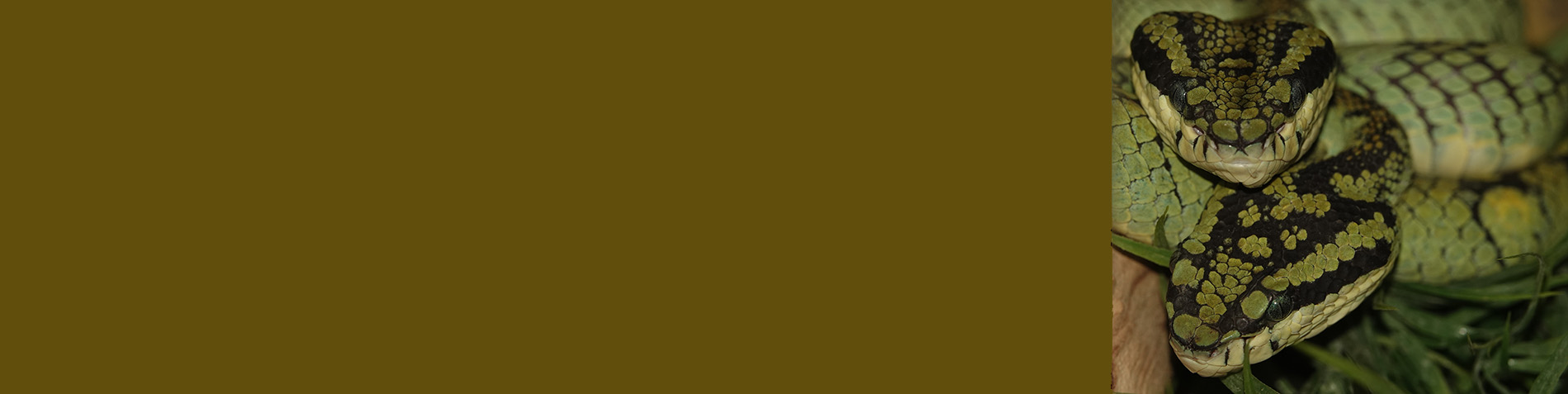

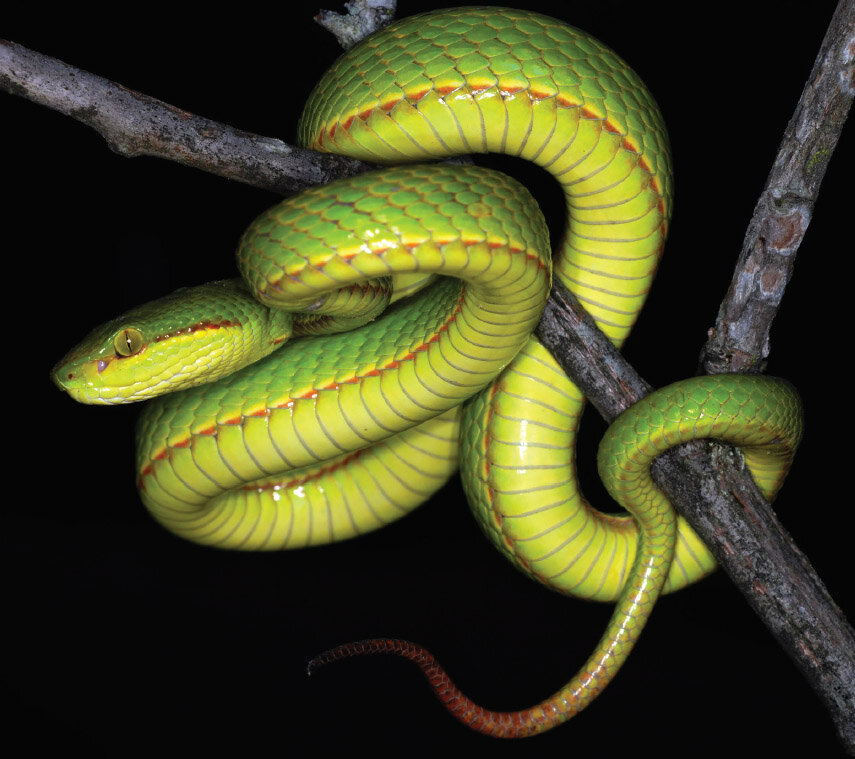

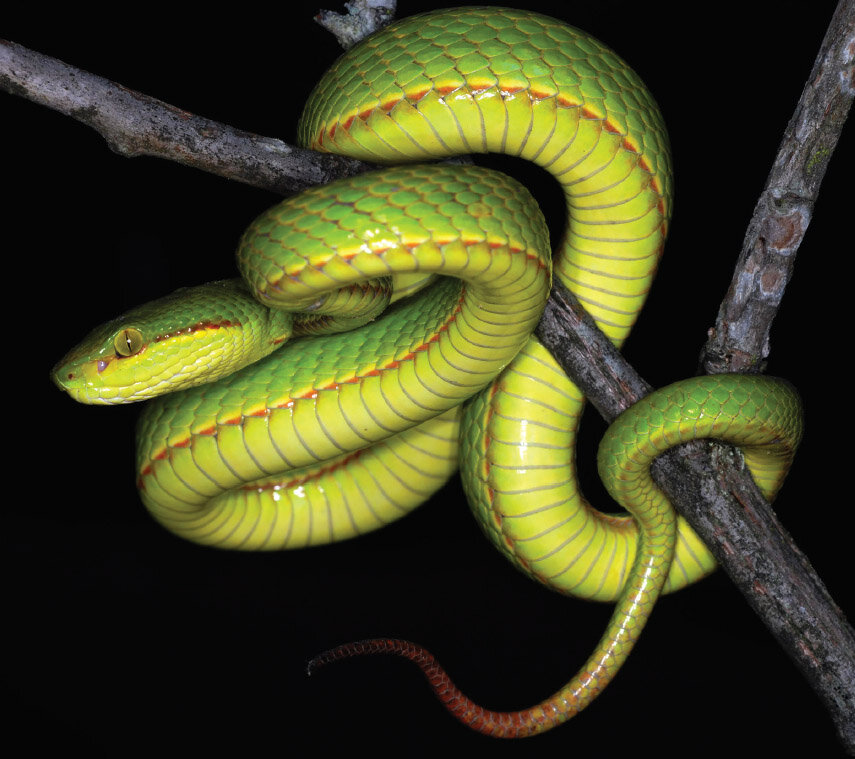
During a herpetological expedition, Arunachal Pradesh in northeast India in the summer of 2019 an adult male Trimeresurus was collected from the outskirts of Pakke Tiger Reserve by Harshal Bhosale. The new species was named Trimeresurus salazar, and is a member of the subgenus Trimeresurus, a relationship determined using two mitochondrial genes, 16S and ND4, and was found to be the sister to Trimeresurus septentrionalis Kramer, 1977. The new species differs from Trimeresurus septentrionalis in bearing an orange to reddish stripe running from the lower border of the eye to the posterior part of the head in males, a higher number of pterygoid and dentary teeth, and a short, bilobed hemipenis.
Description of the new species and T. arunachalensis Captain, Deepak, Pandit, Bhatt & Athreya, 2019 from northeastern India in a span of less than one year highlights the need for dedicated surveys to document biodiversity across northeastern India.
The type specimens were found at night search between 1800–2200 hours along a road. Both individuals were found coiled on shrubs along the road. A third individual was seen but escaped in the thick undergrowth. Three individuals were seen during night searches in six nights. Other serpent species observed at the locality include Boiga gokool, Boiga cyanea, and
Lycodon jara. For now, the new species is known only from the type locality.
The specific epithet is a noun in apposition for J.K. Rowling’s fictional Hogwarts School of Witchcraft and Wizardry’s co-founder, Salazar Slytherin. He was a Parselmouth that links him to serpents. Suggested common name: Salazar’s pit viper.
Citation
Mirza ZA, Bhosale HS, Phansalkar PU, Sawant M, Gowande GG, Patel H. A new species of green pit vipers of the genus Trimeresurus Lacépède, 1804 (Reptilia, Serpentes, Viperidae) from western Arunachal Pradesh, India. Zoosystematics and Evolution. 2020 Apr 15;96:123.
