
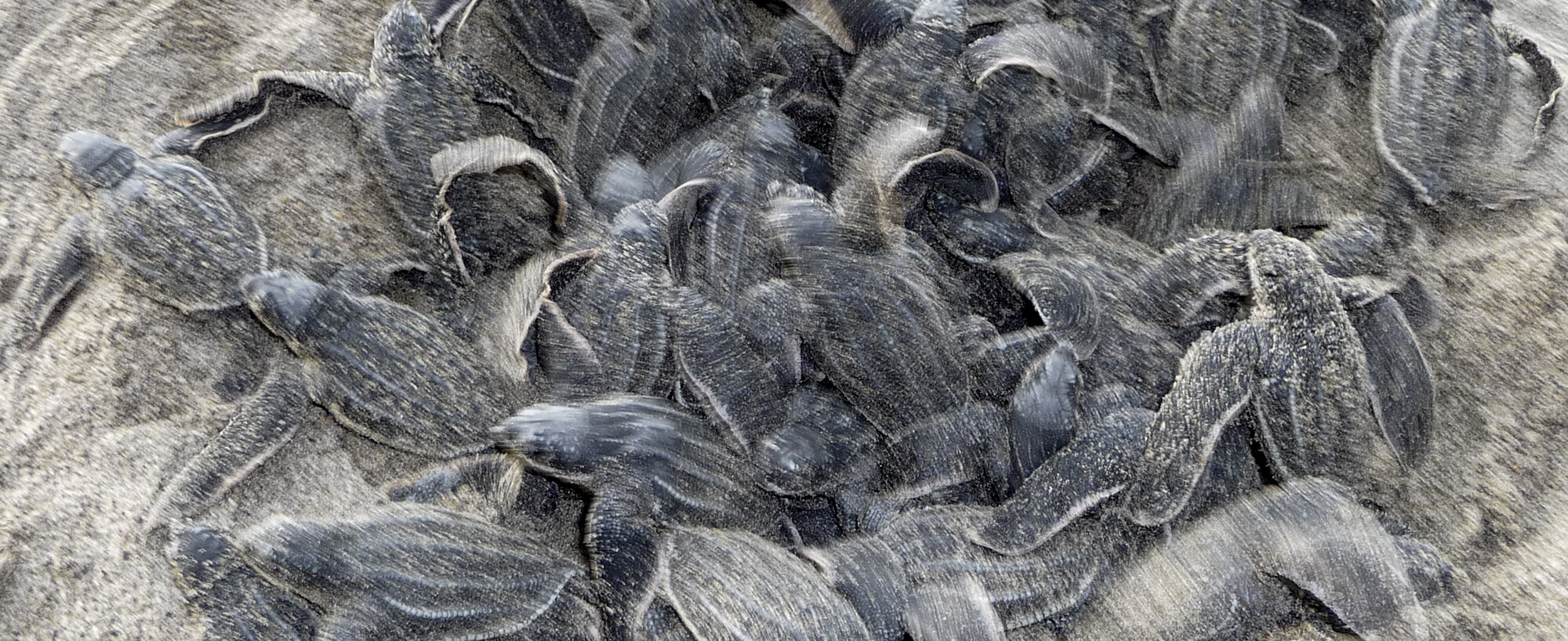


There is a large colony of Leatherbacks that nesting on the north coast of Trinidad at Grande Riviere The beach there is about a kilometer long and hundreds of female Leatherbacks use it for laying multiple clutches of eggs each season. So many turtles use the beach that females are digging up each other’s nests and exposing them to predation from vultures and dogs. But there are other sources of egg mortality.
In a recently published work Ikaran et al. (2020) report that a Leatherback rookery in Gabon also has a high level of predation. They examined 163 nests at Kingere beach and found only 16.7% of eggs produced hatchlings. In 59% of the nests, more than half of the eggs were dead and attacked by invertebrates and 94% had at least one egg affected by invertebrates. The rate of eggs and SAGs (yolkless eggs) affected by invertebrates within a clutch ranged from 0% to 100%, with an average proportion of 39% and 52%, respectively. The most common invertebrates interacting with the eggs were ghost crabs and insects that affected 51% and 82% of the nests, respectively. Crabs and insects co-occurred in 33% of the affected nests. Ants, identified as Dorylus spininodis were found in 56% of the excavated nests. However, it was not possible to determine if the ants predated alive eggs or scavenged dead eggs. Very often, hundreds of ants were found dead within dead eggs. Termites and other invertebrates were associated with the clutch environment and identified as opportunistic feeders. An unusual ecological interaction within the leatherback clutches between termites and ants was found in 11% of the nests. The abrupt transition between the soil forest and the beach might be favoring a thriving microbial and invertebrate activity in the sand profile that colonizes the nests.
Citation
Ikaran M, Agamboué PD, Scholtz O, Braet Y, Godley BJ, Marco A. Cryptic massive nest colonisation by ants and termites in the world’s largest leatherback turtle rookery. Ethology Ecology & Evolution. 2020 Feb 2:1-8.
