
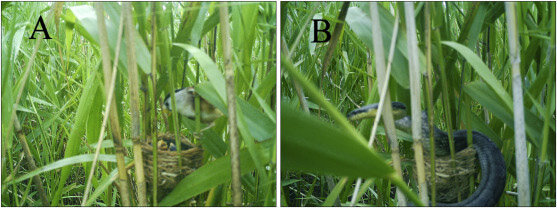

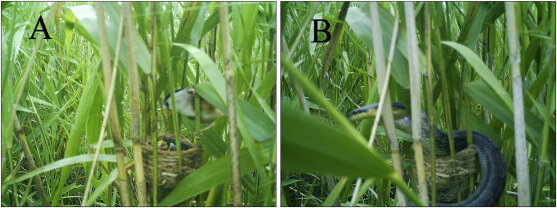
Above: Snake predation on a reed parrotbill nest. (A) The parent feeding nestlings. (B) the same nest was depredated by the snake Elaphe anomala.
Nest predation is a major limiting factor of bird reproductive success, and predation by snakes may have particularly adverse effects on passerines. Chen et al. (2020) studied the Reed Parrotbill (Paradoxornis heudei) a threatened passerine that inhabits reedbeds in East China, where it threatened due to habitat loss and degradation. In this study, Chen et al. monitored reed parrotbill nests in the core area of the Yancheng Nature Reserve, in Jiangsu Province, China. They tracked the final fate of each nest and determined the identity of the predators using infrared cameras. They monitored a total of 13 and 15 active nests in 2017 and 2019, respectively, but only 5 nests were successful. Nest predation was responsible for 22 of 23 nest failures (95.7%). Snakes were the principal predators of the nests, responsible for 19 predation events (86.4%). The authors used abandoned reed parrotbill nests and quail eggs to create artificial nests. However, the survival rate of the artificial nests (63.3%) was significantly higher than that of the natural nests (11.3%), and rats replaced snakes as the principal predators. The only confirmed snake predator was the Korean Rat Snake, Elaphe anomaly, a large snake with a distinct bluish-grey back and pale yellow abdomen and was easily distinguished from other sympatric snakes. For predation events during which the predator was not recorded due to camera failure or for other reasons, they identified predators based on nest state after the predation event because some predators leave evidence behind. For example, rats usually leave eggshell fragments, while snakes prey on nests without leaving any trace. The best model indicated that the daily survival rate of reed parrotbill nests decreased with nest age. The results suggest that severe snake predation may be an important factor threatening populations of the reed parrotbill, even though the wetland habitat is well protected. The identification of specific nest predators may facilitate the conservation of this near-threatened bird through the development of effective management strategies in reserves. More studies on population estimates of the reed parrotbill and the interactions between this endangered bird and snakes using natural (rather than artificial) nests in different areas are needed.
Chen P, Chen T, Liu B, Zhang M, Lu C, Chen Y. Snakes are the principal nest predators of the threatened reed parrotbill in a coastal wetlands of eastern China. Global Ecology and Conservation. 2020 Apr 13:e01055.
