
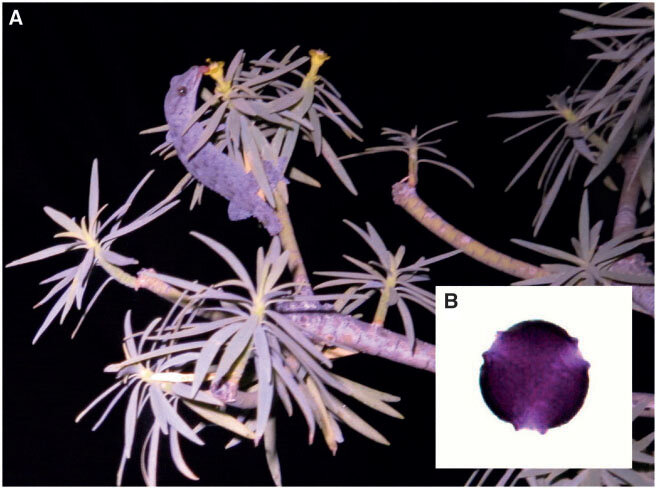


Above. Tarentola delalandii visiting a flowering plant on the island of La Palma (Canary archipelago). (B) Detail of Euphorbia lamarckii pollen grain.
I
Insects are the best known group of pollinators, but some birds (hummingbirds) and mammals (bats) arw also important as pollinators and seed dispersers for flowering plants. Lizard’s role as pollinators has been considered as rare and less important. However, recent reports suggest lizards as partners in mutualistic relationships has been underestimated. However, the reports also uncovered a surprising pattern – that pollination and seed dispersal by lizards is most common on islands. The island phenomenon is likely because island lizards reach very high densities and experience a lower predation risk than do those on the mainland. Cnsequently, lizards can expand their diet to include nectar, pollen and fruit (Olesen and Valido, 2003).
Now a new study by Hernández-Teixidor (2019) noted consistent herbivory for the large insular geckos of the genus Tarentola has been reported in Cabo Verde (Canary Islands) based on food remains and metagenomics. In the surrounding continental zones, geckos have also shown a clear pattern of insect consumption, both in the South of the Iberian Peninsula and North-western Africa. During a nocturnal survey in April 2016 to search for the presence of the giant endemic grasshopper Acrostira euphorbiae, on the island of La Palma (Canary archipelago), one of the authors recorded at least four individuals of Tarentola delalandii on Euphorbia lamarckii shrubs (Euphorbiaceae). This gecko is endemic to La Palma and Tenerife. At first, they were assumed to be hunting nocturnal insect visiting flowers. Further observations confirmed the gecko visited the flowers of E. lamarckii to lick the nectar. Observations in the flowering season in 2018, found a total of 21 (70%) of the 30 captured geckos carried pollen grains. Pollen from at least 14 plant species. The most frequent pollens were from E. lamarckii, Erica sp. “pollen type” (Ericaceae), and Rumex cf. lunaria (Polygonaceae). Euphorbia lamarckii was the most represented in each sample.
Globally, a total of 20 species of native geckos have been recorded as flower visitors. These species are included in 11 genera and 3 families (Diplodactylidae, Gekkonidae, and Phyllodactylidae). Twelve are diurnal (60%), six nocturnal (30%), and two show both periods of activity. Most of these species are distributed in the Afrotropical, five are Australasian, one is in Oceania, and this new interaction (La Palma, Canaries) in the Palaearctic.
References
Hernández-Teixidor D, Díaz-Luis N, Medina FM, Nogales M. 2019. First record of geckos visiting flowers in the Palaearctic Ecozone. Current Zoology 102019, 1–2 doi: 10.1093/cz/zoz051
Olesen JM, Valido 2003. A. Lizards as pollinators and seed dispersers: an island phenomenon. Trends in ecology & evolution 18(4):177-81.
