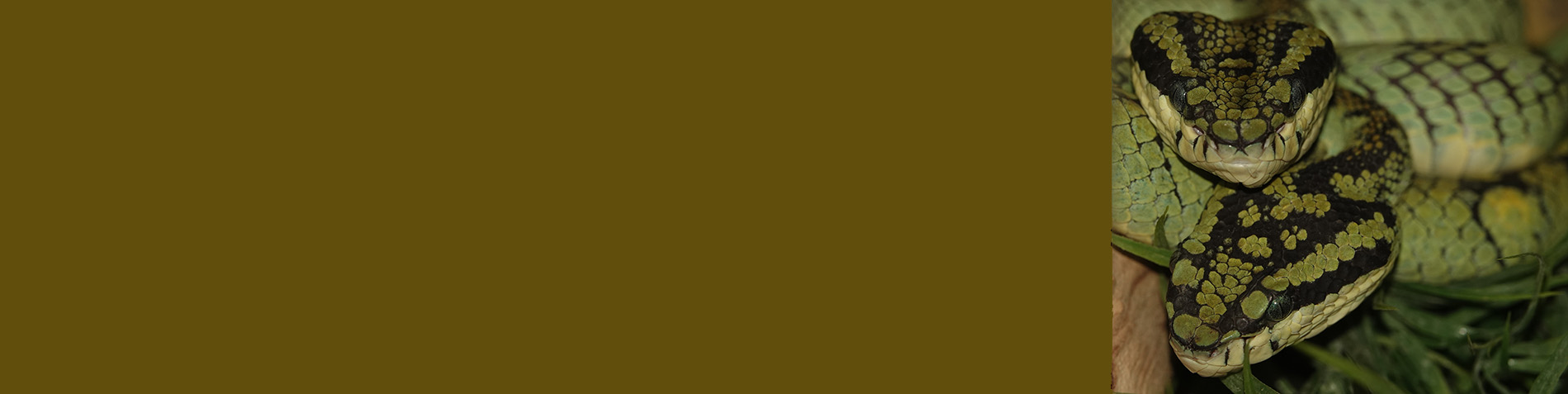


The Flower Snake or Moellendorf’s Rat Snake (Family Colubridae) has had a turbulent taxonomic history. The species is endemic to China and Vietnam (Hòa Bình) but it may also occur in Laos. It was originally described as Cynophis Moellendorffi by Boettger in 1886 but was placed in the genus Coluber by Boulenger in 1894, in Elaphe by Stejneger in 1907, returned to Elaphe by Mell in 1931, moved to Amblycephalus by Deuve in 1961, returned to Elaphe by Schulz in 1996, placed in Orthriophis by Utiger in 2002 and has bounced back and forth between Elaphe and Orthriophis for the last 25 years. The two-meter Flower Snake inhabits rock outcrops and rocky grass, as well as roadsides, ditches and small rivers running through grasslands at altitudes of 50–300 meters. Feng et al. (2020) have sequenced the complete mitochondrial genome of the Flower Snake and found it to be the sister of and Orthriophis taeniurus (commonly known as the Taiwan Beauty or the Beauty Rat Snake. Orthriophis forms a paraphyletic group with Elaphe. Thus, The Flower Snake will be staying in the genus Orthriophis for awhile.
Feng D, Wang M, Ali I, Geng Z, Li Y, Yan P. 2020. The complete mitochondrial genome of Orthriophis moellendorffi and implications for its taxonomy. Mitochondrial DNA Part B. 2020 Apr 2;5(2):1652-3.
