

Pen Guo of the College of Life Science at Yibin University in China and a researh team of other Chinese workers, as well as two Americans (R. Alexaner Pyron and Frank Burbrink) examine the temporal and geographic origins of natricine snakes in order to provide a comparison to the patterns and timing of origin of the ratsnakes, skinks, and crotalines, which all demonstrate similar timing and routes of dispersal through Beringia to the New World. In addition to sequencing several new species, they test hypotheses about the timing and area of origin of natricines in the Old W.orld . They also attempt to understand the causes of the Holartic distribution, which for the other groups of squamates have suggested a single unidirectional dispersal from Asia through Beringia to the New World during the Oligocene and Miocene (the Cenozoic Beringial Dispersal Hypothesis).
Using a combination of six mitochondrial gene fragments (12S RNA, cyt b, ND1, ND2, ND4 and CO1) and one nuclear gene (c-mos) from 22 genera the authors infered phylogenetic relationships among natricine snakes and examine the date and area of origin of these snakes. The phylogenetic results indicate the subfamily Natricinae is strongly supported as monophyletic including a majority of extant genera, and a poorly known and previously unassigned species Trachischium monticola; two main clades are inferred within Natricinae, one containing solely taxa from the Old World and the other comprising taxa from a monophyletic New World group with a small number of Old World relatives. They found that within the Old World clade, the genera Xenochrophis and Amphiesma are apparently not monophyletic. Divergence dating and ancestral area estimation indicate that the Old World natricines originated in tropical Asia during the later Eocene or the Oligocene. Additionally they recover two major dispersals events out of Asia, the first to Africa in the Oligocene, 28 million years ago and the second to the Western Palearctic and the New World at 27 million years ago. This date is consistent with the dispersal of numerous other Old World groups into the New World.
 |
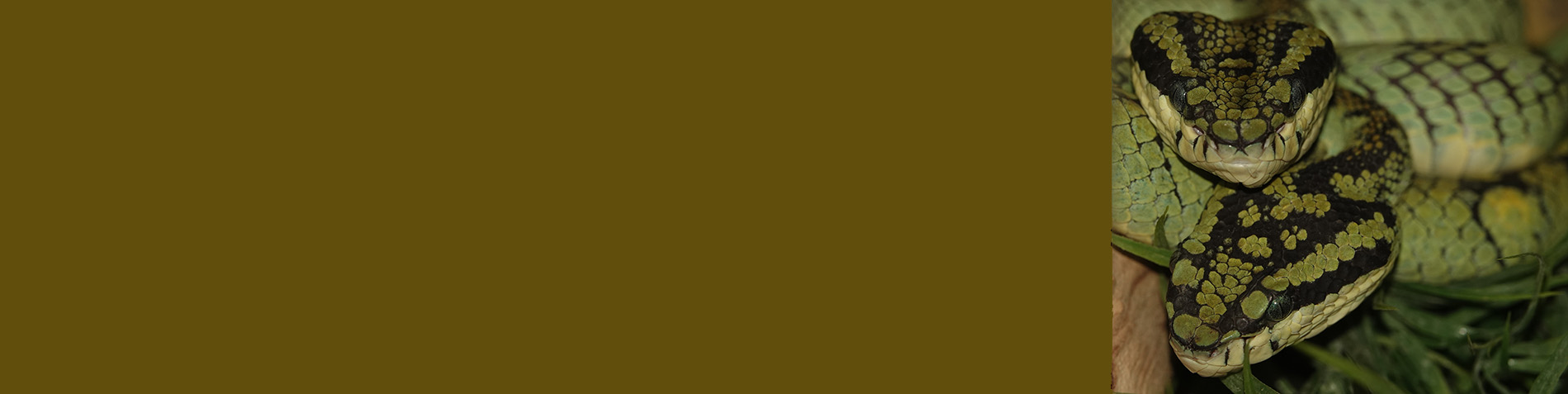
| Trachischium monticola, a fossorial, worm-eating natracine snake from South Asia |
Peng Guo, Qin Liu, Yan Xu, Ke Jiang, Mian Hou, Li Ding, R. Alexander Pyron, Frank T. Burbrink. 2012. Out of Asia: Natricine snakes support the Cenozoic Beringian Dispersal Hypothesis. Molecular Phylogenetics and Evolution, 63:825-833.