-
More on Pseustes poecilonotus as a nest predator
posted on
Fragmented tropical forest landscapes are becoming more abundant, and loss of species following fragmentation are often predictable. Larger animals, tend to disappear first from fragments due to the bushmeat trade. However, another vulnerable group includes understory, insectivorous birds, and ant-following birds. Nest predation is one mechanism that may limit bird populations and has long been…
-
Sex reversal triggers rapid transition from genetic to temperature-dependent sex.
posted on
Hatchling Bearded Dragon A climate-induced change of male dragons into females occurring in the wild has been confirmed for the first time, according to University of Canberra research recently published on the cover of international journal Nature. The researchers, who have long studied Australia’s bearded dragon lizards, have been able to show that a reptile’s…
-
A preliminary revision of Asian Pipe Snakes, Cylindrophis
posted on
An undescribed pipe snake from Thailand (JCM) and a map showing the known taxa. The Asian Pipe Snake of the Cylindrophiidae contains about ten species. These are burrowing, semi-aquatic snakes that are basal to most other living snakes. Linnaeus (1758) described Anguis maculata from Sri Lanka, Laurenti (1768) described Anguis ruffa described by Laurenti (1768). In…
-
Feeding system of the Eastern Diamondback Rattlesnake
posted on
The Eastern Diamondback Rattlesnake, Crotalus adamanteus, is the largest rattlesnake species and has an exclusively endothermic diet. Although native to seven states in the southeastern Coastal Plain, the species has been extirpated from Louisiana, is listed as endangered in North Carolina, and is currently under consideration for listing as threatened under the Endangered Species Act.…
-
Modeling the first snake
posted on
A reconstruction of the ancestral crown-group snake, Artwork by Julius Csotonyi. The original snake ancestor was a nocturnal, stealth-hunting predator that had tiny hind limbs with ankles and toes, according to new research. Snakes show incredible diversity, with over 3,400 living species found in a wide range of habitats, such as land, water and in trees.…
-
Eating-induced changes of the Burmese python’s intestines due to changes in gene expression
posted on
The Burmese python’s body undergoes massive reconstruction followed by complete deconstruction every time it eats. Within three days of eating, its organs expand up to double in size and its metabolism and digestive processes increase 10- to 44-fold. Ten days after eating, the snake’s meal is digested and these changes have reversed, allowing the body…
-
tail length in snakes associated with gravity
posted on
An arboreal eyelash viper (Bothriechis schlegelii) resting on a branch in Costa Rica. Photograph by Coleman M. Sheehy III. Gravity is a pervasive force that can severely affect blood circulation in terrestrial animals, and these effects can be particularly pronounced in tall or long organisms such as giraffes and snakes. Upright postures create vertical gradients…
-
Geckos evolved daytime activity multiple times
posted on
A diurnal Phelsuma and a nocturnal Cyrtodactylus. Geckos are the only clade of lizards that are mostly nocturnal; 72% of the 1552 described species are active at night. Geckos possess numerous adaptations to low light and low temperatures, suggesting nocturnal activity evolved early in their evolution. These adaptations include the evolution of vocalization and acoustic…
-
Tracking Python bivittatus in Everglades National Park
posted on
The largest and longest Burmese Python tracking study of its kind — here or in its native range — is providing researchers and resource managers new information that may help target control efforts of this invasive snake, according to a new study led by the U.S. Geological Survey. Among the findings, scientists have identified the…
-
The endemic freshwater snake Parahelicops boonsongi moved to a new genus
posted on
Isanophis boonsongi new comb., preserved holotype (FMNH 135328). From top to bottom: Dorsal view – Ventral view – Lateral view of the head and neck, left side. Photographs by Patrick David. There is little doubt that Southeast Asia harbors the most diverse assemblage of living snake species. And, a number of species from the Indochinese region,…
-
The sea snake assemblage in the Muar estuary
posted on
Enhydrina schistosa. Photo credit: Aaron Lobo The first major survey of marine snakes were published by Malcolm Smith and covered the coastal areas of the Gulf of Thailand and the Malay Peninsula between 1915 and 1918 and yielded a collection of 548 sea snakes representing 17 species. These snakes were obtained as by-catch from local…
-
Dehydration and drinking in sea snakes
posted on
A new article (Lillywhite et al. 2015) in the Journal of Zoologyreports on the drinking behavior a sea snakes. It had been assumed sea snakes had a salt gland located under their tongue and that it was involved in the regulation of sodium ions,allowing the snakes to drink sea water. However, experimental work suggested that…
-
Coyote refuses to eat a dead kingsnake
posted on
The very short video below shows a coyote attempting to scavenge a dead California Kingsnake (Lampropeltis californiae) in southeastern Arizona. The canid picked it up with its mouth and then dropped it – apparently because it tasted bad. The snake was one of two killed by a human and left to rot. The kingsnake is…
-
Jack’s Water Snake, Homalopsis mereljcoxi Murphy, Voris, Murthy, Traub and Cumberbatch 2012
posted on
Homalopsis buccata: Morice, 1875b: 58 [in part]. Homalopsis mereljcoxiMurphy, Voris, Murthy, Traub and Cumberbatch, 2012c: 13. Holotype: FMNH 263756. Type locality: Thailand, Ban Badan (14°31’04”N, 101°58’25” E). Distribution: Homalopsis mereljcoxi is known from lowland localities in Thailand, Cambodia, and Vietnam. On the western edge of its known range it is found as far north as…
-
Kapuas Mud Snake, Homalophis gyii Murphy, Voris, Auliya 2005
posted on
Enhydis doriae – Brown, 1902:180 Proceedings of the National Academy of Science Philadelphia. Enhydris gyii Murphy, Voris, and Auliya 2005, Raffles Bulletin of Zoology, 53:116 Holotype. – A female, ZFMK 65824 from Indonesia, Kalbar, Sungei Kapuas, near Putussibau (0º49’60”N, 112º55’60”E). Collector: Mark Auliya, November 11, 1996. Paratypes (2). – ZFMK 65825, a female from Indonesia,…
-
Sarawak Mud Snake, Homalophis doriae Peters, 1871
posted on
Homalophis doriae Peters, 1871: 577. Syntypes, MSNG CE 30665 and ZMB 7120. Type Locality: Sarawak, Borneo. Hypsirhina doriae: Boulenger, 1893, 3: 13. Enhydris doriae: Haas, 1950: 576. Diagnosis. Dorsal scales in 29–33 rows at mid-body; suboculars present; 11–16 upper labials with last 5–9 horizontally divided. It may be most easily confused with H. gyii, which…
-
Ancient over-water dispersal of amphisbaenia
posted on
Tiny, burrowing reptiles known as worm lizards or amphisbaenians became widespread long after the breakup of the continents, leading scientists to conclude that they must have dispersed by rafting across oceans soon after the extinction of the dinosaurs, rather than by continental drift as previously thought. Scientists at the Universities of Bath, Bristol, Yale University…
-
Gyiophis vorisi (Murphy, 2006)
posted on
Voris’ Mud Snake Enhydris maculosa: Gyi, 1970: 114 [In part.]. Figure 16. Enhydris vorisi Murphy, 2007: 171. Holotype: KU 92465. Type Locality: Maubin, Irrawaddy Division, Myanmar. Gyiophis vorisi Murphy and Voris, 2014:22. Distribution: Known only from the vicinity of Maubin in the Ayeyarwady River Delta, Myanmar (Murphy, 2007). Diagnosis: Two pairs of chin shields, 142…
-
Gyiophis maculosa (Blanford, 1881)
posted on
Blanford’s Mud Snake Hypsirhina maculata Blanford, 1879b: 130. Holotype: Das et al. (1998: 39) gives the number as ZSI8207. Type locality: In 1879a Blanford gave the type locality as “Bassein in Pegu” in 1879b he states “Pegu…in the neighbourhood of Bassein.” Das et al. (1998: 39) suggests “Pegu… (probably in the neighborhood of Bassein) is…
-
Bushmaster – a preview of a forthcoming book
posted on
Bushmaster – due out on June 2, 2015 – is the story of one man’s obsession with an enigmatic and deadly reptile. Raymond Ditmars (1876-1942), the first curator of reptiles at New York’s world-famous Bronx Zoo, popularised cold-blooded animals as never before. His love for snakes, insects and other misunderstood creatures was conveyed in books, lectures, and pioneering…
-
A new squamate phylogeny that resolves from previous problems
posted on
Estimated phylogeny of squamate reptiles from likelihood analysis of combined morphological and molecular data, after removal of four “rogue” fossil taxa. Red dots indicate clades with bootstrap values from 90–100%, black dots indicate values from 70–89% (values not shown; for bootstrap values for all branches see. Fossil taxa are indicated with “≪” and green branches. The four…
-
The Python & the Marsh Rabbit in the Florida Everglades
posted on
The invasive Burmese python (Python molurus bivittatus or Python bivittatus) has been suspected in the drastic decline of mammal populations in Everglades National Park (ENP) over the last several decades, The park is globally recognized for its unique biotic communities, sits at the southern end of the Greater Everglades Ecosystem (GEE), a vast freshwater wetland (≈10 000…
-
A giant temnospondylid amphibian from Portugal’s Triassic
posted on
A previously undiscovered species of crocodile-like amphibian that lived during the rise of dinosaurs was among Earth’s top predators more than 200 million years ago. Paleontologists identified the prehistoric species — which looked like giant salamanders — after excavating bones buried on the site of an ancient lake in southern Portugal. The species was part…
-
A new genus and species of xenodermatid snake from Laos
posted on
A) Fimbrios klossi, Paksong, Champasak Province. B) Parafimbrios lao, from the Muang Ngoi, Ngoi District, Louangphabang Province, Laos. Photo Credit: A. Teynié. The Asian family Xenodermatidae includes five genera: Xenodermus Reinhardt, 1836 (1 species), Achalinus, Fimbrios, Stoliczkaia, and Xylophis, and hold a total of 17 species. The Philippine genus Oxyrhabdium has been removed from the…
-
Three-dimensional reconstruction of the Acanthostega gunnari, a tetrapod skull in transition between water and land
posted on
Here are the articulated cranium and lower jaws shown in oblique right lateral view (A). Right facial skeleton and skull roof shown in “exploded” view to illustrate the nature of sutural contacts (B); the left side of the cranium (braincase omitted) is shown in internal view (C). The right lower jaw in “exploded” view to…
-
Chameleons use nanocrystals to create color change
posted on
Many chameleons have the remarkable ability to make rapid and complex color changes in their social interactions. In a collaboration between biology sections researchers and physics at the Faculty of Science of the University of Geneva (UNIGE) results in the discovery of the mechanisms governing the phenomenon. In the study published by Nature Communications, the group co-led by…
-
Chytrid fungus detected in Madagascar frog species
posted on
Chytrid fungus was proved present on Platypelis pollicaris from Ranomafana. Photo Credit: Miguel Vences / TU Braunschweig The chytrid fungus, which is fatal to amphibians, has been detected in Madagascar for the first time. This means that the chytridiomycosis pandemic, which has been largely responsible for the decimation of the salamander, frog and toad populations in…
-
A Miocene radiation of crocs in the Pebas Wetland
posted on
The massive wetlands once covered the Amazon River basin about 13 million years ago during the late middle Miocene. Three newly discovered species of crocodylians, including Kuttanacaiman iquitosensis (left), Caiman wannlangstoni (right) and Gnatusuchus pebasensis (bottom), look for clams, which they could likely scoop up with their mouths and crunch with their peglike teeth. Artist…
-
New drug potential from Heloderma
posted on
Heloderma suspectum Lizards and other reptiles are not normally considered venomous, but a number of lizard species actually do produce and use venom. The most classic venomous lizard is no doubt the gila monster — a heavy-bodied lizard. As the first in the world, a group of researchers has made a comprehensive description of the…
-
The Spider-tailed Viper in action
posted on
The following video was sent to me by Patrick Prévost (Amneville Zoo, France). Video of captives moving their tail on a sand substrate have been available on You-Tube. This video shows a snake catching a bird. Sorry about the ad!
-
A second chance for two Australian sea snakes (Aipysurus) presumed extinct
posted on
Photographs A,C: A. apraefrontalis (SAMA R68142) from Ashmore Reef; and B, D:Aipysurus foliosquama (WAM R150365) from Barrow Island. One in five reptile species are estimated to be at risk of extinction and many are thought to have become extinct within the last 50 years. Threats to reptiles include habitat loss and degradation, climate warming, and overharvest for…
-
Body size and extinction
posted on
A new University of Toronto study may force scientists to rethink what is behind the mass extinction of amphibians occurring worldwide in the face of climate change, disease and habitat loss. The old cliché “size matters” is in fact the gist of the findings by graduate student Stephen De Lisle and Professor Locke Rowe…
-
Coral snake venom targets GABA(A) receptors
posted on
The rare coral snake Micrurus mipartitus (type locality, Caracas, Venezuela). Credit: Alejandro Solórzano For more than a decade, a vial of rare snake venom refused to give up its secret formula for lethality; its toxins had no effect on the proteins that most venoms target. Finally, an international team of researchers figured out its recipe: a toxin…
-
New – old snakes – revise the earliest date for snake origins
posted on
Fossilized remains of four ancient snakes between 140 and 167 million years old are changing the way we think about the origin of snakes, and how and when it happened. Ancient snakes: (top left) Portugalophis lignites (Upper Jurassic) in a gingko tree, from coal swamp deposits at Guimarota, Portugal; (top right) Diablophis gilmorei (Upper Jurassic), hiding in…
-
Parental care in the middle Jurassic
posted on
Illustration Credit: Chuang Zhao New research details how a preserved fossil found in China could be the oldest record of post-natal parental care from the Middle Jurassic. The specimen, found by a farmer in China, is of an apparent family group with an adult, surrounded by six juveniles of the same species. Given that the…
-
Different selection forces at work on coral snake and rattlesnake venoms
posted on
Eastern Diamondback Rattlesnake If you’re one of the unfortunate few to be bitten by a venomous snake, having access to effective antivenom to combat the swelling, pain and tissue damage to these bites is critical. But new research by a team of biologists at Florida State University has revealed that creating antivenom is a bit tricky.…
-
Sand swimming in snakes and lizards
posted on
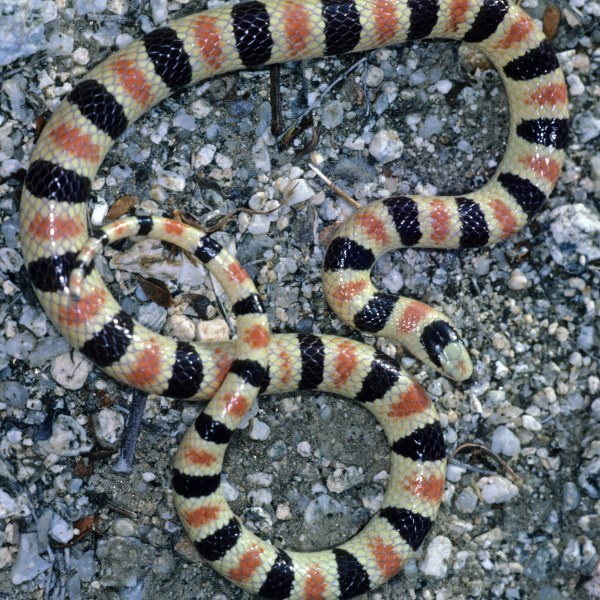
For swimming through sand, a slick and slender snake can perform better than a short and stubby lizard. That’s one conclusion from a study of the movement patterns of the shovel-nosed snake, a native of the Mojave Desert of the southwest United States. The research shows how the snake uses its slender shape to move…
-
New look at the evolution of snake bodies
posted on
Snake skeletons are just as regionalized as lizards, despite loss of limbs and increase in number of vertebrae. Photo Credit: Craig Chandler, Angie Fox, Jason Head, University of Nebraska-Lincoln Sakes may not have shoulders, but their bodies aren’t as simple as commonly thought, according to a new study that could change how scientists think snakes evolved.…
-
A new frog that gives birth to tadpoles
posted on
University of California, Berkeley, herpetologist Jim McGuire was slogging through the rain forests of Indonesia’s Sulawesi Island one night this past summer when he grabbed what he thought was a male frog and found himself juggling not only a frog but also dozens of slippery, newborn tadpoles. He had found what he was looking for:…
-
Draco’s bright coloration mimics falling leaves
posted on
Draco cornutus. Photocredit Devi Stuart-Fox By mimicking the red and green colors of falling leaves, Bornean lizards avoid falling prey to birds whilst gliding, new research has found. The work suggests that populations of the gliding lizard, Draco cornutus, have evolved extendable gliding membranes, like wings, which closely match the colors of falling leaves to disguise…
-
Why does the pelagic sea snake dive?
posted on
Note: It is the end of the year and this blog is going to be in hibernation for a short time. So this post may be the last for several weeks. But it will be active again in the near future. Species that forage exclusively at the sea’s surface but spend much of the rest…
-
Climate change & the ectotherm
posted on
Animals that regulate their body temperature through the external environment may be resilient to some climate change but not keep pace with rapid change, leading to potentially disastrous outcomes for biodiversity. A study by the University of Sydney and University of Queensland showed many animals can modify the function of their cells and organs to…
-
The Reptile Database updated
posted on
Some new lizard species described in 2014 The Reptile Database (RDB) is a very useful tool for herpetologists, and they released a new version a few days ago. The new version lists 10,119 species (including 139 described this year), up from 10,038 in August, 35,615 references (including 1,203 published this year), up from 34,104 in August, which resulted in almost 200 new and…
-
A new model for the evolution of snake venom
posted on
Technology that can map out the genes at work in a snake or lizard’s mouth has, in many cases, changed the way scientists define an animal as venomous. If oral glands show expression of some of the 20 gene families associated with “venom toxins,” that species gets the venomous label. But, a new study from…
-
Humans consume an endangered iguana
posted on
The Valle de Aguán spiny-tailed iguana is a critically endangered species found in Honduras. A recent survey of people living in the region shows that, although residents are aware of the endangered status of the species, the iguana continues to be hunted for food. Of particular concern is the preference for the consumption of female…
-
Turtle relationships and their dispersal across the planet
posted on
The graphic abstract from Crawford et al. with photos added. The question of what are turtles has been a source of a lively scientific debate over the past decades. Until recently, the phylogenetic placement of turtles within Amniota was uncertain and controversial. Molecular studies at the genome level confirm their sister relationship to archosaurs and…
-
A large sea snake harvest that has gone unnoticed for a decade
posted on
Conservation of sea snakes is virtually nonexistent in Asia, and its role in human–snake interactions in terms of catch, trade, and snakebites as an occupational hazard is mostly unexplored. In a recent paper in Biological Conservation Nyguen et al(2014) report data on sea snake landings from the Gulf of Thailand, a hotspot for sea snake…
-
A new Chironius from Bahia, Brazil
posted on
Chironius diamantine. Photo credit: R. Santos The Neotropical colubrid genus Chironius contains a monophyletic assemblage of snakes having very low (10 or 12) dorsal scale rows at midbody. Currently the genus includes 20 species of diurnal snakes distributed from Honduras south to Uruguay and northeastern Argentina. Recently, a lectotype was designated for Chironius flavolineatus, a…
-
Relationships between some Old World Rat Snakes resolved
posted on
These snakes should all be placed in the genus Gonyosoma The Old World Rat Snakes have been a source of confusion for many years, they have a diverse morphology and behaviors that have been a puzzle to herpetologists for some time – the kind of puzzle best solved with molecular techniques. The last decade has…
-
Origin of the ventilatory apparatus of turtles
posted on
A Computed Tomography rendering of a snapping turtle (Chelydra serpentina) showing the skeleton (white), lungs (blue), and abdominal muscles (red and pink) used to ventilate the lungs. Because turtles have locked their ribs up into the iconic turtle shell, they can no longer use their ribs to breathe as in most other animals and instead…

SerpentResearch.Com
Amphibians, Reptiles, & Natural History




You must be logged in to post a comment.