
SerpentResearch.Com
Amphibians, Reptiles, & Natural History
Amphibians, Reptiles, & Natural History

Naturalist, Photographer , Zoologist
After retiring from a career teaching biology and anatomy & physiology and science administration, I study reptiles and amphibians (but focus mostly on squamates). My current interest are in snake phylogeny and diversity, highly aquatic snakes (that are non-sea snakes), the herpetofauna of Trinidad and Tobago, and giant snakes. I have been on the Board of Directors of the Chicago Herpetological Society, the Board of Directors of the Tucson Herpetological Society; a research associate at the Field Museum in Chicago. I have been a member of the International Union for the Conservation of Nature’s (IUCN) Snake Specialists Group International Society for the History and Bibliography of Herpetology (ISHBH); and on the board of directors of Friends of Madera Canyon.
Chironius carinatus. JCM The Neotropical snakes often referred to sipo snakes belong to the genus Chironius. These are large diurnal snakes with a long tail and big eyes that differ from other Neotropical snakes…
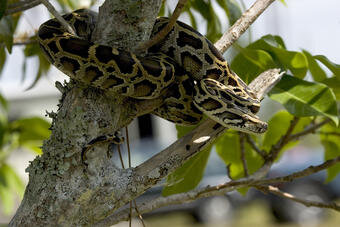
A new genetic analysis of invasive pythons captured across South Florida finds the big constrictors are closely related to one another. In fact, most of them are genetically related as first or second cousins,…
Photographs of some species of Dipsas in life: a D. andiana MZUTI 5413 from Bilsa, province of Esmeraldas, Ecuador b D. andiana from Mindo, province of Pichincha, Ecuador c D. bobridgelyi MZUTI 5414 from Buenaventura, Province…
A Florida man rescued an alligator from a python’s death grip in the Everglades this past weekend, and it was all caught on video.Jack Hubbard of Lakeland posted the gator-python video on his Facebook…

Reticulated Pythons, Malayopython reticulatus, are the longest snakes on the planet. They are power predators and do kill and eat humans on occasion. The snake pictured above is a captive animal in the collection of TC. …
The Living Planet Index (LPI) is a measure of the state of the world’s biological diversity based on population trends of vertebrate species from terrestrial, freshwater and marine habitats. The LPI has been adopted…
A team of international scientists, including paleontologists from Bristol University, Midwestern University (Arizona) and the University of Alberta, have described the world’s oldest known lizard fossil, permitting fresh insight into the evolution of extant…
Two genera of colubroid snakes are known to swallow eggs whole, slit the shell, swallow the contents of the egg, and spit out the remains of the shell. In Africa, there are 13 species…
The Chinese Giant Salamander, Andrias davidianus (Blanchard, 1871), is the largest amphibians living today and may exceed more than one metre in length. It is widespread in central, south-western and southern China, although its…