
SerpentResearch.Com
Amphibians, Reptiles, & Natural History
Amphibians, Reptiles, & Natural History

Naturalist, Photographer , Zoologist
After retiring from a career teaching biology and anatomy & physiology and science administration, I study reptiles and amphibians (but focus mostly on squamates). My current interest are in snake phylogeny and diversity, highly aquatic snakes (that are non-sea snakes), the herpetofauna of Trinidad and Tobago, and giant snakes. I have been on the Board of Directors of the Chicago Herpetological Society, the Board of Directors of the Tucson Herpetological Society; a research associate at the Field Museum in Chicago. I have been a member of the International Union for the Conservation of Nature’s (IUCN) Snake Specialists Group International Society for the History and Bibliography of Herpetology (ISHBH); and on the board of directors of Friends of Madera Canyon.
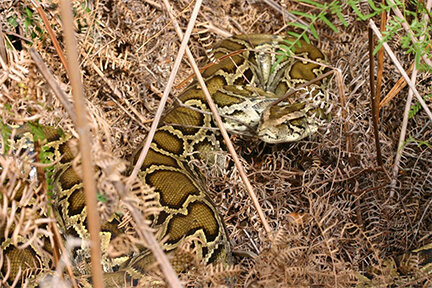
The following story is from the Miami Herald. BY JENNY STALETOVICHjstaletovich@miamiherald.comUpdated May 31, 2018 04:24 PMFaced with an unrelenting spread of invasive Burmese pythons that have mostly wiped out marsh rabbits, bobcats and other…
This is a Sri Lankan Python [Python m. pimbura]. This python occupies many habit types in Sri Lanka.
Releasing potentially invasive snakes into North American ecosystems is apparently an on-going problem. While Burmese and North African Pythons have been released into southern Florida and become a serious threat to wildlife. Other snakes…
A brooding North African Python, Python sebae. This species is larger than theSouth African Python, but both species brood their eggs. J. Lanki Wikipedia Commons The South African python, Python natalensis, lays eggs, and displays behaviors and…
The Reticulated Python is the well—known member of the genus Malayopython. There is, however, a second species in the genus. The Timor python is not as long – reaching about 2.4 m (8 ft)…
Basking’ is the most conspicuous thermoregulatory behavior in many animals that enable them to enhance physiological performance. Several terrestrial poikilothermic ectotherms have adapted to thermoregulate through basking and seek refuge in subterranean burrows in…
Identification of the origin of parasites of nonindigenous species (NIS) can be complex. NIS may introduce parasites from their native range and acquire parasites from within their invaded range. Determination of whether parasites are…
Yellow Spotted Monitor (Varanus panoptes) Photo by Greg Hume Boldness correlates with the mating success, but not body size or sex, of yellow-spotted monitor lizards roaming the remote Oombulgurri floodplains of tropical Western Australia, ecologists report…
This image depicts a reconstruction of what the extinct monitor lizard might have looked like. The parietal and pineal foramina are visible on the overlaid skull. Photo credit: Senckenberg Gesellschaft für Naturforschung / Andreas Lachmann /…