


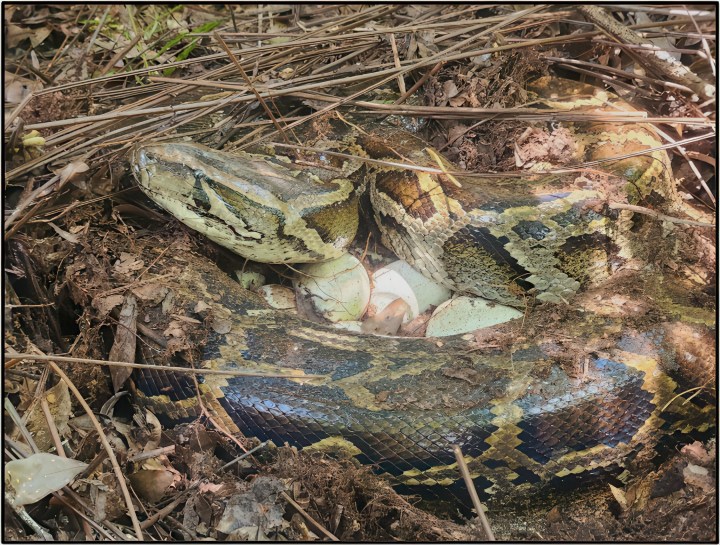
Lisa McBride, a U.S. Geological Survey (USGS) biologist, led a study to document a record-setting Burmese python nest found in Big Cypress National Preserve in 2022. McBride’s work details the python’s nesting behaviors and provides the first comprehensive photographic evidence of the brooding process in the wild. In 2022, a radio-tagged female python led researchers to an area of abandoned concrete pipes in Big Cypress. Inside one of the pipes, the female was discovered to have laid a clutch of eggs. This python’s choice of an artificial, concrete structure for nesting was notable, as pythons in the wild are typically known to nest in natural locations with dense vegetation or mammal burrows.
The research team, led by McBride, monitored the nest to document the brooding process. They placed temperature data loggers inside the python’s coils to record her thermogenic behavior as she incubated the eggs. You can find photos and data on temperature at this webpage.
The study was the first to document the full extent of a female python’s shivering thermogenesis in the wild. A behavior where the snake shivers to generate heat to keep its eggs warm. The nest produced the largest python clutch on record and provided valuable data on nesting site selection, incubation behaviors, and hatching success in the Everglades ecosystem.
Throughout incubation, the python was observed to shift her coils, shiver to elevate body temperature, and yawn. Twice, the wildlife camera captures a Virginia Opossum entering the pipe and quickly exiting. The python temporarily leaves her clutch after biologists enclose the nest pipe. After returning to her nest, she lies coiled around the nest for 12 more days. She eventually uncoils and leaves the clutch. Six days later, the clutch began to hatch in the pipe and continued to hatch over the next 13 days. The hatching of this clutch has been documented as the largest clutch size ever reported for a free-ranging Burmese Python, which adds to our expanding knowledge of this invasive species. Photos were captured by U.S. Geological Survey. An additional CSV dataset included showcases a range of temperatures in Celsius collected by three sets of data loggers at three different locations.
References
Currylow, A.F., McBride, L.M., Anderson, G.E., Guzy, J.C., McCollister, M.F., Romagosa, C.M., Hart, K.M. and Yackel Adams, A.A., 2025. Wild Burmese python nest site selection, thermogenesis, and brooding behaviors in the Greater Everglades Ecosystem. Ecosphere, 16(5), p.e70271.
McBride, L.M., Currylow, A.F., Anderson, G.E., Guzy, J.C., and Yackel Adams, A.A., 2025, Photographic sequence of brooding Burmese python (Python bivittatus) and associated temperature of record-sized nest in Big Cypress National Preserve, FL, June to August 2022: U.S. Geological Survey data release, https://doi.org/10.5066/P13GCMCY.