


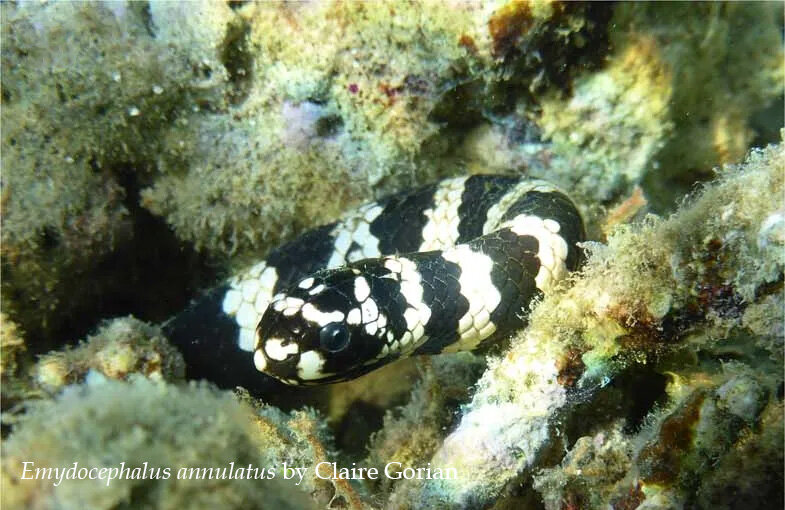


In a new paper, Goiran and Shine (2020) examine female damselfish defending their nests or territories against sea snakes, some of which eat damselfish whereas others do not. They asked the question, can the fishes identify which sea snake taxa pose a threat? The authors recorded responses of damselfishes to natural encounters with five species of snakes in two shallow bays near Noumea, New Caledonia. The fish attacking the snakes were mostly by demersal territorial species of damselfish and were non-random with respect to the species, size, sex, and coloration of the snakes involved. The most common target of the attack was the Turtleheaded Sea Snake, Emydocephalus annulatus, a specialist egg-eating seasnake that poses no danger to adult fishes. Individuals of Dubois’ Sea Snake, Aipysurus duboisii, a generalist predator that were melanic (and thus resembled the Turtle headed Sea Snake in color) attracted more attacks than did paler individuals. Larger faster-swimming snake species such as the Olive Sea Snake, Aipysurus laevis, or the Sea Krait, Laticauda saintgironsi, were watched but not attacked or were actively avoided like the Olive-headed Sea Snake, Hydrophis major, even though only one of these species (A. laevis) eats pomacentrids. Attacks were more common towards female snakes rather than males, likely reflecting slower swimming speeds in females. Thus, damselfishes distinguish between sea snake species using cues such as size, color and behavior, but the fishes sometimes make mistakes.
Goiran, C., Shine, R. The ability of damselfish to distinguish between dangerous and harmless sea snakes. Sci Rep 10, 1377 (2020). https://doi.org/10.1038/s41598-020-58258-2